
A cash sale stops foreclosure by paying off your outstanding mortgage balance before the foreclosure auction takes place, which legally halts the entire process. The moment your lender receives full payoff from a cash buyer, the foreclosure proceedings end. No auction, no credit catastrophe, no forced eviction. Understanding how cash sale stops foreclosure gives you real options when the clock is running out.
How does a cash sale stop foreclosure proceedings?
A cash sale works as a foreclosure prevention tool because it satisfies the debt your lender is trying to recover. When a cash buyer purchases your home, the sale proceeds pay off your mortgage in full at closing. Your lender gets their money, the foreclosure case closes, and you walk away with whatever equity remains. That is the core mechanic, and it works reliably when the timing is right.

Federal guidance confirms that homeowners retain the legal right to sell their property until the foreclosure auction is complete. Once the auction gavel falls, ownership transfers immediately and your right to sell disappears. This means you have a real window to act, but that window has a hard deadline.
The key distinction between a cash sale and a traditional financed sale is speed. A financed buyer needs mortgage approval, appraisals, and underwriting, which can take 30–60 days or longer. A cash buyer skips all of that. Closings can happen in as little as one to two weeks. When a foreclosure auction is weeks away, that speed is the difference between keeping your equity and losing everything.
What foreclosure timeline factors affect your cash sale?
Foreclosure moves through distinct phases, and your options change at each stage. Knowing where you stand tells you how much time you have to close a cash sale.
- Notice of Default: Your lender files this after missed payments, typically 90–120 days into delinquency. This is the earliest warning and your best window to act.
- Pre-foreclosure period: The time between the Notice of Default and the scheduled auction. You still own the home and can sell it.
- Foreclosure auction: The public sale where the lender recovers the debt. Once the auction completes, the winning bidder pays cash immediately, often by the next business day, and ownership transfers on the spot.
- Judicial vs. non-judicial foreclosure: Judicial foreclosure requires a court process and takes longer, sometimes months to over a year. Non-judicial foreclosure moves faster, sometimes in as little as 60 days after the first notice. Your state determines which process applies.
The pre-foreclosure period is your most valuable asset. The longer you wait, the fewer options you have. Lenders can and do accelerate timelines, so a date you think is weeks away can move closer without warning.
Pro Tip: Request the exact auction date from your lender in writing as soon as you receive a Notice of Default. That date is your hard deadline for closing a cash sale.
What makes a cash sale credible enough to pause foreclosure?
Lenders do not pause foreclosure proceedings for just any offer. They require proof that a real, imminent sale is happening. Simply listing your home for sale does not pause foreclosure. Only a credible, verifiable purchase agreement with a near-term closing date can cause a lender to delay the auction.
Here is what lenders typically require before agreeing to pause a foreclosure:
- A signed purchase agreement: The contract must be fully executed by both buyer and seller, with a specific closing date.
- Proof of buyer funds: A cash buyer must provide a bank statement or proof-of-funds letter showing they have the money to close.
- A realistic closing timeline: Lenders want to see a closing date that is days or weeks away, not months. The shorter the timeline, the more credible the request.
- Direct lender communication: Your attorney or real estate professional must contact the lender's loss mitigation department directly, not just the general customer service line.
- A payoff statement request: You or your representative should request a formal mortgage payoff statement so the closing can be structured to satisfy the debt completely.
"When a borrower provides their lender with a verified purchase agreement, many servicers agree to pause or extend foreclosure sale dates to close the transaction if the sale is imminent." This cooperation happens because lenders prefer voluntary sales over forced auctions. Auctions are expensive, legally complex, and often recover less money than a negotiated cash sale.
The lender's motivation matters here. Foreclosure is costly for lenders in both time and money. A clean cash sale that pays off the mortgage in full is genuinely their preferred outcome. That gives you real negotiating leverage when you bring a solid offer to the table.
What are the benefits and trade-offs of a cash sale?
A cash sale is not a perfect solution, but for most homeowners facing foreclosure, it is the best available option. Here is an honest look at both sides.
| Factor | Cash sale | Foreclosure auction |
|---|---|---|
| Speed to resolution | 1–3 weeks typical | Months of legal process |
| Credit impact | Moderate, manageable | Severe, 7-year record |
| Equity recovery | Partial equity possible | Little to none |
| Control over outcome | Seller chooses buyer and terms | Lender controls entirely |
| Repair requirements | None with cash buyers | Property sold as-is at auction |
Selling by cash sale provides fast financial relief and protects remaining equity far better than foreclosure, which causes significant credit damage. A foreclosure stays on your credit report for seven years and can drop your score by 100 points or more. A cash sale, even at a below-market price, leaves you with money in hand and a far cleaner financial record.
The main trade-off is price. Cash buyers typically offer below full market value because they are taking on risk, closing fast, and buying the property as-is. Experts advise homeowners to sell before foreclosure to retain as much equity as possible, even if the sale price is below market value. Recovering some equity is always better than recovering none.
Pro Tip: Get your payoff amount from your lender before accepting any cash offer. Knowing the exact figure you need to clear the mortgage helps you evaluate whether an offer actually solves your problem.
What alternatives exist besides a cash sale?
A cash sale is the fastest and most certain way to stop foreclosure, but it is not the only option. Understanding the alternatives helps you make the right call for your situation.
- Short sale: You sell the home for less than you owe, and the lender agrees to accept the reduced payoff. Short sales require explicit lender approval and are a lengthy process with no guarantee of stopping foreclosure quickly. The Federal Trade Commission recommends initiating short sales well before auction dates because lender approval can take months.
- Deed in lieu of foreclosure: You voluntarily sign the property over to the lender in exchange for being released from the mortgage debt. This avoids the public auction but gives you nothing from any remaining equity. Lenders do not always accept this option.
- Loan modification: Your lender restructures your loan terms to make payments affordable again. This keeps you in the home but requires lender approval and takes time to process.
- Forbearance agreement: A temporary pause or reduction in payments. This buys time but does not eliminate the debt. Missed payments are added to the loan balance.
- Bankruptcy filing: An automatic stay from a bankruptcy filing can temporarily halt foreclosure. This is a legal tool, not a permanent solution, and carries its own serious financial consequences.
Each of these alternatives has a longer timeline than a cash sale. If your auction date is close, a cash sale is the only option that can realistically close in time. The others work best when you have months, not weeks, to work with.
Key Takeaways
A cash sale stops foreclosure by paying off the mortgage before the auction, giving homeowners a fast, controlled exit that preserves equity and limits credit damage.
| Point | Details |
|---|---|
| Timing is everything | You retain the right to sell until the auction is complete; act before that date. |
| Lender credibility matters | A signed purchase agreement with proof of funds is required to pause foreclosure. |
| Cash sales close fast | Cash buyers can close in 1–3 weeks, making them the most reliable foreclosure stop. |
| Trade-offs are real | Expect a below-market offer, but recovering partial equity beats losing everything at auction. |
| Alternatives take longer | Short sales and loan modifications work best with months of lead time, not days. |
What I've learned from watching homeowners wait too long
I have seen homeowners in San Luis Obispo receive a Notice of Default and spend the next two months hoping the situation would resolve itself. It almost never does. By the time they call us at Slocashbuyer, the auction is two weeks out and the options have narrowed to almost nothing.
The biggest misconception I encounter is that listing the home with an agent is enough to stop the clock. It is not. A listing is not a purchase agreement. Lenders do not pause foreclosure for a listing. They pause it for a signed contract with a real buyer who has the money to close.
The second misconception is that a cash offer is a bad deal. Yes, the price is typically below what you would get in a traditional sale. But you have to weigh that against the alternative. A foreclosure wipes out your equity entirely, damages your credit for seven years, and leaves you with nothing. A cash sale below market value still puts money in your pocket and lets you move forward.
My honest advice: contact your lender's loss mitigation department the day you receive a Notice of Default. Ask for the auction date. Then call a cash buyer the same day. The earlier you move, the more leverage you have and the better the outcome.
— Abel
Slocashbuyer can help you stop foreclosure fast
Facing a foreclosure deadline is one of the most stressful situations a homeowner can experience. Slocashbuyer works directly with homeowners in San Luis Obispo, CA, to provide fair cash offers with no repairs, no agent fees, and no hidden costs.

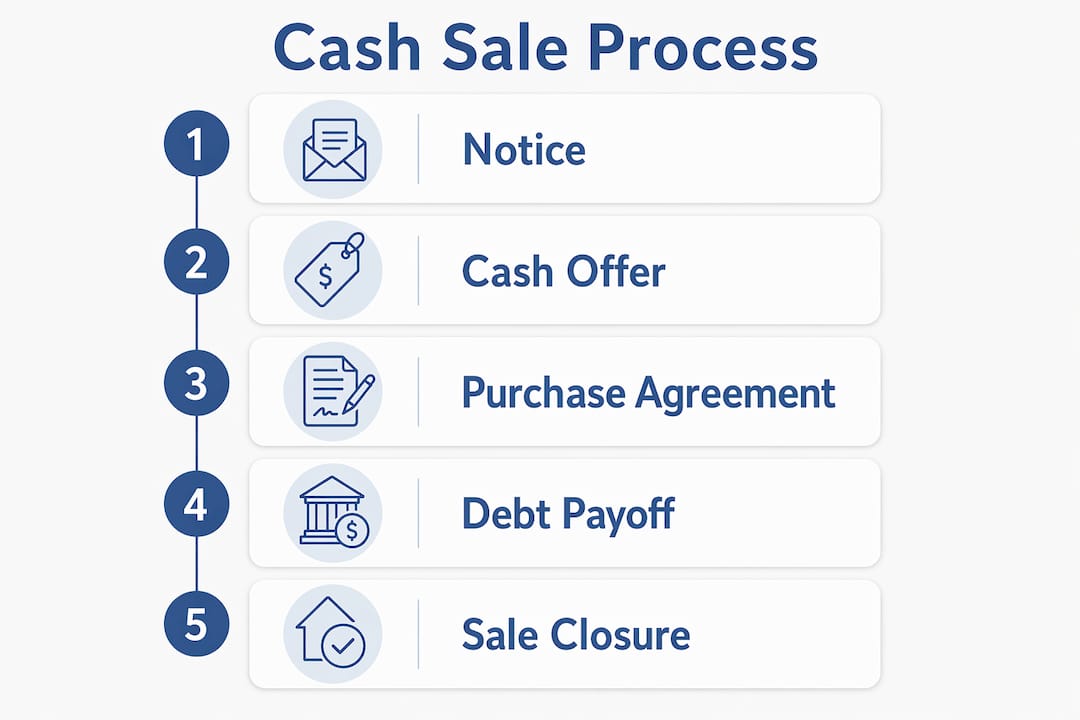
The process is straightforward. You contact Slocashbuyer, receive a cash offer quickly, and choose a closing date that works with your foreclosure timeline. Slocashbuyer can close in as little as one to two weeks, which is fast enough to beat most auction deadlines. If you need to sell your house fast and stop foreclosure before it goes to auction, reach out today for a no-obligation cash offer. There is no pressure and no obligation. Just real help when you need it most.
FAQ
How quickly can a cash sale stop foreclosure?
A cash sale can close in as little as one to two weeks, which is fast enough to stop most foreclosure auctions. The sale must fully close and the mortgage must be paid off before the auction date.
Does listing my home pause foreclosure proceedings?
No. Simply listing your home does not pause foreclosure. Lenders require a signed purchase agreement with verified buyer funds and an imminent closing date before they will consider delaying an auction.
Can I sell my home after receiving a Notice of Default?
Yes. Homeowners retain the right to sell until the foreclosure auction is complete. A Notice of Default begins the process but does not end your right to sell.
Will a cash sale hurt my credit score?
A cash sale has a far smaller credit impact than a completed foreclosure. Foreclosure stays on your credit report for seven years and causes severe score damage. A cash sale, even at a reduced price, resolves the debt cleanly.
What if the cash offer is less than I owe on my mortgage?
If the offer is less than your mortgage balance, you may need lender approval for a short sale. A cash buyer and a real estate attorney can help you negotiate this with your lender before the auction date.