Yes, you can sell your San Luis Obispo County home as-is for cash, often closing in days instead of months. Local cash buyers like SLO Cash Buyer purchase homes in any condition, no repairs or agent required, while you still complete standard California disclosures like the Transfer Disclosure Statement. If speed matters more than squeezing out every last dollar, your next move is simple: request a written cash offer and compare it against your timeline and repair costs before you decide.
TL;DR:
- A cash sale in San Luis Obispo County typically closes within 7 to 14 days, significantly faster than traditional listings, especially when repairs or delays are involved.
- Sellers facing foreclosure, costly repairs, inherited properties, or urgent life changes should prioritize cash offers to avoid extended timelines or financial loss.
- Disclosures, including the Transfer Disclosure Statement, are mandatory, and full honesty is necessary to prevent future legal claims regardless of the sale being "as-is."
- Verifying proof of funds, a firm written offer, and transparency about deductions are crucial steps to vet legitimate cash buyers and avoid scams.
- Proper paperwork, clear disclosures, and understanding contractual protections in California help sellers maintain legal rights and negotiate better terms before accepting a cash offer.
Table of Contents
- When a Cash, As-Is Sale Makes Sense for SLO County Homeowners
- How an As-Is Cash Sale Works in California, Step by Step
- What Will You Actually Net? Costs and Proceeds Explained
- Do You Still Have to Disclose Problems in an As-Is Sale?
- How to Vet a Cash Buyer Before You Sign Anything
- Legal Protections Sellers Have in a California Cash Sale
- Negotiating a Cash Offer: What You Can Actually Ask For
- Why Cash Buyers Walk Away, and How to Prevent It
- A Local Perspective on Fair, Fast Cash Offers
- Ready to Request Your Cash Offer?
- Sources
When a Cash, As-Is Sale Makes Sense for SLO County Homeowners
Not every seller needs speed. But if you're facing one of these situations, a cash sale usually beats the traditional listing process:
- Foreclosure is approaching. Once a notice of default lands, every week counts, and a fast cash close can stop the auction before it happens.
- The house needs work you can't afford or don't want to do. Foundation issues, an old roof, outdated systems — repairs eat into any profit a traditional sale might bring anyway.
- You inherited a property you don't want to manage. Probate timelines are stressful enough without also becoming a part-time contractor.
- Life is moving fast. Divorce, a job relocation, or a landlord tired of problem tenants all create real pressure to close quickly.
Here's the tradeoff, stated plainly: a cash sale trades some sale price for speed, certainty, and zero repair headaches. The practical rule is this — if the time or money it would take to prep and list your home outweighs the gap between a cash offer and a listed sale price, cash wins.
How an As-Is Cash Sale Works in California, Step by Step
The process is more straightforward than most sellers expect, and understanding each checkpoint helps you spot a legitimate buyer from a shaky one.
- Request a written offer. A reputable buyer will walk your property (in person or virtually) and give you a firm, written cash offer, not a verbal estimate that changes later.
- The buyer verifies funds and pulls a title report. This confirms the buyer can actually close and surfaces any liens, unpaid taxes, or title defects that need resolving before escrow.
- Escrow opens. A neutral third party (the escrow or title company) holds funds and documents until every condition of the sale is met.
- You complete required disclosures, including the Transfer Disclosure Statement, so the buyer knows the property's known condition.
- Funds transfer and the deed records. Once everything clears, you get paid and the keys change hands.
Cash offers can arrive within about 24 hours of a walkthrough, and closings often happen in 7 to 14 days depending on the program. Compare that to a traditional sale, where financing contingencies alone can stretch 30 to 45 days after you already have a buyer under contract. For a more detailed local breakdown of what to expect week by week, see this home selling timeline for SLO sellers.
What Will You Actually Net? Costs and Proceeds Explained
Selling for cash doesn't mean selling for free. Several costs typically still apply, even when a buyer waives inspections and repair requests:
- Transfer taxes, which apply in most California sales regardless of financing
- Escrow and title fees, split by local custom but negotiable
- Prorated property taxes and any HOA dues owed at closing
- Payoff of your existing mortgage or any liens against the property
Cash offers usually come in below what a fully repaired, professionally staged home might fetch on the open market, because as-is pricing accounts for the work and risk the buyer is absorbing. In a county where home values run well above the national median, that discount can translate into real dollars, which is exactly why comparing offers matters before you sign anything.
Pro Tip: Take your written offer, subtract known closing costs and your mortgage payoff, and you'll have a realistic net proceeds number in about five minutes. Do this with every offer you receive so you're comparing apples to apples.
Analysts covering California's cash-offer market specifically recommend gathering more than one firm offer before accepting, since the size of the discount can vary more than sellers expect once you factor in local values.
Do You Still Have to Disclose Problems in an As-Is Sale?
Yes, and this trips up more sellers than you'd think. "As-is" describes the price and repair terms, not your legal obligations.
California law requires sellers to complete a Transfer Disclosure Statement and reveal known material defects, whether the buyer is paying cash or financing through a bank. Selling as-is does not waive that duty, and it does not shield you from a fraud or nondisclosure claim if a buyer later discovers a problem you knew about and didn't mention.
That last point matters more than most sellers realize. California's discovery rule can extend how long a buyer has to bring a claim, sometimes well past closing day, if the defect wasn't reasonably discoverable at the time of sale.
The fix is straightforward: prepare your disclosures early, be thorough rather than minimal, and if your situation involves something complicated (a boundary dispute, a past insurance claim, unpermitted work), talk to a real estate attorney before you sign. A short conversation now is cheaper than a lawsuit later.
How to Vet a Cash Buyer Before You Sign Anything
Not every "we buy houses" offer is legitimate, and a little diligence protects you from wasted time or worse. Before accepting any offer, ask for:
- Proof of funds. A bank statement or escrow verification letter confirms the buyer can actually close, not just make promises.
- A firm written offer with clear line items, an expected closing date, and the name of the escrow or title company handling the transaction.
- References or recent local closings. A buyer with a real track record in San Luis Obispo County should be able to point to actual past deals.
- Transparency about deductions. Any legitimate discount from market value should be explained, not buried.
Walk away if a buyer refuses to show proof of funds, pressures you to sign within hours, or wants to skip escrow entirely. Legitimate buyers use escrow and title services precisely because they protect both sides.
Pro Tip: A real buyer won't flinch if you ask to speak with their title company directly. If that request makes someone uncomfortable, that discomfort is your answer.
Legal Protections Sellers Have in a California Cash Sale
California gives sellers real protections in a cash transaction, but only if you understand how to use them. Your right to disclose in writing, rather than verbally, creates a paper trail that protects you if a buyer later claims you hid something. Putting every material fact in the TDS, even minor ones, is one of the simplest ways to limit future liability.
You also have the right to use a neutral escrow company rather than handing money or documents directly to a buyer. Escrow holds both sides accountable: the buyer can't take title until funds clear, and you can't be pressured into releasing the deed before payment is confirmed. That structure exists specifically to prevent one side from taking advantage of the other.
Contract terms matter too. A written purchase agreement should spell out exactly what "as-is" covers, what contingencies (if any) remain, and what happens if either side backs out. Vague language creates room for disputes. If a buyer's contract feels thin or rushed, that's worth pausing over, not signing through.
Finally, remember that California's disclosure laws apply regardless of how quickly the deal moves. Speed is a feature of cash sales, not an excuse to skip legal steps.
Negotiating a Cash Offer: What You Can Actually Ask For
Cash offers feel take-it-or-leave-it, but there's usually more room to negotiate than sellers assume. Buyers price in convenience and risk, and small concessions on either side can close the gap.
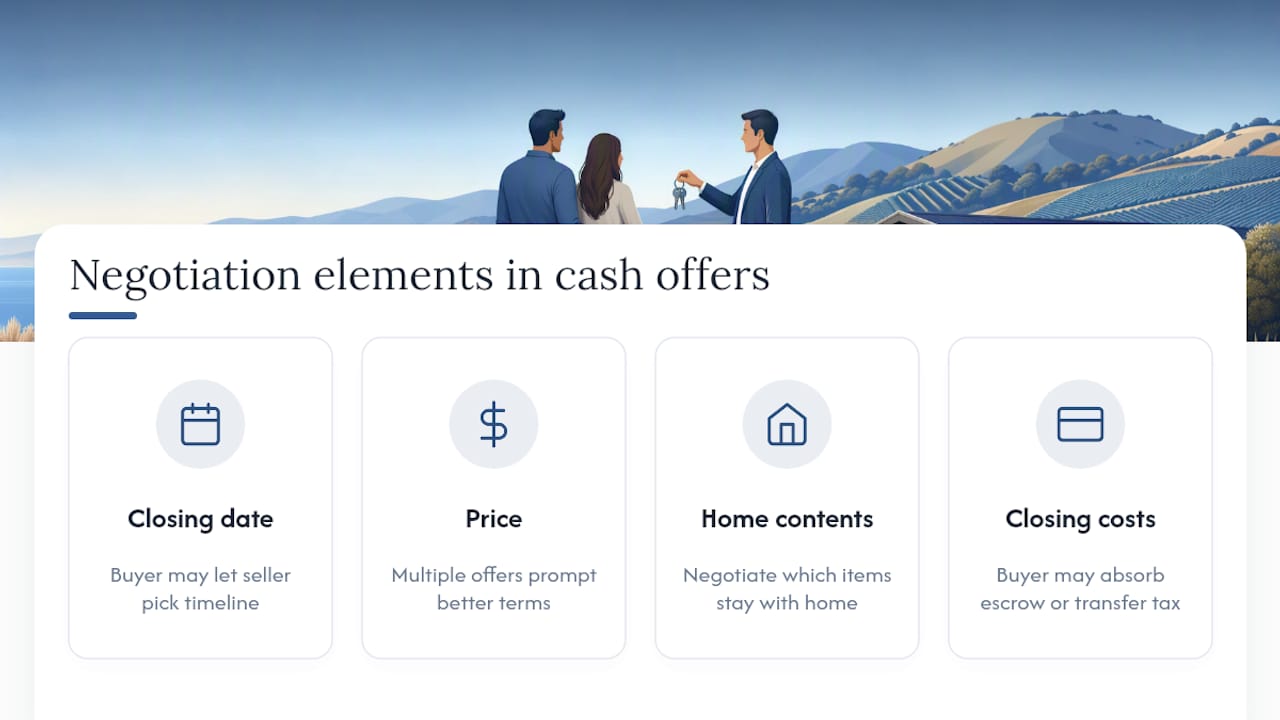
Common areas where sellers successfully negotiate include the closing date (a flexible buyer will often let you pick the timeline that works for your move), what stays or goes in the home (avoiding a separate personal property negotiation), and who covers specific closing costs. Some buyers will absorb your escrow fees or a portion of transfer tax to make a deal happen faster.
If you have more than one offer, use that leverage honestly. Telling a buyer you're comparing offers is normal and expected. It often prompts a better price or better terms, especially if your home is in decent shape and doesn't need major work.
Where sellers lose ground is in over-negotiating on price while ignoring terms that matter more. A slightly lower offer with a guaranteed 10-day close and no contingencies is often worth more than a marginally higher offer that drags on for weeks. Decide what actually matters to you (speed, certainty, price, or a mix) before you start negotiating, so you're not chasing the wrong number.
Why Cash Buyers Walk Away, and How to Prevent It
Cash deals fall apart less often than financed ones, but it happens, and usually for predictable reasons you can head off in advance.
Title problems are the most common culprit. Unresolved liens, unpermitted additions, or unclear ownership after an inheritance can stall or kill a deal once the title search comes back. Pulling a preliminary title report before you even solicit offers can save weeks.

Undisclosed issues discovered during a buyer's walkthrough are another frequent cause. If a buyer finds a problem you didn't mention, whether it's foundation damage or an unpermitted room addition, trust erodes fast, and a serious buyer may walk rather than risk a legal dispute later. Full disclosure upfront, even of things that feel minor, keeps deals on track.
Unrealistic seller expectations also sink deals. If you counter a fair as-is offer expecting near-retail pricing, a buyer whose entire model depends on the discount will simply move on. Understanding the market logic behind as-is pricing before you negotiate prevents wasted time on both sides.
Lastly, sellers who can't produce clear documentation (mortgage payoff statements, HOA information, proof of inheritance in probate cases) create delays that frustrate buyers working on tight timelines. Gathering your paperwork early keeps the process moving.
A Local Perspective on Fair, Fast Cash Offers
SLO Cash Buyer has built its process around one idea: sellers in difficult situations deserve honesty, not pressure. SLO Cash Buyer buys homes as-is throughout San Luis Obispo County, offers transparent written terms, and works on the seller's timeline rather than forcing a rushed decision.
We built our Home Closing Process Checklist because too many sellers go into a cash sale without knowing what documents they'll need or what to expect at each step. That confusion is often what makes people distrust the entire process, not the process itself.
Every situation is different, whether it's foreclosure, inheritance, or simply wanting out from under a property that needs too much work. A fair cash offer starts with understanding your specific circumstances, not applying a generic formula.
— Abel
Ready to Request Your Cash Offer?
If you've read this far, you already know what a legitimate cash sale looks like: a firm written offer, proof of funds, a clear escrow process, and no pressure to sign before you're ready. That's exactly what SLO Cash Buyer provides for homeowners across San Luis Obispo County who need to sell fast, without repairs, cleaning, agent commissions, or hidden fees.

Reaching out is simple. Share your property address, a brief description of its condition, and your ideal timeline, whether that's two weeks or two months. In return, you'll get a firm written cash offer, documentation showing proof of funds, and a flexible closing date built around your schedule. If you have time to gather a second or third offer for comparison, we encourage it. If foreclosure or another deadline is bearing down, we'll move as fast as the paperwork allows. Start by requesting your offer at SLO Cash Buyer and see exactly what your home is worth on your timeline, not the market's.
Sources
For disclosure requirements, review the Transfer Disclosure Statement guidance from SmartAsset and the practical as-is selling guide from Catalyst Legal. For process details and buyer vetting, see HomeLight's cash buyer guide and SLO Cash Buyer's Home Closing Process Checklist. For how a cash sale compares to foreclosure outcomes, see this HouseGoodbye explainer.
This article is general information, not a substitute for advice from a qualified lawyer. Consult a qualified legal professional about your own circumstances before acting on anything here.
- Do sellers cover transfer tax in California? — SmartAsset
- How to find cash home buyers in California — HomeLight
- Sell a house as‑is in California: Practical guide — Catalyst Legal
- California cash offer programs (2026) — HomePivot