
Yes, you can sell the family home during a California divorce, but usually only with both spouses' written agreement or a court order. Once you file, automatic temporary restraining orders (ATROs) under Family Code §2040 lock down community property, so neither spouse can list, transfer, or refinance the house alone.
If you're facing foreclosure or need cash fast, don't wait to act.
- Talk to a family law attorney before you list or sign anything
- File a Request for Order if your spouse won't cooperate on a sale
- Save every mortgage statement, notice of default, and repair estimate now
Pro Tip: If foreclosure is even a remote possibility, document everything immediately. Judges move faster when they see clear proof of financial harm.
Key Takeaways
Selling the family home during a California divorce requires either both spouses' written consent or a court order, and the fastest path to financial closure is often a clean sale rather than a contested court battle.
| Point | Details |
|---|---|
| ATROs restrict unilateral sales | Once you file for divorce, you generally need written spousal consent or a court order to sell. |
| Community property presumption applies | Homes bought during marriage are presumed 50/50 community property regardless of whose name is on the deed. |
| Court can force a sale | Judges can order a sale and appoint a referee, or an elisor in extreme cases, when spouses can't agree. |
| Selling costs cut into proceeds | Expect roughly 8 to 10% of the sale price to go toward commissions, escrow, and title fees. |
| Cash sales solve urgent timelines | SLO Cash Buyer offers as-is purchases with fast closings for divorcing homeowners facing foreclosure or relocation deadlines. |
Table of Contents
- Community Vs. Separate Property: What California Law Says About Your Home
- What Are Your Options for the House?
- Can a Court Force the Sale of the House?
- Who's Liable for the Mortgage, and What Happens With Foreclosure Risk?
- Your Step-by-Step Checklist for Selling During Divorce
- When a Fast, As-Is Sale Makes Sense in San Luis Obispo
- Impact of Divorce on Credit and How the House Sale Affects It
- Handling Disagreements Over the House Sale
- Homeowners Insurance and Utilities While the Sale Is Pending
- How SLO Cash Buyer Can Help You Sell Fast in San Luis Obispo
- Sources
Community Vs. Separate Property: What California Law Says About Your Home
The title on your deed matters less than you'd think. California treats a home bought during the marriage as community property, split 50/50 by default, regardless of whose name is on it.
Separate property exceptions apply when one spouse bought the home before marriage, inherited it, or received it as a gift. Even then, marital funds used for mortgage payments or renovations can create reimbursement claims under Moore/Marsden principles, meaning the community estate might be owed a share even on a separate-property house.
- Community property: acquired during marriage, presumed 50/50
- Separate property: owned before marriage, inherited, or gifted to one spouse
- Reimbursement claims: marital money spent on a separate home can still create a community interest
Timing also affects your tax bill. Married couples selling before the divorce is final can generally exclude up to $500,000 in capital gains under IRC §121. Wait until after the divorce, and each ex-spouse typically caps out at $250,000.
Pro Tip: Ask your attorney whether selling before your judgment is finalized could save you real money on taxes. That timing decision is easy to overlook when emotions are running high.
What Are Your Options for the House?
You generally have four paths forward, and the right one depends on your finances, your kids' stability, and how well you and your spouse can still cooperate.
Sell and split proceeds. This is the cleanest financial break: you turn one illiquid asset into cash you can divide right away. Expect commissions, escrow fees, and lien payoffs to eat into gross proceeds before anyone sees a check.
Buyout. One spouse keeps the house and pays the other their equity share. This typically requires a professional appraisal to set fair value and a refinance to remove the departing spouse from the mortgage, since a quitclaim deed alone doesn't erase loan liability.
Deferred sale (Duke Order). Under Family Code §3800, a judge can let a custodial parent stay in the home temporarily if it serves the children's stability, provided that parent can actually afford the payments alone.
Co-ownership. Some exes keep joint title after divorce, usually for tax or market timing reasons. It works only with an airtight written agreement covering who pays what and when the house finally sells.
- Sell now: fastest financial closure, but you split net (not gross) proceeds
- Buyout: keeps the house in the family, but demands strong solo credit
- Deferred sale: protects kids' routine, but freezes equity for years
- Co-ownership: flexible, but requires unusual trust between exes
Pro Tip: A deferred sale sounds generous, but ask your attorney what happens if the resident spouse falls behind on payments. Frozen equity helps no one if the house ends up in foreclosure.
Can a Court Force the Sale of the House?
Yes. When spouses can't agree, either one can file a Request for Order asking the family court to order a sale. Judges typically grant this when there's no other way to divide the asset, when foreclosure looms, when one spouse can show real financial hardship, or when a spouse is stalling without a valid reason.
A court can appoint a referee to manage a contested sale, and in rare cases where one spouse refuses to sign anything, the judge can appoint an elisor to execute the paperwork instead. The sale proceeds even without that spouse's cooperation.
The process usually runs like this:
- File a Request for Order with supporting financial declarations
- Attend a hearing where both sides present evidence
- The court issues an order authorizing sale, sometimes naming a referee
- The referee (or elisor, if needed) manages listing, offers, and closing
- Court-ordered sales take longer than negotiated ones
- Legal fees and referee costs reduce net equity
- A judge's price and timeline may not match what either spouse wanted
Who's Liable for the Mortgage, and What Happens With Foreclosure Risk?
Both spouses stay legally responsible for a joint mortgage until it's refinanced or paid off. Your divorce decree is an agreement between you two. It does nothing to change the contract you both signed with the lender.
If payments start slipping, you have a few real options: a short sale (which needs lender approval and usually takes months), a refinance by the spouse keeping the home, an emergency court-permitted sale, or a cash sale that closes fast enough to stop a scheduled auction.
- Missed payments damage both spouses' credit, not just the one living in the house
- Lenders don't care who "keeps" the house in the settlement, only who's on the note
- A pending foreclosure can justify emergency court action to authorize an immediate sale
Pro Tip: If you're even a month behind, call your lender before your attorney finishes drafting anything. Loss mitigation departments move slowly, and every week counts.
Your Step-by-Step Checklist for Selling During Divorce
Selling a home mid-divorce isn't just a real estate transaction. It's a legal process wrapped around a real estate transaction, and skipping steps costs money.
- Confirm your ATRO status and get written consent from your spouse, or file for a court order
- Identify separate-property contributions or reimbursement claims before listing
- Get a professional appraisal so both sides agree on value
- Check title for existing liens or multiple mortgages that must be paid at closing
- List the home (or accept a cash offer) once legal authority is settled
- Close escrow and distribute net proceeds per your settlement agreement or court order
Timelines vary widely. A cooperative sale with both spouses on board can move through the normal escrow timeline, while a contested Request for Order can add months before anyone even lists the property.
Budget for these costs before you count your share:
- Appraisal fees, typically a few hundred dollars
- Total selling costs of roughly 8 to 10% of the sale price, covering commission, escrow, and title fees
- Full payoff of any mortgage balance and recorded liens
- Possible capital gains tax exposure depending on filing status and timing
When a Fast, As-Is Sale Makes Sense in San Luis Obispo
Cash home buyers purchase the property as-is, close in days instead of months, and skip agent commissions and repair negotiations entirely. You typically net a lower gross price than a market listing, but you get certainty and speed, which matters when a foreclosure clock is ticking or when both spouses just want out.
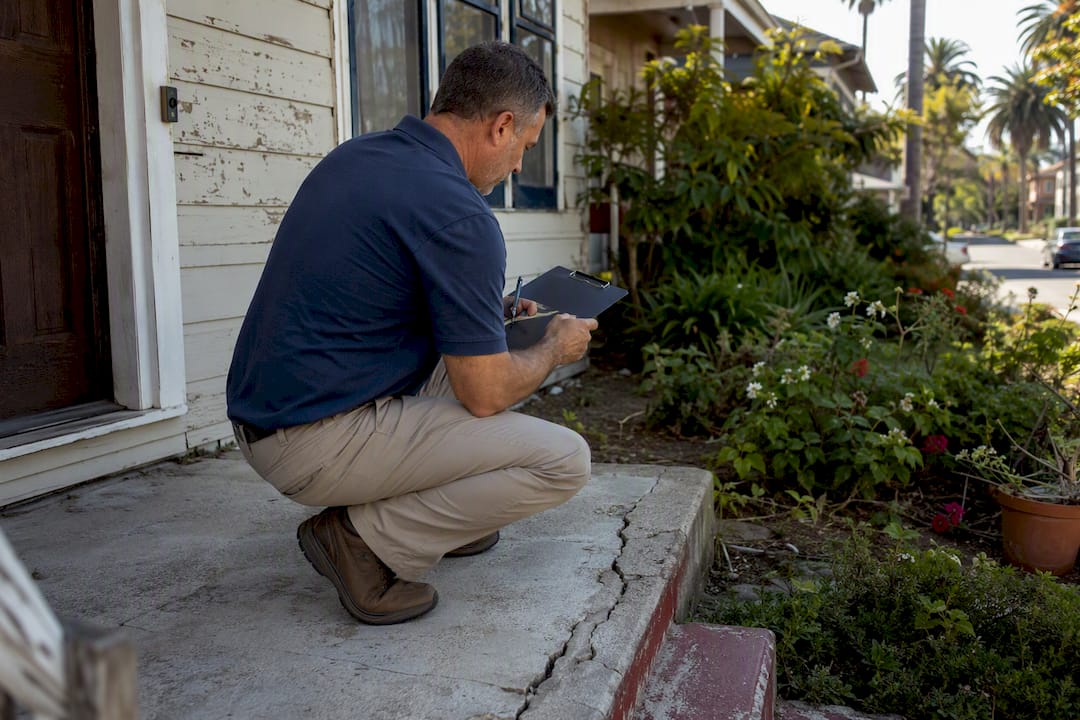
This route tends to make sense when refinancing for a buyout isn't realistic on one income, when you need to relocate for a job or a fresh start, or when neither spouse wants to manage months of showings during an already stressful season. A cash offer can also stop a scheduled foreclosure auction when timing is tight.
Before you sign anything, verify the offer terms are clear, confirm there are no hidden fees buried in the contract, and make sure escrow handling and a written release of claims are part of the closing package.
- As-is means no repair requests, no cleaning, no staging
- Faster closing means faster access to your share of equity
- Fewer parties involved often means fewer disagreements to manage
Pro Tip: Get any cash offer in writing and read the fine print on contingencies. A legitimate buyer won't pressure you to skip that step.
Impact of Divorce on Credit and How the House Sale Affects It
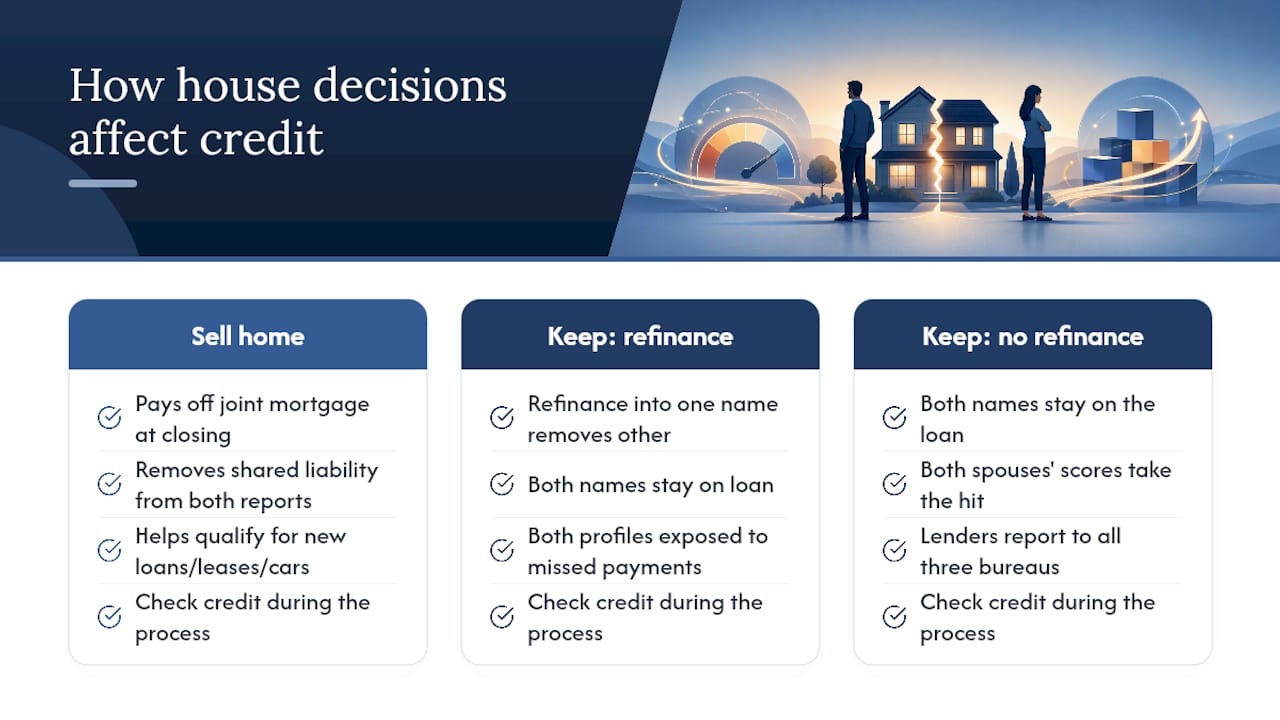
Divorce itself doesn't touch your credit score. Missed mortgage payments during the process absolutely do, and both spouses' scores take the hit if either one falls behind on a joint loan.
This is where timing gets tricky. If one spouse moves out and stops contributing to the mortgage while waiting for a settlement, the remaining spouse can quietly fall behind, and both credit files suffer even though only one person controls the payments. Lenders report to all three credit bureaus based on the account, not based on who's living in the house or what your divorce paperwork says.
Selling the home resolves this cleanly. Paying off the joint mortgage at closing removes that shared liability from both credit reports going forward, which matters enormously if either spouse needs to qualify for a new mortgage, an apartment lease, or even a car loan soon after the divorce finalizes.
If you're keeping the house through a buyout, refinancing into the retaining spouse's name alone is the only way to fully remove the other spouse from that debt. Until that refinance closes, both names stay on the loan, and both credit profiles stay exposed to any missed payment, regardless of what the settlement agreement says about who's "responsible."
Check your credit reports during the process, not after. Catching a missed payment early gives you time to negotiate a solution before it turns into a 30-day, 60-day, or 90-day late mark that can sit on your report for years.
Handling Disagreements Over the House Sale
Not every divorcing couple agrees on price, timing, or even whether to sell at all. Before assuming you need a courtroom fight, know that mediation resolves a large share of these disputes faster and cheaper than litigation.
A mediator doesn't decide for you. Instead, they help both spouses work through pricing disagreements, disputes over repairs versus selling as-is, or arguments about who covers carrying costs while the home sits on the market. Many California family courts either require or strongly encourage mediation before a contested Request for Order hearing, so you may end up there regardless.
Arbitration is a step further than mediation: both spouses agree in advance to accept a neutral arbitrator's binding decision. It's faster than a full court process but still costs money and removes your ability to negotiate directly with your spouse.
Common sticking points worth planning for:
- Disagreement over listing price or which offer to accept
- One spouse wanting to keep the house, the other wanting to sell immediately
- Arguments over who pays for repairs, staging, or pre-sale updates
- Disputes over splitting costs while the home sits unsold
Court-ordered sales resolve stalemates, but they usually reduce net equity through legal fees, referee costs, and longer timelines. If you can reach even a partial agreement through mediation, whether on price, timing, or repairs, you keep more control and more money than letting a judge decide everything.
Homeowners Insurance and Utilities While the Sale Is Pending
Insurance and utility accounts don't automatically split just because a divorce is filed, and overlooking them creates real risk while the house sits on the market.
If one spouse moves out, the homeowners policy needs a second look. Some insurers consider a property "unoccupied" after a certain number of days, which can affect coverage terms or even trigger a policy change if the remaining spouse isn't listed as sole occupant. Notify your insurance carrier of the change in occupancy status, and make sure the policy stays active through closing, since a lapse could leave the property uninsured during a vacancy, a repair period, or a showing.
Utilities present a more everyday problem: who keeps paying the electric bill, water, and gas while the divorce works through the courts? Leaving accounts in both names means both credit profiles stay exposed to unpaid balances. Many couples designate one spouse to keep utilities current through closing, then settle reimbursement later through their settlement agreement.
If the house sits vacant during a contested sale or a deferred sale period, insurance carriers may require specific vacant-home coverage, which usually costs more and covers less than a standard policy. Don't assume your existing policy still applies once nobody's living there full time.
- Confirm occupancy status with your insurer if either spouse moves out
- Keep one clear point of contact for utility bills to avoid service shutoffs
- Ask about vacant-property insurance requirements if the home sits empty during a sale
A Quick Note From SLO Cash Buyer
We've watched fast, as-is sales stop foreclosure and cut legal costs for divorcing homeowners more than once. Transparency and local knowledge make the difference for San Luis Obispo families going through this.
How SLO Cash Buyer Can Help You Sell Fast in San Luis Obispo
SLO Cash Buyer is the alternative to a drawn-out agent listing when your divorce timeline can't wait for months of showings and negotiations. Instead of repairs, staging, and commission fees eating into a settlement that's already split two ways, you get a straightforward cash offer on the house as it sits today.

Here's what that looks like in practice: we make a fair cash offer with no hidden fees, you skip repairs and cleaning entirely, and closing happens on a timeline that works around your court dates and settlement deadlines, not around a buyer's mortgage approval. This works well whether you're facing foreclosure, need to relocate quickly, or simply want a clean, fast exit that both spouses can agree to without more months of conflict. Our as-is home buying process is built for exactly this kind of urgency.
If you're weighing your options for the family home, reach out for a no-obligation cash offer through our San Luis Obispo home buying page. There's no pressure and no cost to find out what your house is worth in its current condition.
Sources
For deeper legal detail, consult California Family Code provisions on ATROs and deferred sales, plus these resources:
- Sell, Keep, or Buy Out the Family House in a CA Divorce? | Provinziano & Associates
- Selling the House During Divorce in California — Process, Tax, and Forced Sales | Furubotten Law
- Who Gets the House in a California Divorce? - LegalClarity
- Divorce
This article is general information, not a substitute for advice from a qualified lawyer. Consult a qualified legal professional about your own circumstances before acting on anything here.