
The fastest reliable way to complete a mobile home sale in San Luis Obispo County is selling as-is to a local cash buyer, with closing typically landing in 7 to 21 days once your paperwork is ready. You'll get less than full retail value, but you skip repairs, agent commissions, and months of waiting. The sections below walk through park rules, title transfer, fair pricing, and how to vet any buyer before you sign.
TL;DR:
- Cash buyers usually offer between 60% and 80% of the home's after-repair value minus repair costs, depending on condition and age.
- The closing process can take between 7 and 21 days once all documents, park approval, and tax clearance are confirmed.
- Proper documentation, including title, tax clearance, and park approval, must be prepared early to avoid delays in closing.
- Park approval remains a critical step, especially if the home stays on a leased lot, with buyer screening influencing approval time.
- Valid proof of funds, clear agreement terms, and verified escrow arrangements are essential to vetting legitimate cash buyers before signing.
Table of Contents
- What Does an As-Is Mobile Home Sale in San Luis Obispo Involve?
- What Documents Do You Need Before Closing?
- How Do Cash Buyers Calculate Their Offers?
- How Do You Vet a Cash Buyer Before Signing?
- What Are the Steps to Close in 7 to 21 Days?
- Why Speed Matters More Than the Sticker Price
- How to Request a No-Obligation Cash Offer
- Where to Verify the Rules Yourself
- Sources
- FAQ
What Does an As-Is Mobile Home Sale in San Luis Obispo Involve?
Selling as-is doesn't mean selling blind. California's Mobilehome Residency Law protects your right to advertise and sell your home while it stays in the park. Park management can set reasonable rules around open houses and buyer approval, but they can't charge you a transfer fee unless they're actually performing a service for you.
That said, park approval is a real gatekeeper. If your home stays in the park after the sale, most parks will screen the buyer's income, credit, and background before they let the deal close. Skip this step and you can watch an otherwise clean sale stall for weeks.
You're also still required to disclose known defects, even in an as-is transaction. California law doesn't let "as-is" erase your duty to tell a buyer about a leaking roof, faulty wiring, or plumbing problems you already know about. Leaving those out can create liability after closing, regardless of how the sale was framed.
Your buyer pool generally breaks into three types:
- Cash investors who close fast, skip financing contingencies, and buy in current condition.
- Licensed dealers who may offer more but often want the home moved off the lot.
- Private buyers who usually need financing, which slows everything down since chattel loans for mobile homes are harder to get and more expensive than a standard mortgage.
That financing gap is exactly why cash buyers represent the largest pool of ready buyers for homes that need repairs or need to sell fast.
What Documents Do You Need Before Closing?
Title transfer in California runs through the Department of Housing and Community Development, and missing paperwork is the single biggest reason closings drag past three weeks. Gather these before you accept an offer:
- Certificate of Title (the "pink slip") showing you as the legal owner with no unresolved liens.
- Tax clearance certificate confirming property taxes are current.
- Bill of sale documenting the agreed purchase price and transfer date.
- Written seller disclosures covering known defects.
- Park notice or approval forms, if your home remains on a leased space.
- Government-issued ID matching the name on the title.
HCD manages the actual registration and title transfer, and it requires the completed paperwork and tax clearance before it will process a new owner. According to LegalClarity's breakdown of the transfer process, submissions filed late can trigger penalty fees, so timing matters as much as accuracy.
A realistic timeline looks like this:
- Days 1 to 3: You receive and accept a written cash offer.
- Days 3 to 5: Escrow opens; park notified if applicable.
- Days 5 to 12: Park approval process runs alongside HCD paperwork submission.
- Days 12 to 21: Tax clearance finalizes, escrow closes, funds transfer.
Homes with clear title and no back taxes routinely close on the faster end of that window.
How Do Cash Buyers Calculate Their Offers?
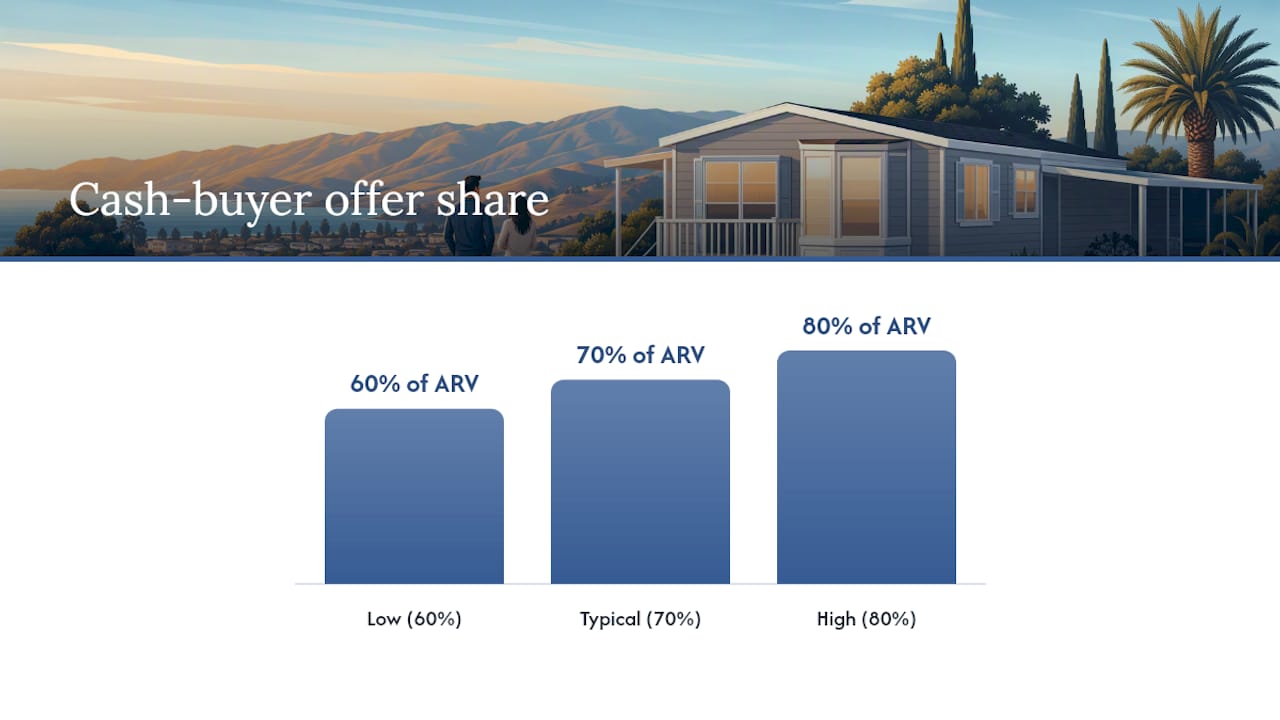
Most cash buyers use a straightforward formula: offer amount equals roughly 60% to 80% of after-repair value, minus estimated repair costs. That margin covers the buyer's repair budget, holding costs, and the risk of buying a home they haven't fully inspected room by room.
Several factors push your number up or down:
- Age of the home, especially whether it was built before the 1976 HUD code, which affects both value and financing eligibility for a future buyer.
- Structural condition, including roof, subfloor, and foundation issues.
- Space rent at your park, since higher monthly lot fees reduce what an investor can profitably pay.
- Relocation requirements, since moving a manufactured home is expensive and logistically complicated in California, and buyers who have to move it will subtract that cost from your offer.
Here's a simple example. Say your home's after-repair value is $90,000, and it needs about $12,000 in repairs. A buyer working at 70% of ARV would calculate: $90,000 × 0.70 = $63,000, minus $12,000 in repairs, landing at roughly $51,000. That's not a lowball number. It's the math nearly every serious as-is buyer runs before writing an offer.
How Do You Vet a Cash Buyer Before Signing?
Not every "cash buyer" ad is legitimate, and a bad deal can cost you weeks you don't have. Before you agree to anything, ask these questions directly:
- Can you show proof of funds for this purchase?
- How did you arrive at this price, and what's the breakdown?
- What's your projected closing timeline?
- Who pays closing costs and escrow fees?
- Which escrow company will handle this, and have you worked with them before?
- Who's managing the HCD paperwork and tax clearance filing?
Ask for proof of funds, a sample purchase agreement, and written escrow instructions before you sign anything. A serious buyer will hand these over without hesitation.
Watch for warning signs: buyers who ask for money upfront, refuse to use a licensed escrow company, pressure you to sign before you've seen any paperwork, or have no local presence you can verify.
Pro Tip: Call the escrow company directly before closing day. A legitimate cash buyer won't mind, and it takes five minutes to confirm the deal is real.
What Are the Steps to Close in 7 to 21 Days?
- Prepare your documents. Pull your title, confirm tax status, and complete your disclosure forms before you list or contact a buyer.
- Notify the park, if required, so approval steps can start early instead of becoming a bottleneck later.
- Get a written offer and open escrow with an agreed closing date in the paperwork.
- Sign transfer documents and submit them to HCD alongside your tax clearance request.
- Confirm park approval is finalized before your target closing date.
- Close escrow and receive funds once every requirement clears.
Speed comes down to two things: using an escrow or title company that's handled mobile home transfers before, and turning around requested documents the same day whenever possible. Sellers who stall on paperwork are the ones who watch a 10-day closing turn into 40.
Why Speed Matters More Than the Sticker Price
Most sellers fixate on getting close to retail value, and I understand why. But retail value assumes a financed buyer, a clean park approval, and zero repair issues, three things that rarely line up at once for an older manufactured home. The real comparison isn't "cash offer versus retail price." It's "cash offer versus months of carrying costs, park approval risk, and a financed buyer who can still fall through in week six."
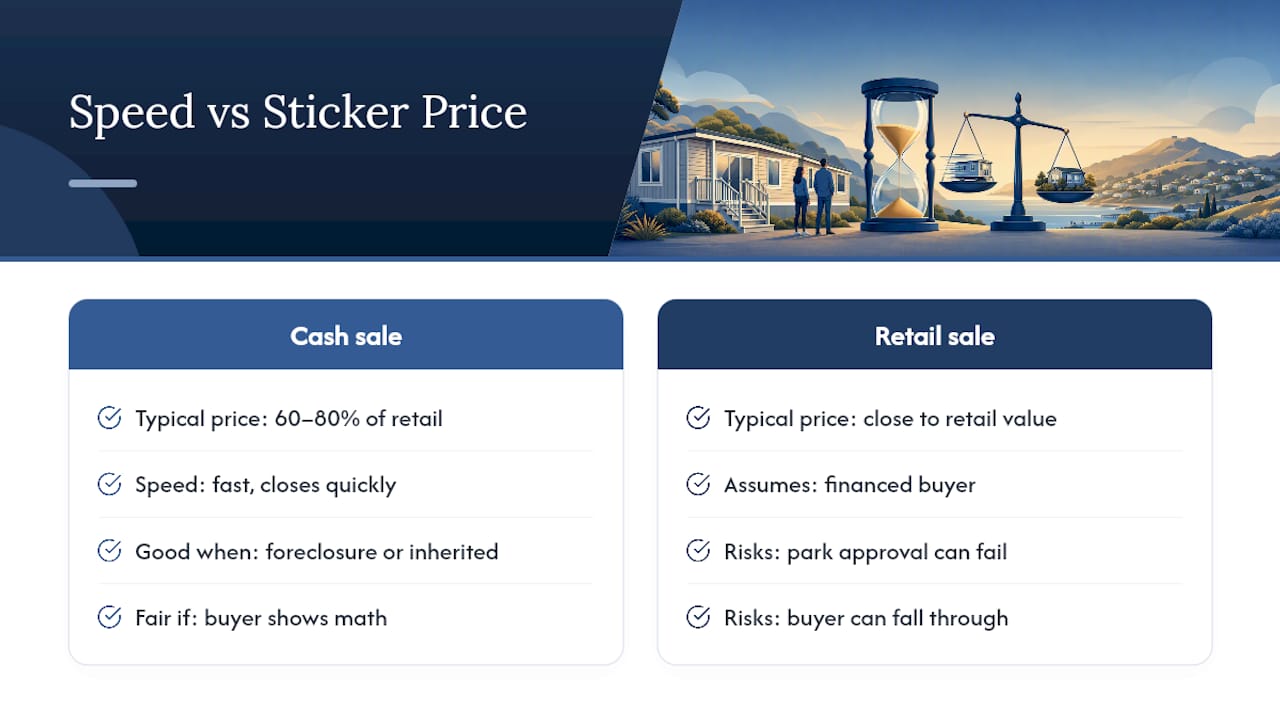
I'd also push back on the idea that a lower cash offer means you're being taken advantage of. The 60% to 80% formula isn't arbitrary. It reflects the actual cost structure of buying a home nobody else can finance easily. What matters more than the percentage is transparency: does the buyer show you the math, put the timeline in writing, and use a real escrow company? That's the difference between a fair discount and a predatory one.
If you're dealing with foreclosure, an inherited home you never wanted to manage, or repairs you simply can't afford, the math on a fast cash sale usually works in your favor once you account for what waiting actually costs.
— Abel
How to Request a No-Obligation Cash Offer
Some local cash buyers purchase mobile and manufactured homes as-is and can assist with park approval and HCD paperwork that sellers often find overwhelming. That's the real advantage here: you're not managing title clearance and park forms by yourself while also trying to coordinate a buyer.

Getting started is simple. Send a few photos of your home, your title status, your park name, and your ideal timeline. From there, SLO Cash Buyer - San Luis Obispo County Home buyer puts together a written cash offer with a proposed closing window and an escrow plan, so you know exactly what you're agreeing to before anything is signed.
If you'd rather explore a traditional sale first, listing your home on the market with a licensed agent is also an option worth comparing. But if speed and simplicity matter more right now, review the details of the Cash Offer program and measure it against the vetting checklist above before you decide. Either way, request your offer today and see the numbers for your specific situation.
Where to Verify the Rules Yourself
Before you sign anything, confirm the details directly from primary sources:
- The California Department of Housing and Community Development handles all mobilehome registration and title transfers.
- The Mobilehome Residency Law spells out your rights when selling inside a park.
- MHVillage's California selling guide covers park coordination and buyer financing considerations in more depth.
Sources
- California Civil Code — Mobilehome Residency Law (selected sections)
- California Department of Housing and Community Development — Mobilehome & Manufactured Homes
- How to transfer a mobile home title in California - LegalClarity
- Selling a Mobile Home As-Is: What Buyers Expect and How to Price | KDS Homebuyers
FAQ
How Fast Can I Sell My Mobile Home for Cash in San Luis Obispo?
Most cash sales close in 7 to 21 days once title, tax clearance, and park approval are in order. Homes with clear paperwork close fastest; missing documents or unresolved liens can push the timeline out.
Do I Need Park Approval to Sell My Mobile Home?
If your home stays on its current lot, yes. Under the Mobilehome Residency Law, parks can require buyer screening and approval, though they cannot block a legitimate sale outright.
Do I Still Need to Disclose Problems on an As-Is Sale?
Yes. California requires sellers to disclose known defects even when a home sells as-is, and skipping this step can create liability after the sale closes.
How Much Will a Cash Buyer Offer for My Mobile Home?
Cash offers typically fall between 60% and 80% of after-repair value, minus estimated repair costs. The exact number depends on your home's age, condition, and monthly space rent.
What Does SLO Cash Buyer Charge in Fees?
Certain cash buyers do not charge agent commissions or hidden fees on cash offer programs. Current pricing details and program specifics are available on its FAQ page.