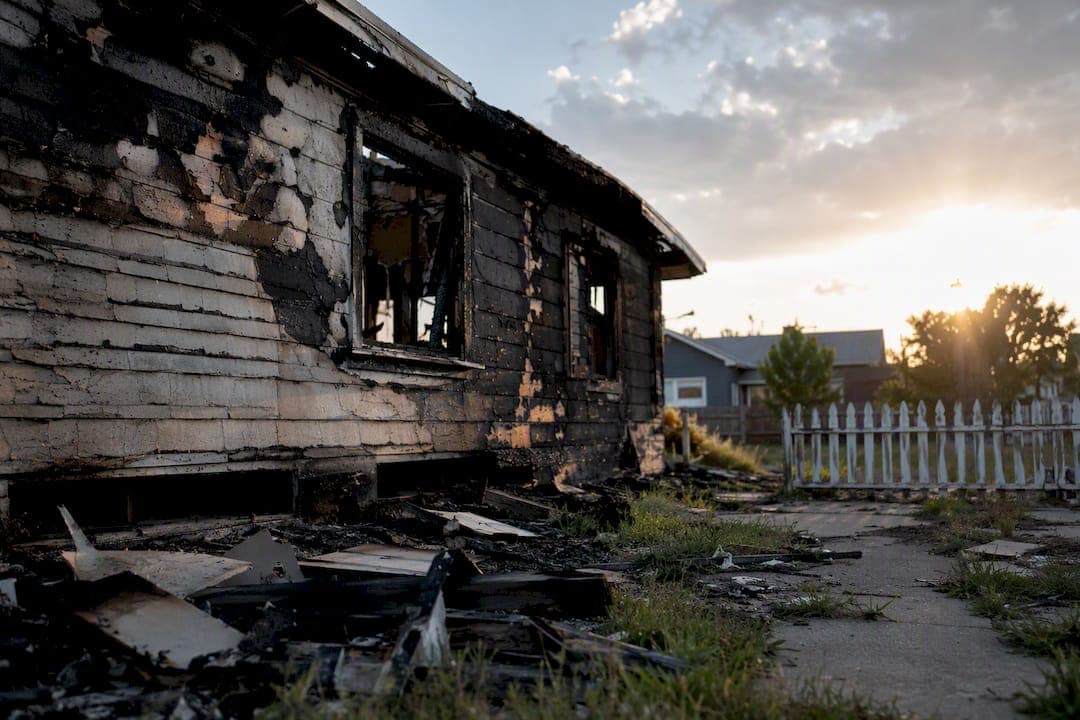
Yes, you can sell a fire-damaged house, and you have three realistic paths: repair and list, sell as-is to a cash buyer, or clear the lot and sell the land. If you need speed or certainty, or if you don't have much equity to work with, an as-is cash sale is usually your fastest route. Repairs generally recover more money but demand time, cash, and patience. This guide walks through how to weigh those options, the exact steps to take, and the legal and insurance pitfalls that trip up sellers who move too fast.
TL;DR:
- Repair costs for fire damage typically range from $3,000 to $52,000, and exceeding this budget can trigger mandatory full rebuilding under local codes.
- Selling as-is to a cash buyer usually results in the fastest closing within 7 to 21 days but involves discounts to cover repair costs and profit margins.
- When repair costs surpass a set percentage of the home's pre-damage value, many jurisdictions require a complete rebuild, which can double or triple the budget and timeline.
- Insurance proceeds are often restricted by lenders to pay down mortgages or go into escrow, significantly affecting available funds for repairs or sale proceeds.
- Proper documentation, professional valuations, and clear communication with insurers and lenders are essential to avoid delays and legal issues during the sale process.
Table of Contents
- What Are Your Options for Selling a Fire-Damaged House?
- How Do You Decide Which Selling Path Makes Sense?
- What Steps Should You Take From Assessment to Closing?
- How Does Insurance and Your Mortgage Affect What You Keep?
- How Do You Price and Market a Fire-Damaged Property?
- When Does a Fast Cash Sale Actually Make Sense?
- How Do You Request an Offer From SLO Cash Buyer?
- Sources
What Are Your Options for Selling a Fire-Damaged House?
Every homeowner facing this decision lands on one of three roads, and each one suits a different kind of seller.
Repair and list. This path fits homeowners with equity, insurance proceeds in hand, and enough runway to manage a renovation. Restoration can take anywhere from a few weeks for minor smoke damage to six months or more for structural rebuilds. It typically recovers the highest sale price, since buyers pay full market value for a finished home rather than discounting for risk. The catch is upfront cost. Fire restoration averages between roughly $3,000 and $52,000, with a median near $27,000, depending on how deep the smoke and structural damage go.
Sell as-is to a cash buyer or investor. This suits sellers who need to move fast, who lack the cash for repairs, or who simply don't want to manage contractors and inspections. Investor buyers commonly close in 7 to 21 days, because they skip financing contingencies and buy the property in its current condition. The trade off is price. These offers are discounted to cover the buyer's repair costs, holding costs, and profit margin, so you're trading top dollar for speed and simplicity.
Sell the land and let the buyer demolish. This becomes the practical choice when the structure is a total loss or when repair costs would trigger a full rebuild under local building codes. Demolition typically runs several thousand dollars, varying with size and hazardous-material abatement, but in strong land markets, especially where lot value has outpaced the aging structure, clearing the property can sometimes net more than trying to sell a damaged shell.
A few things worth flagging before you pick a lane:
- Repair and list generally maximizes price but requires the most time and capital.
- As-is cash sales close fastest and remove contractor and inspection risk.
- Land sales work best when rebuild costs would exceed the finished value.
- Your insurance settlement and mortgage balance often determine which options are even financially viable.
How Do You Decide Which Selling Path Makes Sense?
The right choice isn't emotional, it's arithmetic. Once you have real numbers instead of guesses, the decision usually becomes obvious.
Step 1: Get two valuations. Order a professional appraisal of the home in its current, as-is condition, and separately get an after-repair market-value estimate (a real estate agent's comparative market analysis works fine here). You need both numbers to run the comparison.
Step 2: Collect contractor bids. Get at least two detailed, line-item bids from licensed restoration contractors, not verbal estimates. Build in a 10% to 20% contingency for hidden damage, since smoke and firefighting water often cause more expense than the visible char ever suggests, according to restoration industry data on long-term fire damage costs.
Step 3: Confirm your insurance and lender position. Talk to your adjuster in writing about the claim estimate, and ask your mortgage servicer whether insurance proceeds go directly to you or must first pay down the loan. This single phone call changes the entire calculation, because if the lender takes the payout first, your repair budget may shrink dramatically.
Once you have those three numbers, the formula is simple:
- Take the after-repair value.
- Subtract total repair cost, including your contingency.
- Subtract holding costs (mortgage payments, insurance, utilities, and property taxes during the repair period).
- Compare that number to your best as-is cash offer.
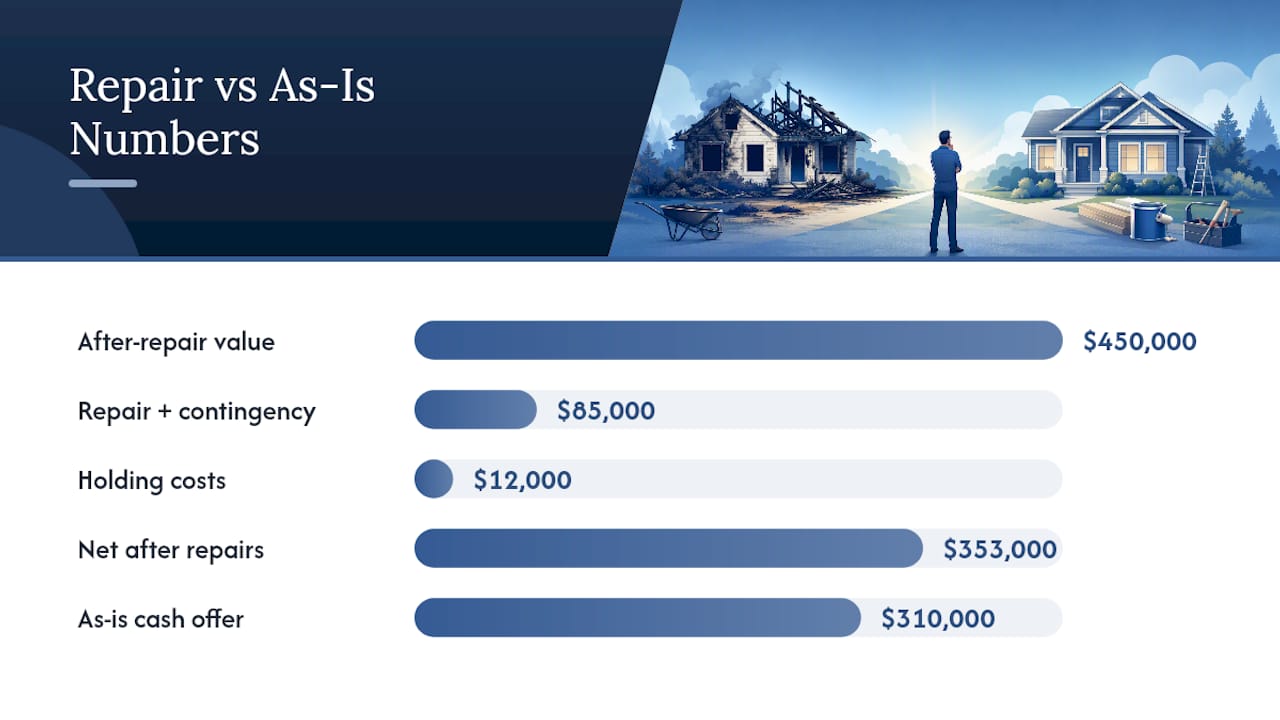
Here's a worked example. Say your home would be worth $450,000 repaired, restoration bids total $85,000 with contingency, and holding costs during a five-month rebuild run $12,000. That leaves you with $353,000 net. If a cash buyer offers $310,000 as-is with a two-week close, the repair path nets more on paper, but only if you have the capital to front the renovation and the patience to manage it.
Pro Tip: Before assuming repair is the better math, check your local building department for "substantial damage" thresholds. Many jurisdictions follow FEMA guidance that forces a full code-compliant rebuild once repair costs cross a set percentage of pre-damage value, which can quietly double your budget and timeline.
Don't ignore the non-financial side of this decision either. Managing a renovation while displaced from your home, coordinating with adjusters, and fielding contractor delays takes an emotional toll that spreadsheets don't capture. If your equity position is thin, if you're facing foreclosure, or if you simply need this chapter closed, that weighs into the decision just as much as the dollar figures.

What Steps Should You Take From Assessment to Closing?
Selling a fire-damaged home moves through predictable stages, and skipping one usually costs you later, either in a failed inspection, a lender delay, or a legal dispute after closing.
Right after the fire:
- Secure the property against weather and trespassing, and get the fire department's incident report for your records.
- Photograph every room and the exterior before any cleanup begins, since this documentation protects you with both the insurer and future buyers.
- Notify your mortgage servicer and insurance company within the timeframe your policy requires.
Assessment and testing:
- Hire a licensed structural engineer or fire-damage specialist to evaluate what's salvageable.
- Get remediation bids that separate smoke, soot, and water damage from structural repairs.
- If the home was built before 1978, arrange lead-paint testing. Federal rules require sellers to disclose known lead hazards and give buyers a 10-day inspection window, and fire damage often re-exposes old paint layers that were previously sealed.
Valuation and insurance coordination:
- Order the as-is appraisal and after-repair CMA discussed above.
- Track your claim number and get every adjuster estimate in writing.
- Confirm directly with your lender whether proceeds are disbursed to you or applied to the loan balance first.
Insurance interaction sits at the center of nearly every fire sale, and the scale of recent wildfire losses shows why. The economic impact of the Los Angeles wildfires ran into billions of dollars in insured losses, a reminder that you're one of many homeowners navigating this same claims process, and adjusters are often stretched thin after major disasters.
Disclosure and marketing:
- Complete your state's seller disclosure form accurately, listing the fire, the cause if known, and all repairs performed.
- Gather permits, repair receipts, and the fire report as backup documentation for buyers and their agents.
- If listing as-is, be upfront in the listing description. Investor buyers specifically look for honest damage disclosure because it speeds their own underwriting.
Closing:
- Confirm your lender's payoff amount early, since fire-damaged sales sometimes involve a short payoff negotiation if the loan balance exceeds the sale price.
- Title companies may require additional documentation for fire-damaged properties, so ask your title agent what they need before you're under contract.
An as-is home sale checklist can help you track these documents so nothing slips through during a stressful stretch.
How Does Insurance and Your Mortgage Affect What You Keep?
The check from your insurance company rarely lands in your bank account without conditions attached, and understanding those conditions before you list the home saves you from an unpleasant surprise at closing.
If you carry a mortgage, your lender almost always has a legal interest in the insurance payout. Many servicers require that claim proceeds either pay down the loan directly or get held in escrow until repairs are verified. Contact your servicer early and get their position in writing, because this single detail determines how much cash you actually have to work with, whether you repair or sell as-is.
On the tax side, don't assume your insurance settlement is automatically taxable income. The IRS treats a fire loss as an involuntary conversion under Section 1033, which can let you defer capital gains if you reinvest the proceeds into a replacement property within the statute's allowed timeframe. If the home was your primary residence, the standard principal-residence exclusion may shelter much of the gain before Section 1033 even becomes relevant. These rules have real deadlines and eligibility requirements, so this is exactly the kind of decision where a tax advisor earns their fee.
Practical steps worth taking now:
- Get your insurer's settlement offer and payment timeline in writing.
- Ask your lender to confirm, in writing, how proceeds will be disbursed and whether any balance is required to pay down the mortgage.
- Keep a dated file of every communication with both parties, since claim disputes often hinge on timelines.
- Talk to a tax professional about Section 1033 eligibility before you decide how to use the settlement.
How Do You Price and Market a Fire-Damaged Property?
Pricing a fire-damaged home wrong in either direction costs you. Price too high and it sits, scaring off both retail buyers and investors. Price too low and you leave money on the table before negotiations even start.
For as-is investor offers, expect discounts that reflect the buyer's repair costs, carrying costs, and margin, often landing well below repaired market value depending on damage severity. For repair-and-list, price against comparable sales of fully restored homes in your area, not against your pre-fire estimate, since buyers will scrutinize the finished condition, not your memory of the house.
Marketing channels differ by path. Repaired listings belong on the MLS alongside standard comparable homes. As-is properties often move faster through investor networks and cash-buyer platforms that specialize in distressed properties. Land or teardown sales sometimes perform better marketed specifically as lots, drawing builders and developers rather than traditional homebuyers who might be put off by a burned structure.
A few tactics that consistently help sellers net more, regardless of path:
- Disclose fire history plainly in the listing rather than burying it, since transparency builds buyer trust and reduces renegotiation after inspection.
- If offering seller credits instead of repairs, get a contractor estimate first so the credit reflects real cost, not a guess.
- Expect financing contingencies to be harder to satisfy on fire-damaged homes, since many lenders won't approve loans until repairs are complete, which is part of why cash buyers dominate this niche.
- Watch for appraisal gaps if a buyer is financing a partially repaired home, as lenders often require a second inspection before releasing funds.
When Does a Fast Cash Sale Actually Make Sense?
SLO Cash Buyer - San Luis Obispo County Home buyer purchases homes in any condition, fire damage included, without asking sellers to complete repairs or pay listing fees. That matters most for a specific kind of seller: someone facing foreclosure risk, someone who needs to relocate quickly for work or family, or someone who simply doesn't have the equity or capital cushion to front a restoration.
I'd push back gently on the instinct to assume repair-and-list is always the "smarter" choice just because the math on paper shows a higher number. That math only holds if you actually have the cash reserves and the months of patience a rebuild demands. A lot of sellers underestimate how draining it is to manage contractors, adjusters, and permits while living somewhere else.
A reputable cash buyer should give you a transparent offer, a clear closing timeline, and written coordination with your lender on any payoff. If a buyer won't put those details in writing, that's a red flag worth taking seriously.
— Abel
How Do You Request an Offer From SLO Cash Buyer?
If a fast, no-repair sale sounds like the right fit after weighing your options, SLO Cash Buyer - San Luis Obispo County Home buyer can put a fair cash offer in front of you within days, not months. Unlike listing with an agent and waiting through inspections and financing contingencies, or negotiating repair credits with a retail buyer, this route skips straight to a number you can act on.

To get a same-week offer, have these ready: photos of the damage, your insurance claim number, your current mortgage statement, and the fire department's incident report. That paperwork lets us give you an accurate figure quickly instead of a vague estimate that changes later.
Once you accept, the closing process typically moves in days rather than the months a traditional sale requires, with no cleaning, no repairs, and no agent commissions to subtract from your proceeds. If you're weighing your property buyer options after a fire, reach out for a no-obligation cash offer and see the number for yourself before committing to any path.
This article is general information, not a substitute for advice from a qualified lawyer. Consult a qualified legal professional about your own circumstances before acting on anything here.