
Most California homeowners selling a primary residence owe nothing in federal capital gains tax, thanks to the Section 121 exclusion of up to $250,000 for single filers or up to $500,000 for married filing jointly. But any gain above that shelter gets taxed by California as ordinary income, not at a special capital gains rate, and escrow may withhold money at closing whether you owe tax or not.
TL;DR:
- Most homeowners in California can avoid federal capital gains tax through the Section 121 exclusion, provided they meet ownership and use tests within the last five years.
- Gains exceeding the exclusion are taxed as ordinary income at California’s top rate of up to 13.3%, leading to potentially much higher state tax bills than expected.
- Proper calculation of taxable gain requires detailed records of purchase costs, improvements, and depreciation claims, especially if the home was used for rental or business purposes.
- Qualifying for partial exclusions is possible in cases of job moves, health reasons, or unforeseen circumstances, with the exclusion amount prorated based on months of residency.
- Many sellers face substantial escrow withholdings at closing unless they certify for exemption, making prior planning and understanding of rules essential to avoid cash flow surprises.
Table of Contents
- What Is the Capital Gains House Sale California Exclusion?
- How Does California Tax the Gain That Isn't Excluded?
- How Do You Calculate Your Taxable Gain?
- What If You Don't Qualify for the Full Exclusion?
- Can You Reduce the Tax Bill With Timing or Structure?
- What Happens With Escrow Withholding at Closing?
- What Should You Do Before You List the Home?
- A Local Buyer's View on Tax-Driven Selling Decisions
- An As-Is Option When Speed and Certainty Matter More Than Maximizing Price
- Where to Go for the Official Rules and Next Steps
- Sources
What Is the Capital Gains House Sale California Exclusion?
The Section 121 exclusion is the reason most home sellers in California never write a check to the IRS or the Franchise Tax Board. California conforms to this federal rule, so if you qualify, you shelter up to $250,000 of gain if you file single, or $500,000 if you file jointly.
Qualifying comes down to two tests, and both need to be true.
- Ownership test: you owned the home for at least 2 of the 5 years before the sale date.
- Use test: you lived in it as your principal residence for at least 2 of those same 5 years.
Those two years don't need to be consecutive. If you lived in the house for 14 months, rented it out for a year, then moved back in for 12 more months before selling, you can still string together 24 months of qualifying use within the 5 year window. Proving "use" matters more than people expect, especially if you split time between properties. Voter registration, a driver's license address, utility bills, and the address on your tax return all serve as evidence if the FTB or IRS ever questions your residency claim.
There's also a frequency rule: you generally can't claim the exclusion more than once every two years. If you sold a different primary residence 18 months ago and excluded gain then, you likely can't exclude gain again on this sale, though a partial exclusion may still apply (more on that below).
For married couples filing jointly, only one spouse needs to meet the ownership test, but both spouses must meet the use test to get the full $500,000. That trips people up during divorce or after a spouse's death, since it changes who's actually eligible for what amount.
If your gain falls below the exclusion threshold, you often don't even need to report the sale on your tax return, assuming you didn't receive a 1099-S showing otherwise. If your gain exceeds the exclusion, or you're unsure how to calculate it, IRS Publication 523 walks through the worksheets for figuring adjusted basis, the exclusion amount, and the taxable remainder. It's dense reading, but the worksheets are the closest thing to a definitive answer you'll find without hiring a CPA.
How Does California Tax the Gain That Isn't Excluded?
This is where California diverges sharply from most other states, and where sellers get caught off guard. Once you calculate the gain that exceeds your Section 121 exclusion, California doesn't apply a preferential capital gains rate to it. It taxes that gain as ordinary income, stacked on top of your wages and other earnings for the year.
California has no separate capital gains tax rate. Every dollar of taxable gain is taxed at your marginal state income tax rate, which climbs as high as 13.3% for top earners.
California doesn't offer that same discount.
Here's what that looks like in practice. The sale itself can bump you into a higher bracket for the year, which is a detail a lot of sellers miss until they see the tax bill.
How Do You Calculate Your Taxable Gain?
The math isn't complicated, but it requires paperwork most people don't keep well. Getting it right is the difference between overpaying and accurately claiming every dollar you're entitled to shelter.
- Start with the amount realized. That's your sale price minus selling costs: agent commissions, transfer taxes, and title or escrow fees.
- Establish your adjusted basis. Take your original purchase price, add the cost of capital improvements (a new roof, a room addition, a kitchen remodel), add certain acquisition costs, and subtract any depreciation you've claimed.
- Subtract adjusted basis from amount realized. What's left is your gain.
- Apply your exclusion. Subtract $250,000 or $500,000, depending on filing status and eligibility.
- Whatever remains is taxable gain, subject to federal capital gains tax and California ordinary income tax.
The tricky part is step two. Repairs don't count toward basis. Replacing a broken window pane is a repair. Replacing every window in the house with upgraded units is a capital improvement. The IRS draws this line based on whether the work adds value, extends the property's life, or adapts it to new uses, and Publication 523 has examples worth reading before you start pulling receipts.
If you ever used the home as a rental or for business, depreciation recapture applies. Any depreciation you claimed after May 6, 1997 is not excludable under Section 121, and that portion of your gain gets taxed separately at the federal level, in addition to whatever California charges on it. This is a genuinely complicated area, and it's one where a CPA earns their fee.
Pro Tip: Keep every permit, invoice, and receipt for home improvements in one folder from the day you buy the house, not the week before you list it. Reconstructing ten years of remodeling costs from memory is nearly impossible, and every dollar of documented improvement lowers your taxable gain.

For a full breakdown of which closing costs count against your sale price, our guide to seller closing costs walks through what's typical in San Luis Obispo County.
What If You Don't Qualify for the Full Exclusion?
Not every seller fits neatly into the 2 of 5 year box, and California has plenty of situations that call for a partial exclusion or extra care around basis.
- Job-related moves: if your new job is at least 50 miles farther from the home than your old job was, you may qualify for a prorated exclusion even without meeting the full 2-year use test.
- Health reasons: a doctor-recommended move to treat or care for a health condition can also trigger a partial exclusion.
- Unforeseen circumstances: divorce, death of a spouse, multiple births from a single pregnancy, or job loss can all qualify under this catch-all category.
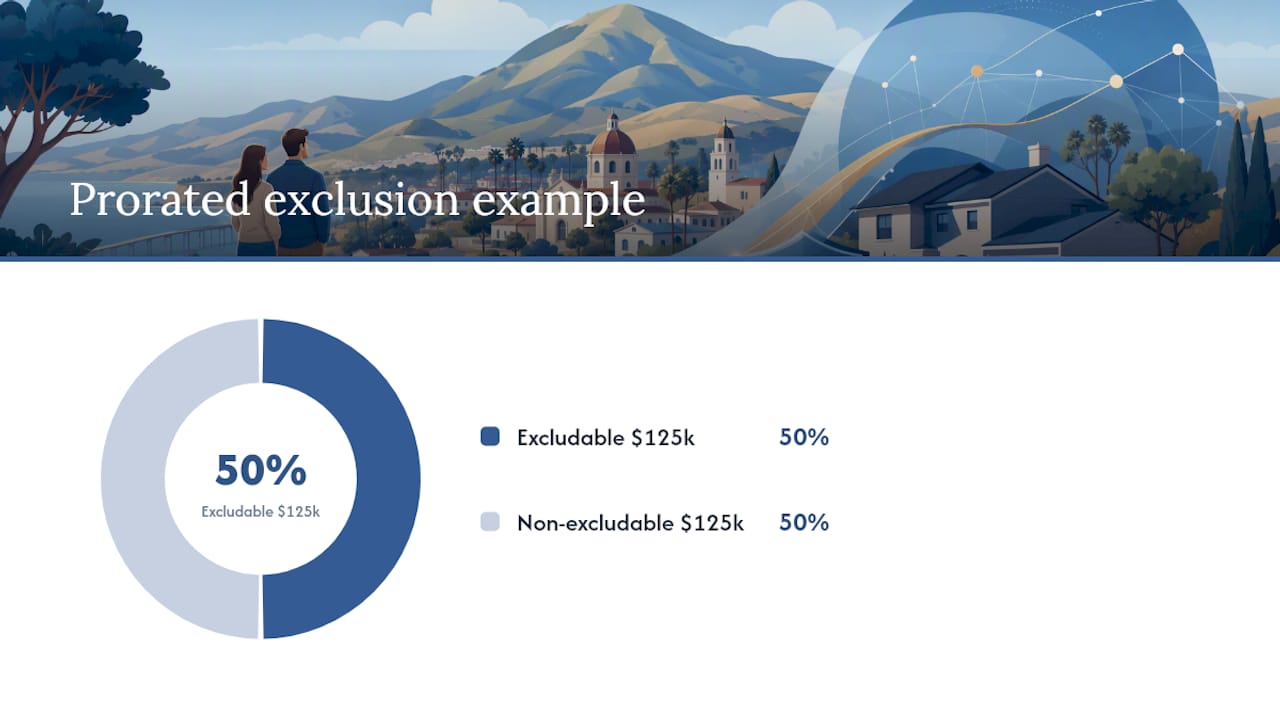
The proration works by months. If you lived in the home for 12 months before an unforeseen circumstance forced a sale, a single filer would prorate roughly half of the $250,000 cap, landing around $125,000 in excludable gain. The worksheets in Publication 523 walk through the exact fraction based on your specific timeline.
If you ever converted the home into a rental, the portion of gain tied to depreciation claimed after May 6, 1997 isn't excludable and gets recaptured separately, regardless of how long you've since lived there again as your primary residence.
Inherited property adds another layer entirely. Heirs typically receive a stepped-up basis equal to the home's fair market value at the date of death, which can dramatically shrink taxable gain if they sell soon after. But Proposition 19 changed how property tax reassessment works for inherited homes; most heirs no longer keep the original owner's low property tax basis unless they move in and the home's value falls under specific thresholds. That's a property tax issue, separate from capital gains, but it affects the total cost of holding versus selling. Our inherited property sale checklist covers this in more depth.
Can You Reduce the Tax Bill With Timing or Structure?
A few legitimate strategies can shrink the tax hit on gain that falls outside your exclusion, though each comes with trade-offs worth weighing carefully.
- Installment sales let you spread the taxable gain across multiple years by carrying a note instead of collecting the full price at closing, which can keep you out of a higher tax bracket in any single year. The trade-off is real: you're now the lender, exposed to buyer default risk, and the terms of the note matter enormously.
- Timing the sale for a lower-income year can reduce your combined marginal rate, since California's ordinary income treatment means the sale stacks on top of whatever else you earned that year. Selling the year after a layoff or retirement, rather than during your peak earning years, can meaningfully change the bracket you land in.
- Harvesting capital losses elsewhere in your portfolio the same year can offset some of the taxable gain, a strategy worth reviewing with a CPA before year end.
- 1031 exchanges only apply to investment or business property, never a primary residence, so this route matters mainly for sellers who converted a home to a rental or are selling a second property.
Moving out of California doesn't erase the tax bill either. Gain from California real property is sourced to California regardless of where you live when you file, so relocating before the sale closes won't shield the gain from state tax.
Pro Tip: If you're weighing an installment sale on a rental or investment property, talk to a tax advisor about how it interacts with depreciation recapture. Recaptured depreciation often can't be deferred the same way the rest of the gain can.
What Happens With Escrow Withholding at Closing?
Even sellers who owe zero capital gains tax can watch a chunk of their proceeds disappear into withholding at closing, if they don't handle the paperwork correctly.
- Form 593 is the real estate withholding certificate every California escrow company uses. Without an exemption certification, escrow will typically withhold 3.33% of your gross sales price, not your gain, which can be a shockingly large number on an expensive home.
- Certify your exemption on Form 593 Part III if the home was your principal residence and you qualify for the Section 121 exclusion. This is the single most effective step to avoid tying up cash at closing.
- Elect alternative withholding if you don't qualify for full exemption but your actual gain is smaller than the default calculation assumes; this method withholds 12.3% of your estimated gain instead of 3.33% of the sale price, which is often lower.
- Expect standard reporting forms: a 1099-S if the sale isn't fully exempt, Form 8949 and Schedule D on your federal return, and California Schedule D or Form 540NR if you're a nonresident seller.
Withholding is a prepayment, not a final tax bill. Money withheld at closing gets reconciled when you file your return, and if you overpaid through withholding, you get it back as a refund, just not immediately. Talk to your CPA before you're sitting in the escrow office; certifying the exemption correctly at signing is far easier than chasing a refund months later.
What Should You Do Before You List the Home?
A short checklist before you put the home on the market saves headaches at closing and protects the exclusion you're entitled to.
- Gather closing statements from your original purchase (HUD or ALTA settlement statement).
- Collect receipts and permits for every capital improvement, not just recent ones.
- Pull records of any rental or business use, including depreciation claimed.
- Line up utility bills or other proof of residency if your ownership timeline is complicated.
- Estimate your adjusted basis and likely taxable gain before you set a listing price.
- Talk to a CPA if your estimated gain looks like it will exceed your exclusion amount.
- Decide with escrow, in advance, whether you're certifying an exemption or electing alternative withholding.
- Plan your cash flow assuming some withholding may occur at closing, with reconciliation coming later at tax time.
Our closing process checklist covers the document flow in more detail if you want a step-by-step walkthrough.
A Local Buyer's View on Tax-Driven Selling Decisions
Every week, we talk with San Luis Obispo homeowners who are doing this math in real time, often under pressure. Foreclosure timelines don't wait for a CPA appointment. Neither does a job relocation with a 30-day notice.
What I've noticed is that withholding fears push some sellers toward decisions that don't fit their actual situation. Someone facing a $40,000 repair bill on a home with modest equity sometimes assumes a traditional sale is their only option, when an as-is cash sale might net them more once they account for holding costs, repairs, and the months a listed home can sit on the market.
The tax rules matter, but so does matching the sale method to your actual cash needs and timeline. A seller expecting real withholding at closing needs to know that going in, not discover it at the signing table. That's the conversation worth having before you decide how to sell, not after.
— Abel
An As-Is Option When Speed and Certainty Matter More Than Maximizing Price
If your gain estimate, withholding exposure, or repair list has you rethinking a traditional listing, SLO Cash Buyer - San Luis Obispo County Home buyer offers a different route to the same goal: getting the home sold without the agent commissions, repair costs, or months of uncertainty that come with listing on the open market. We buy homes as-is in San Luis Obispo County, cover no repair costs, and don't charge fees or commissions, which matters directly to the calculation you just walked through, since fewer selling costs and no repair spending can change your amount realized and your net proceeds.

This fits sellers dealing with foreclosure deadlines, inherited homes they don't want to renovate, or a relocation on a tight clock, where a fast, certain close outweighs squeezing out the last few thousand dollars a slower listing might bring. We can also talk through how escrow withholding under Form 593 applies to your specific sale before you sign anything. If a straightforward, no-obligation cash offer sounds like the right fit for your timeline, request your offer from SLO Cash Buyer and get a clear number to compare against listing.
Where to Go for the Official Rules and Next Steps
Start with the Franchise Tax Board's home sale guidance and IRS Publication 523 for the definitive rules and worksheets. For real estate withholding specifics, the FTB's withholding page covers Form 593 in detail. If you're weighing a sale timeline, our home selling timeline guide breaks down what to expect month by month.
This article is general information, not a substitute for advice from a qualified financial advisor. Consult a qualified financial professional about your own circumstances before acting on anything here.