
When you need to sell your home fast for a job relocation, the clearest path depends on one thing: your hard deadline. If you have fewer than 30 days, an as-is cash sale is your most reliable option, closing quickly within a few weeks. If your employer offers a guaranteed buyout program, that can work too, though it usually requires a marketing window of about two to three months first.
Your fastest options at a glance:
- As-is cash sale (local buyer or investor): closes rapidly within a few weeks, no repairs or agent required
- Employer guaranteed buyout: certainty without open-market risk, but expect a marketing period of several weeks to a few months before the company steps in
- Traditional listing with an agent: generally ranges from about one to three months depending on your local market
- Full corporate relocation program: often takes multiple months from start to funded close
Your immediate next step: Pull out your relocation policy today, check whether a guaranteed buyout or lump-sum benefit is included, and match that against your job start date. That single comparison tells you which path to take.
Pro Tip: Review IRS Publication 523 before you close. A work-related move where your new job is at least 50 miles farther from your home than your old job may qualify you for a partial capital gains exclusion, even if you haven't met the full two-year ownership and use test. Revenue Ruling 2005-74 also governs how employer buyout payments are taxed, so knowing both before closing can save you real money.
Table of Contents
- What does your employer relocation package actually cover?
- How do you quickly evaluate your local market before deciding?
- Which selling strategy fits your relocation timeline?
- What tactics actually speed up a home sale right now?
- How do you prepare your home fast without overspending?
- What does a realistic relocation sale timeline look like?
- Key Takeaways
- When speed should override price
- SLO Cash Buyer makes a fast, as-is sale simple in San Luis Obispo County
- Useful sources and further reading
What does your employer relocation package actually cover?
Most homeowners skip this step and go straight to Zillow. Don't. Your relocation package, if you have one, can significantly influence how you sell your home during a job move.
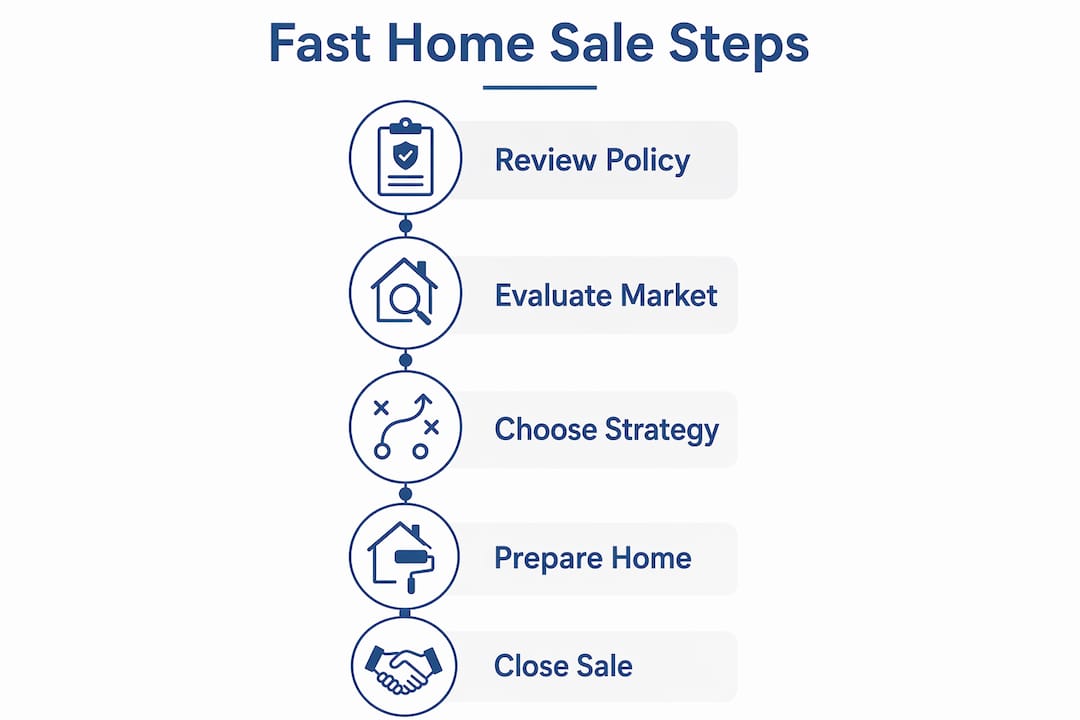
The first thing to look for is whether your policy includes a guaranteed buyout (also called a "direct reimbursement" or "amended value" program). If it does, your employer, usually through a relocation company, will buy your home at an appraised value if you can't find a buyer within the designated marketing window. This removes much of the downside financial risk for you.
Key items to find in your relocation policy:
- Guaranteed buyout or buyer value option (BVO) availability
- Required open-market marketing window before the buyout kicks in
- Loss-on-sale reimbursement and whether it's taxable with a gross-up
- Who pays appraisal fees, closing costs, and agent commissions
- Lump-sum amount (if applicable) and any spending restrictions
Package types, briefly:
- Lump sum: a fixed cash payment you manage yourself; flexible but you absorb any shortfall
- Reimbursement: employer repays documented moving and selling costs up to a cap
- Guaranteed buyout: employer buys the home at an appraised price after the marketing window
- Amended value: if you find a buyer above the appraised offer, the company matches that price
One detail many sellers miss: loss-on-sale reimbursements are often taxable income. Some employers offer a tax gross-up to offset this, but not all do. Check your policy carefully, and if a gross-up isn't included, budget for a higher tax bill in the year you relocate.
Pro Tip: Document every conversation with your HR or relocation counselor in writing. Confirm deadlines, appraisal schedules, and benefit caps by email. Verbal assurances don't hold up when a closing date slips.
Questions to ask HR or your relocation counselor right now:
- Does our program include a guaranteed buyout, and what triggers it?
- What is the required marketing window before the buyout offer is made?
- Are loss-on-sale reimbursements grossed up for taxes?
- Who orders and pays for the relocation appraisals?
- What is my deadline to initiate the program?
How do you quickly evaluate your local market before deciding?
You don't need a full market analysis to make a smart decision. You need about 30–60 minutes and three data points: average days on market (DOM) in your zip code, current active inventory levels, and a rough comparative market analysis (CMA) from a local agent or a free tool like Zillow's Zestimate.

If homes in your area are selling quickly and inventory is limited, a traditional listing might still meet a 1.5 to 2 month deadline. If average market times are longer, prepare for extended timelines and the possibility of price reductions or deals falling through.
Signals that favor a fast cash sale over listing:
- Average days on market beyond a month and a half in your neighborhood
- Several months' worth of active inventory, indicating a buyer's market
- Your home requires repairs that might affect buyer financing
- Your job start date is approaching within about a month or so
Carrying costs change the calculation fast. Every month you hold a home you're not living in costs money: mortgage payment, property taxes, insurance, utilities, and possibly HOA fees. When you add temporary housing in your new city on top of that, the financial gap between a fast cash sale and a higher traditional sale price can shrink quickly. Run the numbers before assuming a higher list price is worth the wait.
Which selling strategy fits your relocation timeline?
There are four realistic paths for selling a house fast during a job move. Each has a different timeline, cost profile, and risk level.
| Strategy | Timeline to Close | Costs & Fees | Certainty | Best For |
|---|---|---|---|---|
| As-is cash sale | 7–21 days | No commissions, no repair costs; slight price discount | Very high — no financing contingency | Hard deadlines under 30 days; homes needing repairs |
| Traditional listing | 30–90+ days | 5–6% agent commissions, possible repair/staging costs | Moderate — deals can fall through | Seller's markets with DOM under 30 days and flexible timelines |
| Employer guaranteed buyout | 60–120 days total | Employer typically covers appraisals and closing costs | High — employer absorbs downside risk | Employees with a buyout benefit and a 60–90 day window |
| Contingent/bridge strategy | 45–90+ days | Bridge loan fees, double carrying costs during overlap | Lower — depends on two transactions closing | Buyers who need sale proceeds to purchase in new city |
A few practical notes on each:
- Cash sale: as-is sales close faster because there's no lender underwriting, no repair negotiation, and no financing contingency. The trade-off is accepting a price below full retail, which is often the right call when your job starts in three weeks.
- Traditional listing: still viable in a hot seller's market, but Zillow's guidance notes that the typical home-sale process runs about two months, and that's before accounting for closing delays.
- Employer buyout: once the relocation company assumes the deed, it also takes over carrying costs, including mortgage, utilities, taxes, and maintenance. That's a meaningful financial relief if you're already paying rent in a new city.
- Contingent/bridge: the riskiest option for relocating sellers. If the sale of your current home falls through, you may be holding two mortgages. Simultaneous closing mechanics add complexity and can delay both transactions.
Relocation appraisals in employer programs estimate the price achievable within the program's marketing window, often up to 120 days, not the highest price you might get with unlimited time on the market. That's worth knowing before you assume the buyout offer will match your Zestimate.
What tactics actually speed up a home sale right now?
If you've decided to sell and need to move fast, these are the tactics that reliably cut days or weeks off your timeline.

Local cash buyers: the fastest option available. A reputable local cash buyer can make an offer within 24–48 hours and close in 7–21 days. No repairs, no showings, no waiting on a lender. The price will be below retail, but the certainty and speed are unmatched for sellers with hard deadlines.
iBuyers: companies that make algorithmic cash offers online. Available in select metro areas; timelines are typically 14–30 days. Fees vary and can approach traditional agent commissions, so compare carefully.
Auction: online or live auctions can move a property in 30–45 days depending on the auction schedule and bidder pool. Works best for unique or distressed properties where traditional buyers are scarce.
Cash-only listings: marketing your property specifically to cash buyers through your agent or MLS can shorten the buyer pool but eliminate financing delays. Pair this with a pre-listing inspection to remove uncertainty for buyers.
Pro Tip: When you list or negotiate, put your timeline in writing. A simple line in the listing remarks ("seller requires close by [date]") attracts buyers who can move fast and filters out those who can't. In the purchase agreement, specify a closing date and request a short inspection period of 5–7 days rather than the standard 10–17.
Pricing tactics for a fast sale:
- Price at or slightly below the most recent comparable sale in your neighborhood to generate immediate interest
- Consider a "bidding window" strategy: list at a competitive price and set an offer review date 5–7 days out to create urgency
- Avoid the temptation to test a high price first; every week without an offer is a week closer to your start date
For sellers in competitive markets who want to list with an agent, a strategic listing approach can help you position the home correctly from day one rather than chasing the market down with price cuts.
How do you prepare your home fast without overspending?
The goal here is simple: make the home show well online and pass a basic inspection without spending money on things that won't move the needle.
High-ROI fixes you can do in a weekend:
- Deep clean every room, including appliances, bathrooms, and windows
- Touch up scuffed paint on walls, baseboards, and doors
- Replace burned-out bulbs and fix any obvious safety issues (loose railings, broken locks)
- Clear clutter from every room, especially closets and the garage
- Address any obvious water stains, leaks, or odors immediately
What to skip if you're selling as-is: major renovations, full kitchen or bath updates, new flooring. These rarely return their cost in a fast sale and eat time you don't have.
For your online listing, professional photos are non-negotiable. Buyers decide in seconds whether to schedule a showing based on the first photo. Hire a real estate photographer for a few hundred dollars; it's the single highest-return investment in a fast sale.
Pro Tip: Prepare a relocation disclosure packet before you list. Include a completed seller's disclosure, any known repair history, HOA documents, and a note that you're relocating and motivated to close by a specific date. Buyers and agents appreciate transparency, and it speeds up the due-diligence phase considerably. Also confirm with your agent or attorney that your state allows remote notarization so you can sign closing documents from your new city.
Timing your disclosures and showings:
- Complete all required disclosures before the first showing, not after an offer
- Coordinate showings in a tight window (e.g., two days of open access) to create urgency
- If you've already moved, arrange a lockbox and give your agent full access authority
What does a realistic relocation sale timeline look like?
Here's how the timelines actually break down, with the bottlenecks that most sellers don't anticipate.
Timeline ranges by strategy:
- Cash sale: 7–21 days from first contact to funded close; bottleneck is title search and any existing liens
- Employer guaranteed buyout: 60–120 days total; bottleneck is the mandatory marketing window and appraisal scheduling
- Traditional listing: 30–90+ days; bottleneck is buyer financing, inspection negotiations, and appraisal gaps
Relocation experts and professional movers consistently recommend building a 2–4 week buffer into your timeline to absorb closing delays from title issues, inspection renegotiations, or buyer financing failures. If your job starts June 1, plan to close by May 1 at the latest.
Deadline-driven checklist:
Moving in 0–2 weeks (hard deadline):
- Contact a local cash buyer immediately and request an offer
- Pull your mortgage payoff statement and any lien documentation
- Confirm remote closing and notarization options with a title company
- Arrange movers and temporary housing in the new city
Moving in 2–6 weeks:
- Check your relocation package and initiate HR/relocation counselor contact
- Order a pre-listing inspection to identify any deal-breakers
- Hire a real estate photographer and prepare the home for listing
- Price aggressively based on recent comps and set an offer review date
- Review the quick home sale timeline to map each step
Moving in 6–12 weeks:
- Initiate employer buyout program if available
- List with an agent using a competitive price and short inspection window
- Negotiate a leaseback or flexible closing date if you need time to move
- Confirm closing cost estimates and budget for carrying cost overlap
Typical costs to budget:
| Cost Item | Typical Factors | Notes |
|---|---|---|
| Agent commissions (if listing) | A percentage of sale price, commonly in the mid-single digits | Usually waived in cash or buyout sales |
| Closing costs (seller-side) | Typically a small percentage of sale price | Includes title, escrow, and transfer taxes |
| Mortgage overlap (per month) | Depends on loan balance | Relevant if closing occurs after your move date |
| Temporary housing (new city) | Varies widely by market | Options include hotels, short-term rentals, or corporate housing |
| Moving costs | Depends on distance and volume | Longer-distance moves generally incur higher costs |
| Pre-listing inspection | A few hundred dollars | Optional, but can expedite buyer due diligence |
Key Takeaways
When you need to sell your home fast for a job relocation, the right strategy depends on your deadline: cash sales close within a few weeks, employer buyouts typically take a couple of months or more, and traditional listings usually require one to three months or longer.
| Point | Details |
|---|---|
| Match strategy to deadline | Cash sale for under 30 days; employer buyout or listing for 60+ day windows. |
| Build a buffer | Add 2–4 weeks to your target close date to absorb title or financing delays. |
| Check your relocation package first | Employer buyouts shift carrying costs and downside risk to the company after deed transfer. |
| Price for speed, not hope | Listing at or below recent comps generates faster offers than testing a high price. |
| SLO Cash Buyer for fast, as-is sales | SLO Cash Buyer - San Luis Obispo County Home buyer closes in as little as 7–21 days with no repairs, commissions, or hidden fees in San Luis Obispo County. |
When speed should override price
Here's the honest truth most real estate advice dances around: for most people relocating for work, the financial difference between a fast cash sale and a maximized traditional sale is smaller than it looks on paper.
Run the carrying costs. Two months of mortgage, insurance, taxes, and utilities on a vacant home, plus temporary housing in your new city, can easily total several thousand dollars. Add the stress of managing a home sale remotely, coordinating showings from hundreds of miles away, and the risk of a deal falling through at the last minute, and the "higher price" of a traditional listing starts to look a lot less attractive.
The sellers who regret choosing speed are usually those who had a genuinely flexible timeline and a hot local market. The sellers who regret not choosing speed are those who listed optimistically, watched the weeks tick by, and ended up accepting a lower offer anyway, after paying two months of carrying costs and starting a new job while still managing a sale.
There's a specific scenario where accepting a modest price concession is clearly the right move: when your home needs repairs, your job start date is firm, and you're moving long distance. In that combination, the logistical and financial cost of a prolonged sale almost always outweighs the price difference.
One tax note worth flagging: if your new job is at least 50 miles farther from your home than your old job was, you may qualify for a partial capital gains exclusion under IRS Publication 523, even without meeting the full two-year test. And if your employer is buying your home through a relocation program, Revenue Ruling 2005-74 governs how those payments are taxed. Consult a tax advisor for your specific situation before closing.
SLO Cash Buyer makes a fast, as-is sale simple in San Luis Obispo County
If your job start date is close and you need a guaranteed close without the uncertainty of listing, SLO Cash Buyer - San Luis Obispo County Home buyer offers a direct path: a fair cash offer on your home as-is, no repairs required, no agent commissions, and no surprise fees at closing.

The process is straightforward. You reach out, share basic details about your property, and receive a cash offer typically within 24–48 hours. If the offer works for you, you choose the closing date, and the team handles the paperwork. Most transactions close in 7–21 days. You don't need to clean, fix anything, or coordinate showings while you're trying to pack and start a new job.
This is especially helpful for homeowners in San Luis Obispo County who are relocating on short notice, dealing with an older home that needs work, or simply want the certainty of a funded close before their move date. There are no commissions taken out of your proceeds and no hidden deductions at the table.
To get started, request a cash offer directly from SLO Cash Buyer - San Luis Obispo County Home buyer. Have your mortgage payoff balance and basic property details ready, and the team can move quickly from there.
Useful sources and further reading
These are the primary sources behind the guidance in this article. They're worth bookmarking if you want to verify specific claims or go deeper on any topic.
- IRS Publication 523 (2025) — The authoritative IRS guide on selling your home, including the partial capital gains exclusion for work-related moves. Read this for tax rules before you close.
- IRS Capital Gains, Losses, and Sale of Home FAQ — Covers year-specific tax changes, including updates affecting casualty loss rules starting in 2026. Check here for the most current guidance.
- LegalClarity: What Is a Relocation Home Sale? — Detailed breakdown of employer buyout structures, Revenue Ruling 2005-74, relocation appraisals, and tax gross-ups. Essential reading if your employer offers a buyout program.
- LegalClarity: How Does a Relocation Company Sell Your House? — Explains the 60–90 day marketing window requirement and how relocation companies manage the resale process.
- Zillow: How to Sell Your House for a Job Relocation — Practical overview of relocation sale strategies and the case for prioritizing certainty over price when timelines are rigid.
- Ready House Buyer: How to Sell a House and Move Out of State — Source for the 2–4 week buffer recommendation and practical guidance on managing a long-distance home sale.
This article is general information, not legal or tax advice. Consult a qualified tax advisor or real estate attorney to confirm how these rules apply to your specific situation.