
Simultaneous closing is defined as two back-to-back real estate transactions on the same property, completed on the same day, where an investor buys from a seller and immediately resells to an end buyer. Also called a double closing or back-to-back closing, this technique is a recognized strategy in real estate investing. It involves a title company, transactional funding, and two separate sets of closing documents. The core appeal is privacy: the original seller and the end buyer never see each other's transaction details, which keeps the investor's profit margin confidential. For homeowners who need to sell fast and investors who want a clean, legal way to flip properties, understanding this process is genuinely useful.
What is simultaneous closing and how does it work step by step?
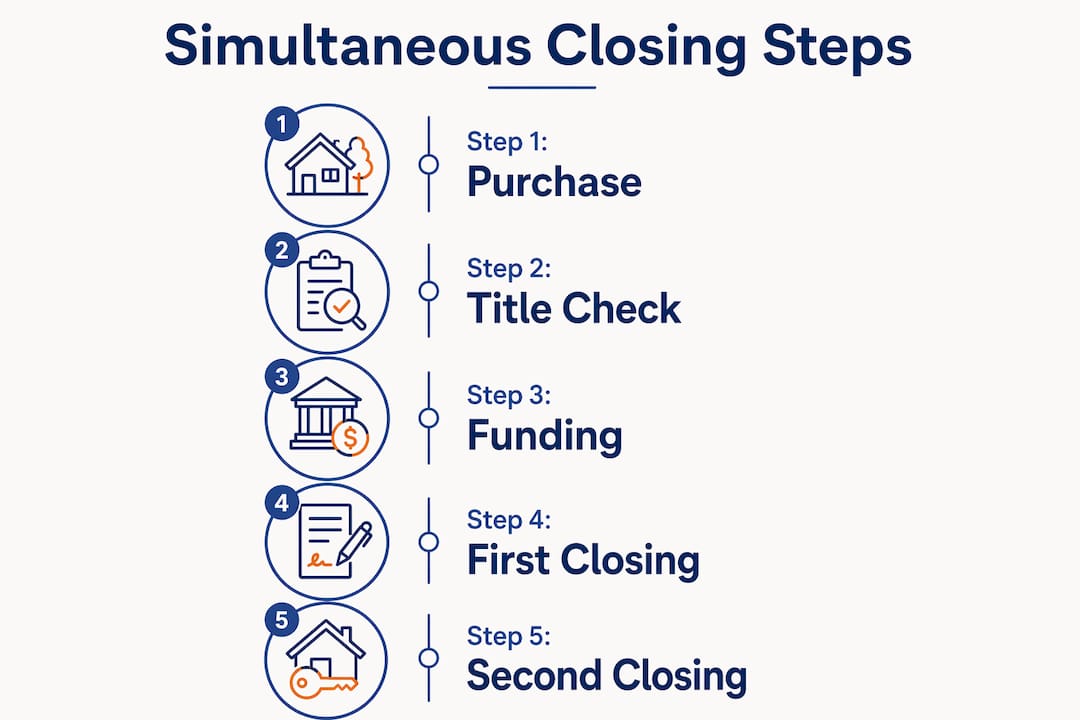
A simultaneous closing involves three parties: the original seller (Party A), the investor (Party B), and the end buyer (Party C). The process runs in two distinct transactions, both handled on the same day by a title company or settlement agent.
Here is how the process unfolds:
- Party A and Party B sign a purchase agreement. The investor contracts to buy the property from the original seller at an agreed price.
- Party B and Party C sign a separate purchase agreement. The investor contracts to resell the same property to the end buyer, typically at a higher price.
- Transactional funding is secured. Because the investor needs to close the first deal before receiving funds from the second, a short-term bridge loan covers the initial purchase. Transactional funding costs 1–2% of the loan amount and is typically repaid within 24 hours.
- The first closing executes. The investor takes legal title from Party A. Two full sets of documents are signed, and title insurance is issued for this transaction.
- The second closing executes. Often within hours, the investor transfers title to Party C. The end buyer's funds repay the transactional loan, and the investor keeps the spread.
The title company acts as the central coordinator throughout. Title companies handle two related transactions on the same property, which requires a firm experienced in back-to-back closings. Not every title company accepts this work, so confirming their willingness upfront is non-negotiable.
Pro Tip: Confirm with your title company that they handle double closings before you sign any purchase agreements. Some firms decline due to liability concerns, and finding out late can collapse the deal.

What are the benefits of simultaneous closing for sellers and investors?
The simultaneous closing process delivers specific advantages that other methods simply cannot match.
- Profit privacy. Separate settlement statements go to Party A and Party C individually. Neither party sees the investor's markup, which protects the business relationship and the deal structure.
- Bypass of anti-assignment clauses. Some contracts prohibit assigning the purchase agreement to another buyer. A double closing sidesteps this restriction because the investor actually purchases the property and then resells it as the legal owner.
- Speed for sellers. Homeowners facing foreclosure, costly repairs, or urgent relocation can offload a property quickly without waiting for a traditional 30–60 day closing cycle. A cash sale stops foreclosure before it reaches auction, and simultaneous closings fit naturally into that timeline.
- Clean title transfer. Because the investor takes actual legal title, the chain of ownership is clear and recorded properly, reducing future title disputes.
- Flexibility for wholesalers. Investors who wholesale properties use this method when assignment is restricted or when they prefer to keep their profit private.
The speed factor deserves emphasis. Sellers who need to close fast do not have to wait for a buyer to secure traditional financing. When the end buyer pays cash or has financing already approved, the entire two-transaction sequence can wrap up in a single business day.
What financial and legal risks come with simultaneous closing?
Simultaneous closing carries real costs and real risks. Going in without a clear plan is how deals fall apart.
Financial risks to know:
- Double closing costs. Investors pay two full rounds of closing costs and title insurance fees, one for each transaction. This reduces net profit and must be factored into the deal from the start.
- Transactional funding fees. For a $150,000 purchase, transactional funding costs between $1,500 and $3,000. On smaller deals, minimum fees can make the percentage look deceptively low.
- Financing delays. A documented case showed a two-day financing delay forced the seller to demand $75,000 to extend the deal. That kind of exposure is real and common.
Legal risks to address:
- State-specific regulations. Simultaneous closing legality depends on state laws governing disclosure, deed recording, and fraudulent conveyance. Some jurisdictions require attorney review before proceeding.
- Fraud red flags. If the two transactions are not structured correctly, lenders or title underwriters may flag the deal as suspicious. Proper documentation and transparency with all parties prevent this.
- Domino effect of delays. Any disruption in the secondary sale cascades to the first transaction. Lender, title company, and registry dependencies are all linked.
"Early preparation and contingency planning are critical. Investor reliance on secondary sale funding is a high-risk strategy that needs bridge financing as a backup. Without it, a single delay can unravel both transactions and leave the investor holding costs they did not plan for."
Pro Tip: Always have bridge financing arranged before the closing date, even if you expect the end buyer's funds to arrive on time. A backup funding source is the difference between a clean close and a costly breach.
Sellers facing negotiation pressure during this process should also understand common negotiation mistakes that cost money at the table.
How does simultaneous closing differ from assignment and traditional closing?
These three methods serve different goals and carry different risks. Knowing which one fits your situation saves time and money.
| Method | Investor takes title? | Profit visible to parties? | Anti-assignment clause applies? | Closing costs |
|---|---|---|---|---|
| Simultaneous closing | Yes, briefly | No, separate statements | No, bypassed by ownership | Two full rounds |
| Contract assignment | No | Yes, on one statement | Yes, can block the deal | One round |
| Traditional closing | Yes, long-term | Varies | Varies | One round |
The biggest practical difference between simultaneous closing and contract assignment is ownership. In an assignment, the investor never takes title. The original purchase contract is simply transferred to the end buyer, and the investor's fee shows up on the settlement statement for everyone to see. That transparency can create friction with sellers who feel the markup is unfair.
A traditional closing is the standard process most homeowners recognize: one buyer, one seller, one set of documents, and a 30–60 day timeline. It works well for straightforward sales but offers no privacy protection and no mechanism for quick investor flips.
Simultaneous closing fits best when an anti-assignment clause blocks the assignment route, when the investor wants profit privacy, or when speed is the priority and the end buyer is already lined up.
What practical tips help you execute a smooth simultaneous closing?
Execution is where most deals succeed or fail. These practices reduce risk and keep both transactions on track.
- Choose an experienced title company. Not all escrow agents are comfortable with back-to-back funding models. Confirm that the title company and their underwriter approve this structure before scheduling anything.
- Never schedule on a Friday. Friday closings create serious risk. Wire transfer issues and documentation errors cannot be resolved over the weekend, and delays add penalty interest and storage costs.
- Secure transactional funding early. Have your bridge financing confirmed and ready before the closing date. Do not assume the end buyer's funds will arrive without a backup plan.
- Communicate with all parties constantly. The title company, both attorneys, the transactional lender, and both buyers and sellers need to know the timeline and their responsibilities. Gaps in communication cause delays.
- Prepare documentation in advance. Both sets of purchase agreements, title commitments, and funding confirmations should be reviewed and ready at least 48 hours before closing day.
Pro Tip: Ask your title company to schedule the first closing in the morning and the second in the afternoon on the same day. This gives time to resolve any last-minute issues without pushing into the next business day.
Understanding how auction home sales work can also help investors recognize when a simultaneous closing is a better fit than a competitive auction process.
Key Takeaways
Simultaneous closing is a legal, efficient real estate strategy that requires two separate transactions, experienced title support, and solid bridge financing to execute without costly delays.
| Point | Details |
|---|---|
| Two transactions, one day | An investor buys from Party A and resells to Party C in back-to-back closings on the same day. |
| Profit stays private | Separate settlement statements mean the seller and end buyer never see the investor's markup. |
| Double closing costs apply | Investors pay two full rounds of closing costs plus transactional funding fees of 1–2%. |
| Friday closings are risky | Schedule on Monday through Thursday to keep wire transfer and documentation issues resolvable. |
| Title company selection matters | Only work with title firms experienced in back-to-back closings and approved by their underwriter. |
My honest take on simultaneous closing as a real estate strategy
I have seen simultaneous closings done well and done badly. The difference almost always comes down to preparation, not the strategy itself.
The technique gets a reputation for being complicated, and honestly, it is. Two transactions, two sets of documents, a short-term loan, and a title company that has to coordinate all of it in a single day. That is a lot of moving parts. But when it works, it works cleanly. The seller gets paid, the end buyer gets the property, and the investor keeps a profit that neither party can dispute because neither party ever saw it.
What I see go wrong most often is investors treating the end buyer's funds as guaranteed before they arrive. That assumption is the single biggest source of failed double closings. Market conditions in 2026 have tightened buyer financing timelines, and a deal that looked solid two weeks out can fall apart on closing day. Bridge financing is not optional. It is the foundation the whole structure rests on.
Simultaneous closing is not the right tool for every deal. If assignment is allowed and you do not mind the profit being visible, assignment is cheaper and simpler. But when you need privacy, when assignment is blocked, or when a seller needs to close fast without the usual delays, this method delivers. Know your costs, know your state's rules, and work with professionals who have done it before.
— Abel
How SLO Cash Buyer - San Luis Obispo County Home buyer helps sellers close fast
If you are a homeowner in San Luis Obispo County who needs to sell quickly, the details of investor closing strategies matter less than finding a buyer you can trust.

SLO Cash Buyer - San Luis Obispo County Home buyer purchases homes in any condition for cash, with no repairs required, no agent fees, and no hidden costs. The process is direct: you get a fair cash offer, you pick a closing date that works for you, and the transaction closes without the delays that come with traditional financing. Whether you are facing foreclosure, dealing with an inherited property, or simply need to move fast, selling your house fast in San Luis Obispo has never been more straightforward. Reach out to SLO Cash Buyer - San Luis Obispo County Home buyer today to get your cash offer and see how quickly your sale can close.
FAQ
What is the simultaneous closing definition in real estate?
Simultaneous closing, also called a double closing or back-to-back closing, is a process where an investor completes two separate property transactions on the same day, buying from a seller and immediately reselling to an end buyer.
Is simultaneous closing legal?
Simultaneous closing is legal in most U.S. states, but legality depends on state laws governing disclosure, deed recording, and fraudulent conveyance. Always consult a real estate attorney before proceeding.
How much does a simultaneous closing cost?
Investors pay two full rounds of closing costs plus transactional funding fees. Transactional funding typically costs 1–2% of the loan amount, which on a $150,000 purchase equals $1,500 to $3,000.
How does simultaneous closing differ from a contract assignment?
In a contract assignment, the investor never takes title and the profit is visible on the settlement statement. In a simultaneous closing, the investor takes legal title briefly and profit stays private through separate closing statements.
What is the biggest risk in a simultaneous closing?
The biggest risk is a delay in the end buyer's financing, which can cascade through both transactions and result in penalties, lost deposits, or a collapsed deal. Securing bridge financing in advance is the most effective way to reduce this risk.