
If squatters occupy your San Luis Obispo property, you have two practical paths: a lawful eviction through the courts, or selling as-is to a cash buyer who takes on the occupancy risk. Eviction protects your equity but takes time. A quick sale trades some of that equity for speed. Either way, document everything, serve written notice, and never resort to self-help measures like changing locks.
TL;DR:
- Eviction in San Luis Obispo requires serving a proper Notice of Termination and waiting at least 10 business days before filing with the court, which can take months if contested.
- Squatters rarely claim ownership after five years because they must prove paying all property taxes during that time, a requirement most do not meet.
- Selling occupied property as-is involves disclosing occupancy and expecting a substantial discount, with the sale typically closing in 21 to 45 days.
- Hiring a local cash buyer can expedite resolution, often closing within days, but requires careful review of proof of funds and eviction liability clauses.
- Court eviction costs include legal fees, filing, sheriff fees, and ongoing mortgage and utility payments, which on median-priced homes can total hundreds of thousands of dollars during a lengthy process.
Table of Contents
- Squatters San Luis Obispo Sale: Your Fastest Path Forward
- How Unlawful Detainer (Eviction) Works in San Luis Obispo County
- Can Squatters Claim Ownership After Five Years?
- Selling Occupied Property As-Is: What You Need to Know
- What Removal or Sale Actually Costs You in SLO
- What to Do in the First 72 Hours
- Why Some Owners Choose SLO Cash Buyer and What to Ask a Cash Buyer
- Local Tradeoffs Every SLO Owner Should Weigh
- Get a Cash Offer for Your Occupied Property
- Sources
- FAQ
Squatters San Luis Obispo Sale: Your Fastest Path Forward
Every situation is different, but most owners fall into one of three lanes. Here's how to sort out which one fits.
- File an unlawful detainer when you have time, the occupant is identifiable, and you want to preserve full market value.
- Sell occupied, as-is when holding costs are piling up, foreclosure is looming, or you simply don't want to manage a court case.
- County disposal programs apply only to publicly owned property. If you're a private homeowner, the County of San Luis Obispo Real Property Disposal, Sales and Grants process isn't a tool you can use, though it's worth knowing it exists in case a neighboring parcel is county-owned.
Weigh your decision against four things: how fast you need cash, how much equity you can afford to give up, your tolerance for legal risk, and your disclosure obligations to a buyer. Those four factors decide more than any online calculator ever will.
How Unlawful Detainer (Eviction) Works in San Luis Obispo County
Removing an unauthorized occupant requires going through the court, full stop. There's no shortcut, and trying one can backfire badly.
- Serve a Notice of Termination. This is the formal starting point, and it has to be done correctly to hold up later.
- File a Summons and Complaint with the San Luis Obispo Superior Court once the notice period expires.
- Wait out the response window. The occupant has 10 business days to respond after being served.
- Pursue default judgment if they don't answer. No response means you can typically move toward a writ of possession faster.
- Get the writ of possession executed. The sheriff, not you, physically removes the occupant once the court signs off.
Contested cases add weeks, sometimes months, especially if the occupant requests a continuance or claims tenancy rights you didn't expect. Simple, uncontested cases can wrap up in a little over a month; contested ones can stretch toward six months.
Pro Tip: Keep copies of every notice, mailing receipt, and court filing in one folder from day one. Judges want a clean paper trail, and a missing step can force you to restart the whole notice process.
Can Squatters Claim Ownership After Five Years?
Rarely, and the tax bill is usually why. California's adverse possession law under Civil Procedure Code § 325 requires five years of continuous, open, and hostile occupation. That part alone trips up most claims, but there's a second hurdle that's even tougher: the occupant must prove they paid all state, county, and municipal property taxes on the parcel for that entire five-year stretch.
The tax-payment trap: Squatters almost never pay property taxes on land they don't own. That single requirement is why successful adverse possession claims in California residential cases are unusual, not the norm.
If you keep your own tax payments current, document them, and serve a written demand to vacate the moment you discover an occupant, you interrupt whatever timeline they'd need to build a claim. Filing eviction paperwork does the same thing. Speed here isn't just about convenience. It's a legal shield.
Selling Occupied Property As-Is: What You Need to Know
Selling a home while someone is living in it without permission is legal in California, and it happens more often than most owners realize. Title transfers at recording, the same as any other sale, and a buyer can agree to take on the responsibility for the eviction process in the sales contract.
That agreement has to be explicit, though. Verbal understanding won't protect you if the deal falls apart mid-escrow.
- Disclose the occupancy. Civil Code § 1102 requires sellers to disclose known unauthorized occupants; skipping this exposes you to a lawsuit after closing.
- Expect a discount. Buyers taking on eviction risk typically offer a substantial discount compared to vacant, comparable homes.
- Request an occupancy-risk clause. This should spell out exactly when liability shifts from you to the buyer, ideally at signing rather than waiting for recordation.
- Confirm the buyer's timeline expectations. As-is sales with occupancy issues generally close in 21 to 45 days once terms are agreed.
The discount stings, but it buys you certainty. No court dates, no waiting on a sheriff's schedule, no risk that a contested hearing drags into next year.
What Removal or Sale Actually Costs You in SLO
Numbers help more than generalities here, so let's get specific. Eviction timelines in San Luis Obispo County typically run from about one to several months depending on whether the case is contested, and costs stack up fast: attorney fees, court filing fees, sheriff execution fees, plus every month of mortgage, insurance, and utility payments you're still covering on an occupied home you can't sell.
The math that matters: San Luis Obispo's median home price sits near $1.0 million, with homes typically spending 36 to 39 days on market. A 15% to 30% as-is discount on a median-priced property translates to roughly $150,000 to $300,000 off the top, which sounds steep until you compare it against months of holding costs and legal fees during a contested eviction.
An as-is sale usually closes in 21 to 45 days, a fraction of the longer eviction timeline. For owners facing foreclosure deadlines, that speed can matter more than the price gap.
What to Do in the First 72 Hours
The moment you discover an occupant, your next few decisions matter more than anything you do afterward. Here's the order that protects you legally and financially.
- Document the occupancy. Photos, dates, and any communication with the occupant establish your timeline.
- Pull your ownership and tax records. Recent property tax payments directly undercut any future adverse possession argument.
- Serve a written notice to vacate. Use certified mail or a licensed process server, never a text message or a note taped to the door.
- Contact the Superior Court's self-help resources if you need guidance on filing an unlawful detainer yourself.
- Never change locks, shut off utilities, or remove belongings. These self-help measures are illegal in California and can expose you to liability even when you're clearly the rightful owner.
Pro Tip: If a title company flags a cloud on title connected to the occupancy, tender the defense to your title insurer before you spend a dollar on litigation. Many policies cover legal costs to clear exactly this kind of defect, and skipping that step means paying out of pocket for something you may already be covered for.
Why Some Owners Choose SLO Cash Buyer and What to Ask a Cash Buyer
Some owners look at a six-month eviction timeline and decide it's not worth the wait. That's where a local cash buyer becomes a reasonable option. A local cash buyer may purchase homes as-is, close quickly, and handle repairs and cleanup after the sale. This can matter if the occupancy left the property in rough shape.

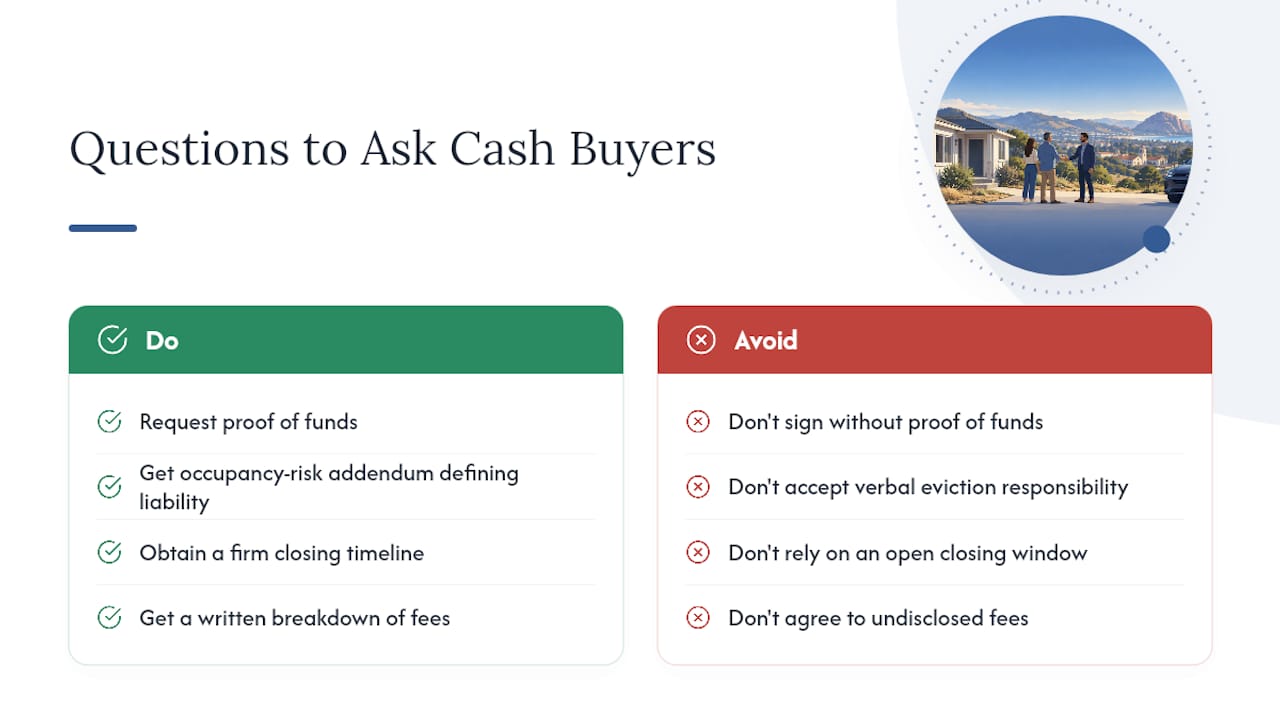
Before signing anything with any cash buyer, ask for proof of funds, an explicit occupancy-risk addendum spelling out who handles the eviction and when liability shifts, a firm closing timeline, and a written breakdown of any fees. This route tends to make the most sense when you have little equity to protect, foreclosure is closing in, or you simply need the situation resolved without months of court dates.
Local Tradeoffs Every SLO Owner Should Weigh
San Luis Obispo's tight housing market means even an occupied, as-is property draws buyer interest. For stressed sellers, speed usually beats squeezing out the last dollar. Document everything, disclose honestly, and choose the path that lets you sleep at night.
— Abel
Get a Cash Offer for Your Occupied Property
If you've read this far, you already know eviction and as-is sales both come with tradeoffs, court timelines on one side, a discount on the other. One option that skips both headaches is a fair cash offer on your home exactly as it sits, occupancy and all, with no repairs, no cleaning, and no agent commissions eating into your proceeds.

Getting started takes one call or a short form on our site. Have your basic ownership documents and any notices you've already served ready, and we'll walk you through what a cash offer looks like for your specific situation, usually within a day or two of reaching out. If you'd rather explore a traditional listing instead, that option may be available so you can compare both paths before deciding. Ready to see your number? Request your cash offer today, or browse our frequently asked questions to see exactly how the process works from start to finish.
This article is general information, not a substitute for advice from a qualified lawyer. Consult a qualified legal professional about your own circumstances before acting on anything here.
Sources
- California Code of Civil Procedure § 325 — LegInfo
- Unlawful Detainer / Evictions — Superior Court of California, County of San Luis Obispo
- Adverse possession in California — Von Rock Law
- Eviction information — California Courts Self-Help
- Sell house with squatters California — HomeHelpers Group
FAQ
Can You Kick Out a Squatter in California?
Yes, but only through the court system. You'll need to serve a Notice of Termination, then file an unlawful detainer with the San Luis Obispo Superior Court, where the occupant gets 10 business days to respond before you can pursue a writ of possession.
Can You Go to Jail for Squatting in California?
Squatting itself is typically handled as a civil matter through eviction, not criminal charges, though related conduct like trespassing or vandalism can carry criminal penalties. The core removal process still runs through unlawful detainer court, not law enforcement showing up to make an arrest.
Will Squatters Get Ownership After Living in a Property for 5 Years?
Almost never, because California law requires the occupant to prove they paid all property taxes for that entire five-year period, something squatters rarely do. Filing an eviction or serving written notice also interrupts the clock long before it becomes a real threat.
Why Is It So Expensive to Buy a House in San Luis Obispo?
Limited inventory and strong demand keep San Luis Obispo's median home price near $1.0 million, with homes typically selling within 36 to 39 days. That tight market is also why an occupied, as-is home still draws serious buyer interest instead of sitting unsold.
Are There Any Tiny Homes for Sale in San Luis Obispo?
Tiny home inventory shifts constantly and isn't something we track as part of our cash-offer business, which focuses on standard residential properties in any condition. If you're selling a smaller or unconventional property occupied by unauthorized occupants, the same eviction and as-is sale principles covered here still apply.