
Inheriting a house is generally not a taxable event for you as the beneficiary, and that surprises most people who assume the IRS is waiting with a bill. The bigger story is the step-up in basis: your tax basis in the house resets to its fair market value on the date the previous owner died, which often eliminates much of the capital gains tax if you sell soon after. Federal estate tax, if it applies, is owed by the estate itself, not by you — a key point explained in this wealth transfer planning guide.
TL;DR:
- The step-up in basis typically resets the property's value to its fair market value at the date of the decedent’s death, greatly reducing capital gains tax if sold soon after.
- Proper documentation, including an appraisal, probate records, and estate filings, is essential to prevent overpaying taxes or facing IRS disputes later.
- State estate and inheritance taxes can significantly impact heirs, especially in states with lower exemption thresholds or direct beneficiary taxes, requiring local legal advice.
- Moving in, renting, or selling the property each carry distinct tax implications, with primary residence exclusions applying only if ownership and use tests are met.
- Recording and reporting requirements, including timely filings and accurate basis calculations, are key to avoiding costly IRS penalties when selling or renting the inherited house.
Table of Contents
- Taxes on an Inherited House: Your First-Week Checklist
- Estate Tax, Inheritance Tax, Income Tax, and Capital Gains: Who Owes What
- How the Step-Up in Basis Actually Works
- State Estate and Inheritance Taxes You Need to Check
- Sell, Keep, or Rent: The Tax Trade-Offs of Each Path
- Records and Filings Heirs and Executors Need to Handle
- When to Bring in an Appraiser, CPA, or Estate Attorney
- Will Inheriting a House Raise Your Property Tax Bill?
- Inherited Mortgages, Liens, and Your Tax Obligations
- Primary Residence vs. Rental: Why the Tax Rules Diverge
- Deductions and Tax Breaks Available to Heirs
- An Editor's Take: The Documentation Gap That Costs Heirs Money
- Need to Sell an Inherited House Fast? Here's a Straightforward Option
- Where to Verify These Rules Yourself
- Sources
Taxes on an Inherited House: Your First-Week Checklist
Before you decide whether to sell, rent, or move in, lock down a few things that protect your tax position later. Skipping these steps is the single biggest reason heirs overpay when they eventually sell.
- Ask the executor about Form 706. Find out whether the estate is filing this federal estate tax return, and whether you're entitled to a Schedule A from Form 8971.
- Get a date-of-death appraisal. This documents fair market value and becomes your evidence if the IRS ever questions your basis.
- Gather the paper trail. Probate documents, the deed, and closing statements all matter once you sell or refinance.
- Decide your holding plan. Selling now, renting for a while, or moving in each carries a different tax outcome, so pick a direction early.
Estate Tax, Inheritance Tax, Income Tax, and Capital Gains: Who Owes What
People often lump these together, but they're four separate taxes with different rules and different payers.
- Estate tax is calculated on the decedent's total estate and paid out of estate assets before you receive anything. You're not personally on the hook for it.
- Inheritance tax doesn't exist at the federal level. A handful of states tax beneficiaries directly, and it depends on your relationship to the person who died.
- Income tax doesn't apply to the inheritance itself. The IRS is explicit that inherited property isn't reported as income on your return, though rent or dividends the house generates after you own it absolutely are taxable.
- Capital gains tax only shows up if you sell, and it's measured against your basis, which for inherited property usually means date-of-death value rather than what the decedent originally paid.
How the Step-Up in Basis Actually Works
This is the rule that saves most heirs from a painful tax bill, so it's worth understanding in plain terms. Your basis in an inherited house isn't what your parent or relative paid for it decades ago. Under IRS basis rules, it's the fair market value on the date they died, or on an alternate valuation date the executor may choose in limited cases.
If the estate files Form 706, the executor is required to furnish you a Schedule A showing the reported value, and that figure should match the basis you use. The instructions for Form 8971 exist specifically to keep the estate's reported value and your basis consistent, so the IRS doesn't see two different numbers for the same asset.
Pro Tip: Here's the math that makes this real. Say the house was worth $450,000 on the date of death and you sell it eight months later for $460,000. Your taxable gain is roughly $10,000, the appreciation that happened after death, not the $250,000 or more the property may have gained since your relative originally bought it.
A few things don't get this treatment:
- Retirement accounts. Inherited IRAs are treated as income in respect of a decedent, taxed as ordinary income when you take distributions.
- Jointly held property can have partial step-up rules depending on how title was held.
- Gifted property you received before death, as opposed to inherited, keeps the original owner's basis instead of stepping up.
State Estate and Inheritance Taxes You Need to Check
Federal rules are only half the picture. Some states layer their own estate tax on top, often with an exemption far lower than the federal threshold. A few states go further and tax beneficiaries directly through an inheritance tax, with the rate frequently tied to how closely you were related to the person who died.
Check two things, not just one:
- Where the decedent lived at the time of death, since that's usually what triggers state estate tax.
- Where the property sits, since real estate taxes often follow the location of the asset regardless of where the owner lived.
Distant relatives and unrelated beneficiaries tend to face the steepest inheritance tax rates in states that impose one, while spouses and children are often exempt or taxed at a lower rate. State rules shift often enough that your executor or a tax professional in that state is your most reliable source, not a general guide like this one.
Sell, Keep, or Rent: The Tax Trade-Offs of Each Path
The decision you make about the house shapes your tax bill more than almost anything else.
- Selling soon after death usually triggers little or no capital gains tax, since the stepped-up basis is close to the sale price. Selling costs, repairs, and market timing still eat into your net proceeds even when the tax bill is small.
- Moving in and living there only qualifies you for the $250,000 (or $500,000 for married couples) home-sale exclusion after you meet the ownership and use test, generally living there as your primary residence for two of the last five years.
- Renting it out first creates taxable rental income right away, and any depreciation you claim while renting can trigger depreciation recapture when you eventually sell, on top of the tax on appreciation that happened after the date of death.
Pro Tip: If you're weighing the rental route, run the numbers with a CPA before you list it for rent, because depreciation recapture has surprised more than one heir who assumed renting was the "safe" middle option. Anyone leaning toward renting first should also look at how rental property sales are taxed before committing.
Records and Filings Heirs and Executors Need to Handle
Good documentation now saves you a real headache at tax time. Here's who does what and when.
- Collect the essentials early: the date-of-death appraisal, deed, probate paperwork, closing statements, and Schedule A from the executor if Form 8971 applies.
- Executor's job: file the decedent's final personal tax return, and Form 706 if the estate's value requires it.
- Your job at sale time: report the transaction on Schedule D and Form 8949, using your stepped-up basis to calculate gain or loss.
- If you rented the property: keep rent ledgers, repair receipts, and depreciation schedules, plus proof of any period you lived there if you're claiming the personal-residence exclusion later.
Anyone managing the sale itself should also work through an inherited property sale checklist alongside these filings, since the paperwork for probate and for taxes tends to overlap.
When to Bring in an Appraiser, CPA, or Estate Attorney
Not every estate needs a full professional team, but certain triggers make it worth the cost.
- An appraiser is worth hiring whenever the property's value is significant or the family isn't in full agreement on what it's worth.
- A CPA should get involved for Form 706 coordination, basis questions, rental income accounting, or when you're ready to report a sale.
- An estate attorney earns their fee during probate disputes, title problems, contested wills, or when siblings need to buy each other out of a shared inheritance.
Will Inheriting a House Raise Your Property Tax Bill?
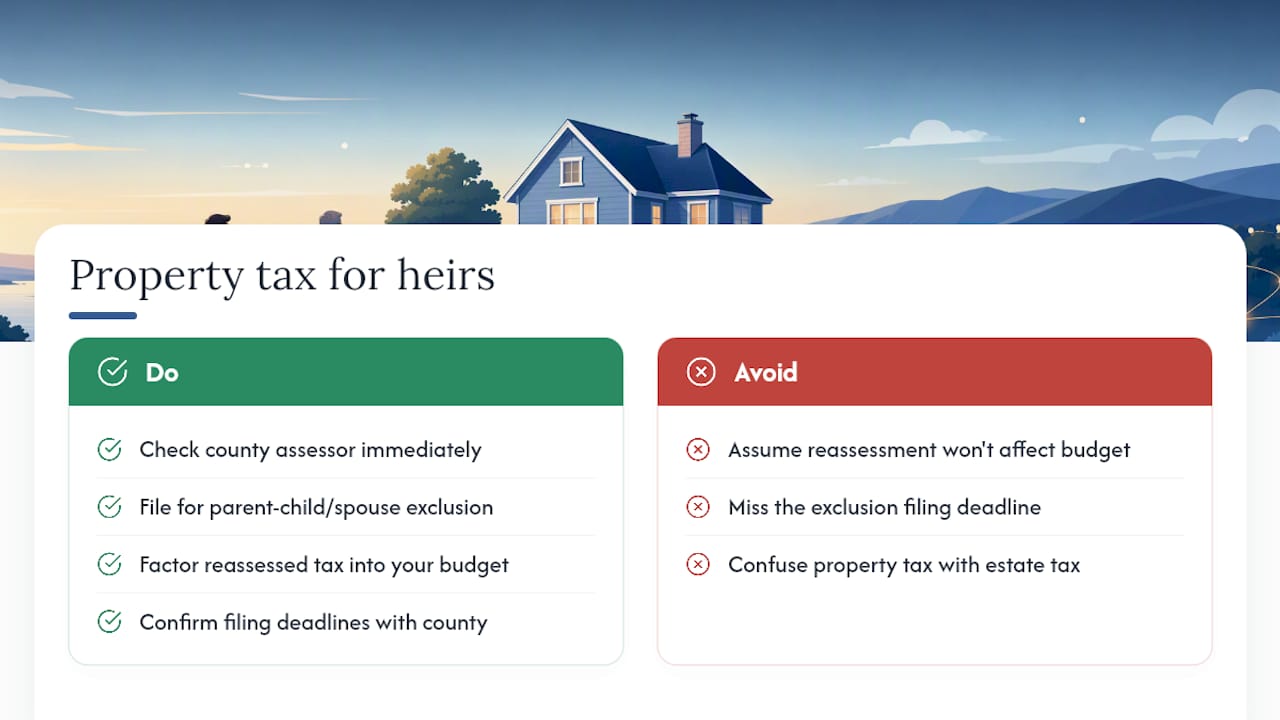
Inheriting a house can trigger a property tax reassessment, and this catches heirs off guard more than almost anything else on this list. Many counties reassess property at current market value when ownership transfers, which can push the annual property tax bill up sharply if the decedent had owned the home for decades under a lower assessed value.
Some states offer exclusions or exemptions for transfers between parents and children, or for a primary residence inherited by a spouse, but these rules vary widely by county and state and often come with strict filing deadlines. Missing the window to claim an exclusion can lock you into the higher reassessed value for as long as you own the property.
This is separate from any federal or state estate tax question. Property tax is a local, ongoing cost tied to owning the house year after year, not a one-time tax on the inheritance itself. If you're planning to hold the property for a while, whether to live in it or rent it, factor the post-reassessment tax bill into your budget before you commit. If you're planning to sell quickly, the reassessment may barely register since you won't own the house long enough to feel it.
Check with the county assessor's office where the property sits as soon as you can. Some jurisdictions require you to file a claim for an exclusion within a set number of months after the transfer, and there's no retroactive fix once that window closes.
Inherited Mortgages, Liens, and Your Tax Obligations
An inherited house often comes with an inherited mortgage, and federal law protects you here more than most people realize. Under the Garn St. Germain Act, lenders generally cannot call an entire mortgage due just because ownership passed through inheritance, which means you can typically keep making payments under the existing loan terms rather than refinancing immediately.
That mortgage balance doesn't change your basis calculation. Your stepped-up basis is based on the property's fair market value, not on what's still owed against it. Where the mortgage matters is in your net proceeds if you sell: the payoff amount comes off the top of the sale price, separate from any capital gains tax calculation.
Liens are a different problem entirely. Unpaid property taxes, contractor liens, or judgment liens attached to the house typically need to be satisfied before or at closing, and they don't disappear just because ownership changed hands. Title work during probate should surface these, but it's worth confirming directly with a title company before you list the property or accept an offer, since an unresolved lien can delay or derail a sale.
None of this changes whether you owe income tax on the inheritance itself. It does affect how much cash actually lands in your pocket after a sale, which matters just as much when you're deciding what to do with the property.
Primary Residence vs. Rental: Why the Tax Rules Diverge
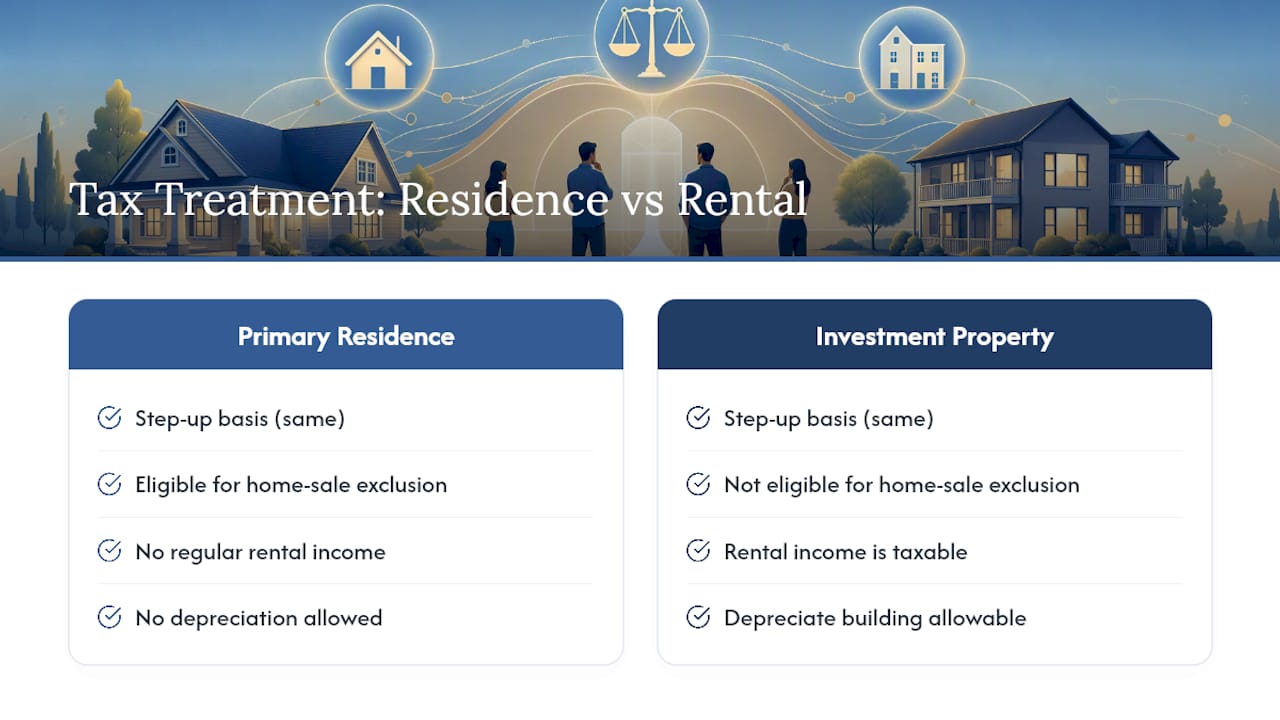
How you use an inherited house after you receive it changes the tax rules that apply from that point forward, even though your starting basis is identical either way.
Move in and make it your primary residence, and you're on a path toward the home-sale exclusion, provided you meet the ownership and use test of living there for a sufficient time before selling. That exclusion can shield a substantial amount of gain for a single filer or a married couple, on top of whatever protection the step-up in basis already gave you.
Treat it as investment property instead, whether you rent it out or hold it vacant, and different rules kick in. Rental income is taxable as it comes in. You can depreciate the building, which lowers your taxable rental income year to year, but that depreciation gets recaptured and taxed when you eventually sell. There's no home-sale exclusion available for a property you never lived in as your primary residence.
Heirs sometimes try to split the difference, living in the house briefly before renting it or vice versa. That's workable, but the timeline matters for which tax treatment applies, so track dates carefully and talk to a CPA before assuming you qualify for the exclusion. Owners dealing with a rental that also needs repairs sometimes find it simpler to sell the rental property outright rather than manage both tenants and tax complexity at once.
Deductions and Tax Breaks Available to Heirs
A few tax breaks are worth knowing about, even though inheriting a house itself doesn't hand you a specific tax credit.
The step-up in basis is, functionally, the biggest tax benefit you get, since it can eliminate most of the capital gains tax that would otherwise apply if the house had appreciated over decades under the original owner's basis. If you sell, ordinary selling costs, real estate commissions, transfer taxes, and certain repairs made specifically to prepare the house for sale can reduce your taxable gain, so keep every receipt.
If you rent the property before selling, standard rental deductions apply just as they would for any landlord: mortgage interest, property taxes, insurance, maintenance, and depreciation all offset your rental income. If you move in and later sell after meeting the occupancy test, the home-sale exclusion functions like a deduction against your gain, potentially eliminating your capital gains tax bill entirely on top of whatever the step-up already erased.
There's no special federal tax credit that exists purely because a property was inherited rather than purchased. The benefit comes from basis and timing, not from a line-item credit on your return, which is exactly why the decisions you make in the first few months matter so much.
An Editor's Take: The Documentation Gap That Costs Heirs Money
The tax rules around inherited property aren't actually the hard part. Most heirs lose money not because they misunderstood capital gains or missed a filing deadline, but because nobody got a proper date-of-death appraisal, and by the time the IRS or a title company asks for one, the moment has passed and the estimate is a guess dressed up as a fact.
I've watched families spend more arguing over what the house was "probably worth" than a $400 appraisal would have cost them to settle for good. Get the appraisal early, keep every probate document in one folder, and treat Schedule A from the executor as something you actually read rather than file away. Every estate has its own wrinkles, joint ownership, contested wills, out-of-state property, so none of this replaces a conversation with a CPA or estate attorney once your situation gets even slightly complicated.
— Abel
Need to Sell an Inherited House Fast? Here's a Straightforward Option
If the tax picture is clear and you've decided selling makes the most sense, the next question is usually how fast you can actually close, especially if the estate has bills, a mortgage payment, or multiple heirs waiting to settle up.

A local home buyer purchases houses in various conditions, often offering cash with no repairs, cleaning, or agent commissions required. This can be useful for heirs facing probate delays, a house needing significant repairs, or family members wanting to settle the estate without lengthy showings and negotiations. Before you sign anything, talk to a tax professional about your specific basis and gain, since this is a selling option, not tax advice. When you're ready to see what your inherited property is worth, get a cash offer on your San Luis Obispo home and get a real number in hand within days.
Where to Verify These Rules Yourself
The tax rules here come directly from IRS guidance, and it's worth reading the primary sources before you file anything.
- IRS FAQs on Gifts & Inheritances for the basics on step-up in basis and why inherited property isn't taxable income.
- Instructions for Form 8971 and Schedule A for how executors report estate values to beneficiaries.
- IRS Publication 551, Basis of Assets for the detailed mechanics of date-of-death valuation.
- Estate tax FAQs for the current federal exemption threshold and who owes the tax.
This article is general information, not a substitute for advice from a qualified financial advisor. Consult a qualified financial professional about your own circumstances before acting on anything here.
Sources
- Gifts & inheritances | Internal Revenue Service
- Frequently asked questions on estate taxes | Internal Revenue Service
- Instructions for Form 8971 and Schedule A (Rev. August 2025)
- Publication 551, Basis of Assets — Internal Revenue Service