Most "we buy houses" companies are legitimate businesses, not scams, but the industry does attract bad actors who prey on stressed sellers. The speed and convenience of a cash sale come at a price: offers typically run below retail value. Before you sign anything, demand proof of funds, insist on an independent title company, and get a real estate attorney to review the contract.
TL;DR:
- Verify proof of funds, insist on an independent escrow and title company, and have a legal review before signing any deal with a cash buyer.
- Be cautious of high-pressure tactics, requests for upfront payments, or buyers who cannot produce proof of funds, as these are common scam indicators.
- Understand that reputable cash buyers provide clear explanations of their offer, and can accommodate your timeline while allowing you to choose your own closing vendor.
- Selling for cash typically results in lower offers than retail value, but provides faster closing, no repair costs, and suits urgent situations like foreclosure or major repairs.
- Tax implications of a cash sale mirror traditional sales, with exclusions possible if you’ve lived in the home, and it’s crucial to document costs and seek tax advice before closing.
Table of Contents
- Is "We Buy Houses" a Scam, or a Real Business Model?
- What Are the Red Flags of a Cash Home Buyer Scam?
- How Do You Vet a Cash Buyer Before You Sign Anything?
- Do You Still Have to Disclose Defects in an "As-Is" Cash Sale?
- Is Selling for Cash Worth It, or Should You List Traditionally?
- How Does a Reputable Local Cash Buyer Actually Protect Sellers?
- The Bottom Line on Vetting a Cash Buyer
- What Are the Tax Implications of a Cash Home Sale?
- A Local Buyer's Take on Trust in This Industry
- Ready to Sell Your San Luis Obispo Home for Cash? Here's How
- Where to Verify These Warnings Yourself
- Sources
Is "We Buy Houses" a Scam, or a Real Business Model?
The confusion is understandable. The same yard signs and "sell your house fast" postcards that legitimate investors use are also copied word for word by con artists chasing deed theft or upfront-fee schemes. The business model itself, buying homes as-is for cash and reselling or renting them, is completely legal and fills a real need for people who can't wait out a traditional listing.
Cash buyers fall into a few distinct categories, and knowing which one you're dealing with tells you a lot about what to expect.
- Franchise cash buyers operate under a recognizable national brand but are usually run by local, independently owned offices. Offers follow a formula based on comparable sales, and closing typically takes about one to three weeks.
- Local flippers buy, renovate, and resell. They tend to know your specific neighborhood well and can often move faster than a franchise because there's no corporate approval chain.
- Wholesalers (assignors) don't plan to close on your home at all. They lock in a purchase contract at a low price, then sell, or "assign", that contract to another investor for a fee before closing ever happens.
- iBuyers are large, tech-driven companies that generate offers through automated valuation models. They're transparent about pricing but often charge service fees comparable to a traditional agent commission.
The tell that separates these types fastest is whether a buyer can produce proof of funds or a bank letter on request. Wholesalers frequently can't, because they're not the ones actually paying for your house.
What Are the Red Flags of a Cash Home Buyer Scam?
Scammers rely on urgency and confusion. If you notice any of the following, slow down before you sign anything.
- Pressure to sign today. A legitimate buyer gives you room to think it over and consult an attorney. Federal guidance on real estate investment scams notes that manufactured urgency is one of the most consistent warning signs across fraud cases.
- Requests for upfront money. You should never pay an application fee, a "processing fee," or anything else to sell your own house. Money should flow to you, not from you.
- Weak or missing proof of funds. If a buyer hedges when asked to show they can actually close, that hesitation is the answer.
- Requests to sign the deed before closing. Some foreclosure-rescue scams ask homeowners to transfer title "temporarily" while promising to lease the home back. The North Carolina Department of Justice's warning on these schemes documents cases where the original owner stayed legally liable for a mortgage on a house they no longer controlled.
- Buried assignment or price-reduction clauses. These let a buyer transfer your contract to someone else or renegotiate your price after inspection, often deep in the fine print.
- A title company the buyer insists on, with no room for questions. A trustworthy buyer never objects to you choosing your own closing agent.
Reporters at ProPublica documented cash-buyer franchisees using high-pressure sales tactics against vulnerable sellers, tactics that, in some cases, weren't illegal but were clearly predatory. That's the uncomfortable truth of this industry: legal and ethical aren't always the same thing.
Pro Tip: Ask point blank, "Are you buying this house with your own funds, or do you plan to assign this contract to someone else?" Get the answer in writing. A wholesaler who won't answer directly is telling you something.
How Do You Vet a Cash Buyer Before You Sign Anything?
Roughly 30% of home purchases nationally involve cash, so you're not dealing with a fringe market. You're dealing with a large one that includes plenty of legitimate operators alongside a smaller number of opportunists. Vetting takes maybe an hour and it's the single best insurance policy you have.
- Ask directly whether the buyer intends to close personally or assign the contract, and get a written yes on which one it is.
- Require proof of funds or a bank letter, and insist on a real earnest money deposit, typically 1 to 3% of the purchase price, held in independent escrow rather than paid directly to the buyer.
- Check the company's state business registration, its Better Business Bureau profile, and its Google reviews. A buyer with three years of purchase history behind them is a different bet than one that registered its LLC last month.
- Use an independent title or escrow company for closing, and be wary if the buyer pushes hard for their own "preferred" vendor with no room for you to choose otherwise.
- Get a real estate attorney to read the purchase contract before you sign. This is worth the cost every single time.
- If anything feels off after you've asked these questions, stop. Contact your state's consumer protection office or a legal aid organization before moving forward.
A buyer who explains clearly how they arrived at their offer number, factoring in repairs, holding costs, and resale risk, is showing you good practice, not a weakness in their pitch. Vagueness about the math is a bigger warning sign than a low number itself. For a closer look at what happens between contract and closing day, this closing process checklist walks through each step.
Do You Still Have to Disclose Defects in an "As-Is" Cash Sale?
Yes, and this trips up more sellers than almost anything else in the process. "As-is" means the buyer isn't asking you to fix anything before closing. It does not mean you're released from telling them what's wrong with the house.
Seller disclosure laws generally require you to reveal known material defects, foundation cracks, past flooding, lead paint, mold, regardless of how the sale is structured. Skip that step and a buyer can come after you with a lawsuit or a demand to unwind the deal after closing, even in a fast cash transaction. This as-is home sale checklist breaks down exactly what needs to be disclosed and what doesn't.
A few other legal essentials worth locking down before you sign:
- State consumer-protection offices maintain complaint channels specifically for real estate scams. It's worth a quick check before you commit to an unfamiliar buyer.
- Unpaid liens, back taxes, or a clouded title can derail a sale even after you've agreed to terms, which is exactly why an independent title search matters.
- If you suspect fraud at any point, save every email and text, and get legal counsel involved immediately rather than waiting to see how things unfold.
Is Selling for Cash Worth It, or Should You List Traditionally?
Speed and simplicity are the real product here, not necessarily the highest price. Weighing the two paths honestly means putting numbers next to both.
| Factor | Cash sale | Traditional listing |
|---|---|---|
| Typical closing time | about one to three weeks | 30 days |
| Repairs required | None | Often needed to compete on market |
| Agent commission | None | Typically 5 to 6% of sale price |
| Sale price vs. retail | Typically below retail value | Full market value, condition-dependent |
| Buyer pool | Single buyer, no bidding | Multiple potential buyers |
| Best fit | Foreclosure risk, inherited property, major repairs, urgent relocation | Sellers with time, a move-in-ready home, and no urgency |
The math that actually matters isn't the offer number by itself. It's the offer minus the commissions, repair costs, and carrying costs (mortgage, insurance, taxes) you'd otherwise pay while a traditional listing sits on the market. For someone facing foreclosure, a cash sale that closes in two weeks can be worth far more than a higher offer that might not survive financing or inspection contingencies.
How Does a Reputable Local Cash Buyer Actually Protect Sellers?
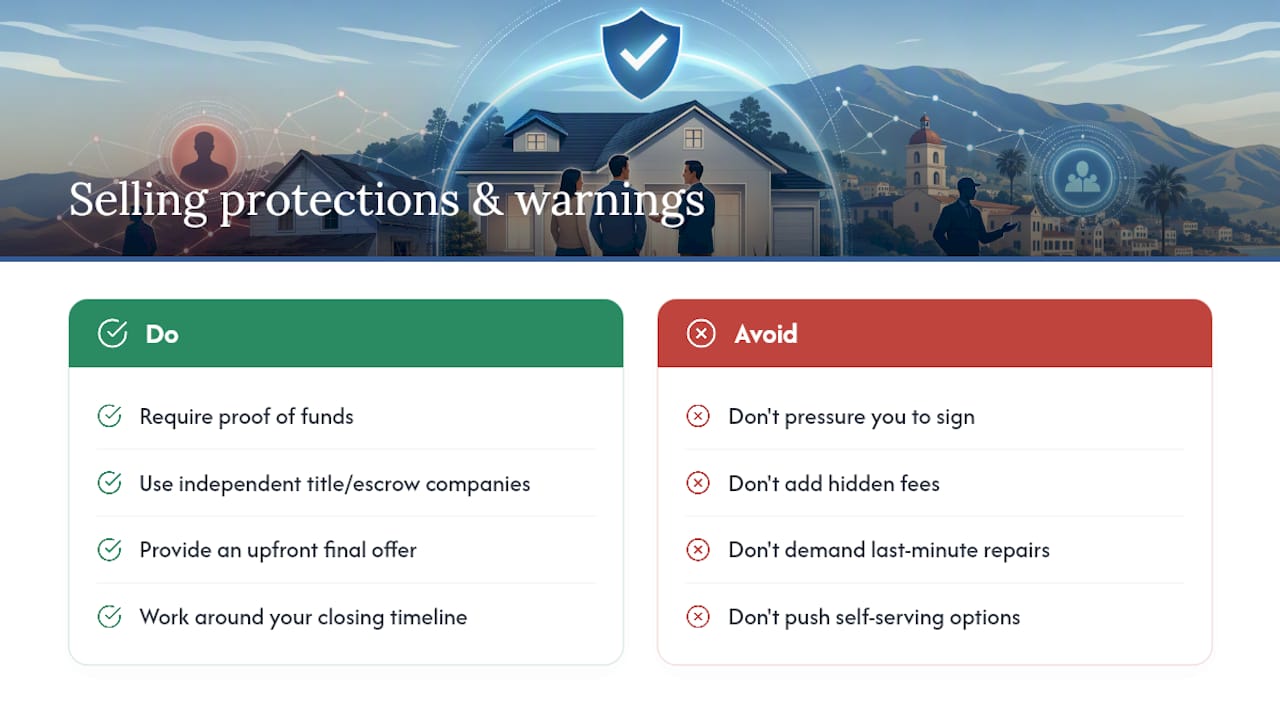
What separates a trustworthy buyer from a risky one usually shows up in the process, not the pitch. SLO Cash Buyer - San Luis Obispo County Home buyer purchases homes as-is, meaning no repairs, no cleaning, and no staging is required before an offer goes out. There are no hidden fees added at closing, and the cash offer presented upfront is the number sellers should expect to see again at the closing table.
On the protection side, that looks like:
- Proof of funds provided without a seller having to ask twice.
- Closings handled through independent, seller-approved title and escrow companies rather than a buyer-controlled vendor.
- Clear, flexible closing timelines set around the seller's actual situation, not a rushed deadline designed to limit their options.
- An optional path to list with a licensed agent instead, for sellers who decide top-dollar value matters more than speed.
This approach tends to serve people facing foreclosure, managing an inherited property from out of state, dealing with repairs they can't afford, or simply needing to relocate on short notice.
Pro Tip: Any buyer worth working with should welcome you bringing in your own attorney and title company. If a buyer resists that, treat it as your answer.
The Bottom Line on Vetting a Cash Buyer
Most companies advertising "we buy houses" are exactly what they claim to be: real buyers offering a faster, lower-hassle alternative to a traditional sale. The minority that aren't tend to give themselves away through pressure tactics, vague answers about funding, and reluctance to let you choose your own title company.
Three things to do before you sign anything: verify proof of funds in writing, insist on an independent escrow and title company, and have an attorney review the contract for assignment or price-reduction clauses. If a buyer resists any of these three requests, that's not a negotiating tactic on your end. It's a reason to walk. If red flags pile up, contact your state's consumer protection office or a legal aid organization before you go any further.
What Are the Tax Implications of a Cash Home Sale?
Selling for cash doesn't change your tax situation compared to a traditional sale, the IRS taxes the transaction the same way regardless of how the buyer paid for it. What matters is whether the sale produces a taxable capital gain.
If the home was your primary residence for at least two of the last five years, you can typically exclude up to $250,000 of gain if you're single, or $500,000 if you're married filing jointly. Inherited properties get a different treatment: your cost basis usually steps up to the home's fair market value at the time of the previous owner's death, which often shrinks or eliminates taxable gain if you sell soon after inheriting.
Sellers facing foreclosure should know that a cash sale that pays off the mortgage in full generally avoids the tax complications tied to a short sale or foreclosure, where forgiven debt can sometimes count as taxable income.
A few things worth doing before you close:
- Pull your original purchase records and any capital improvement receipts. They raise your cost basis and lower your taxable gain.
- Ask your closing agent for a copy of the settlement statement. You'll need it at tax time regardless of how quickly the deal closed.
- Talk to a tax professional or CPA about your specific situation, especially with inherited property or a home you've owned less than two years, before you assume you owe nothing.
A Local Buyer's Take on Trust in This Industry
The cash-buying industry doesn't have a trust problem because most buyers are dishonest. It has a trust problem because the bad actors are loud and the good ones rarely explain their process. A legitimate buyer isn't afraid of scrutiny. Proof of funds, independent escrow, a contract an attorney can review freely, none of that threatens a fair offer. It only threatens someone trying to hide something.
The sellers who get burned usually aren't naive. They're just in a hurry, and hurry is exactly what scammers exploit.
— Abel
Ready to Sell Your San Luis Obispo Home for Cash? Here's How
If you've made it this far, you already know what separates a trustworthy cash buyer from a risky one: proof of funds, independent escrow, no pressure to sign before you're ready. SLO Cash Buyer - San Luis Obispo County Home buyer is built around exactly those protections, so you're not choosing between speed and safety.

The offer we give you upfront is the number you see at closing. No hidden fees, no last-minute repair demands, no pressure to sign anything before your attorney has reviewed it. We handle closings through independent title companies of your choosing, and we work around your timeline, whether that's two weeks or two months. If a traditional listing with a licensed agent makes more sense for your situation, we'll tell you that too, instead of pushing you toward the option that benefits us most.
Getting started is simple: share a few details about your property, and we'll walk you through the proof-of-funds process and give you a clear closing timeline before you commit to anything. If foreclosure, an inherited property, or major repairs are pushing you toward a fast sale, visit SLO Cash Buyer to see what a straightforward cash offer looks like for your home. You can also review our property buyer guidance or see how a cash sale can stop foreclosure before auction if time is the pressure you're facing.
Where to Verify These Warnings Yourself
Don't take any of this on faith, including from us. These sources let you check the claims directly and file a complaint if you ever need to.
- North Carolina Department of Justice: "We Buy Homes" Scams, for real examples of deed theft and foreclosure-rescue schemes.
- ProPublica's investigation into cash-buyer practices, documenting predatory tactics used against vulnerable sellers.
- FTC guidance on spotting real estate investment scams, a plain-language rundown of common pressure tactics.
- Conventus Law's legal primer on selling to cash investors, covering assignment clauses and contract traps in detail.
- Diamond Home Buyers' guide to spotting cash buyer scams, for another practical vetting comparison.
Sources
- Want to Sell Your Home for Cash? Read This First — ProPublica
- “We Buy Homes” Scams — North Carolina Department of Justice
- How to spot real estate investment scams — Federal Trade Commission (FTC)