
The fastest way to avoid carrying two mortgage payments during a relocation is to time a simultaneous close, secure bridge financing backed by solid preapproval, or sell directly to a cash buyer. Each path works — the right one depends on your timeline, cash reserves, and how much financial risk you can absorb.
Your three immediate options:
- Sell first, then rent back. Close on your current home, negotiate a rent-back agreement for up to 60 days, and use that window to find and close on your next home.
- Buy first with bridge financing. Get fully preapproved, then use a bridge loan or HELOC to fund the down payment on your new home before your current one sells.
- Sell to a cash buyer. A cash sale can close in 1–2 weeks, compared to 30–60 days for a traditional listing, which nearly eliminates timing overlap.
Three things you can do today: call your lender about preapproval and HELOC eligibility, ask your agent about simultaneous-close experience, and contact SLO Cash Buyer - San Luis Obispo County Home buyer for a no-obligation cash-offer evaluation if your timeline is tight.
Key Takeaways
Selling first or timing a simultaneous close are the highest-probability ways to avoid dual mortgage payments during relocation, with cash sales offering the fastest exit when timing is the binding constraint.
| Point | Details |
|---|---|
| Sell first to protect cash flow | Selling before buying removes financial overlap risk, though it may require short-term housing. |
| Open a HELOC before listing | HELOC approval takes 2–6 weeks and most lenders won't approve one once your home is listed. |
| Bridge loans are short-term tools | Most lenders expect bridge loan repayment within 6–12 months, funded by your sale proceeds. |
| Cash sales close in 1–2 weeks | A cash sale nearly eliminates timing overlap compared to a standard 30–60 day traditional sale. |
| SLO Cash Buyer for urgent timelines | SLO Cash Buyer - San Luis Obispo County Home buyer offers as-is cash purchases in San Luis Obispo County with no fees and fast closings. |
Table of Contents
- How do you decide: buy first or sell first?
- What financing options prevent long-term dual mortgage burden?
- What contract tactics reduce the risk of overlapping payments?
- A practical timeline to synchronize selling and buying
- Short-term housing options if you sell before buying
- When does a cash sale make the most sense?
- How do you prepare your home to sell fast?
- Questions to ask lenders, agents, and cash buyers
- What the right path actually looks like for each homeowner
- SLO Cash Buyer - San Luis Obispo County home buyer: skip the timing risk entirely
- Sources
How do you decide: buy first or sell first?
Your finances and risk tolerance answer this question faster than any general rule.
Buy first gives you flexibility. You move on your schedule, avoid temporary housing, and don't feel rushed into accepting a low offer on your current home. The cost is real: you may carry two mortgage payments for weeks or months, and lenders will scrutinize your debt-to-income ratio (DTI) carefully. According to Rocket Mortgage, getting fully preapproved before you buy is non-optional here — lenders need to see that you can handle temporary dual payments.
Sell first protects your cash flow. You know exactly what proceeds you have before committing to a purchase price, which removes most financial guesswork. The trade-off is housing uncertainty: you may need short-term rentals, a rent-back arrangement, or a stay with family while you search.
Ask yourself these three questions before choosing:
- Can you cover two mortgage payments for 60–90 days without financial strain?
- Do you need sale proceeds to fund your down payment on the next home?
- Is your job-start date fixed, or do you have flexibility in your move window?
| Scenario | Buy First | Sell First |
|---|---|---|
| Tight cash flow | High risk | Lower risk |
| Needs sale proceeds for down payment | Difficult without bridge financing | Natural fit |
| Fixed relocation deadline | Possible with bridge loan | Requires fast sale |
| Employer relocation package available | Feasible | Feasible |
| Flexible timeline | Good fit | Good fit |
If your employer offers a relocation package, ask specifically whether it covers temporary housing or bridge-loan costs — that changes the math significantly.
What financing options prevent long-term dual mortgage burden?
Short-term financing tools exist precisely for this gap. Each one has real trade-offs worth understanding before you commit.
Most lenders expect repayment within 6–12 months. Rates are higher than a standard mortgage, and fees add up, but the structure is clean: you borrow, you buy, you sell, you repay. The Fidelity guide on buying and selling simultaneously notes that bridge loans are designed as temporary instruments, not long-term solutions.
HELOCs typically carry lower rates than bridge loans, but timing is critical. Most lenders will not approve a HELOC once your home is listed for sale, so you need to open one before you list. Approval can take 2–6 weeks, sometimes longer. Factor that lead time into your plan.
401(k) loans are worth considering if you need down-payment funds quickly. Many lenders do not count a 401(k) loan as consumer debt for DTI calculations, which can make qualifying easier. The risk: if you leave your job or miss repayments, the outstanding balance may be treated as a taxable distribution with penalties.
Mortgage recasting is a quieter option. After your current home sells, you apply a lump sum of the proceeds to your new mortgage's principal, and the lender recalculates your monthly payment based on the lower balance. It costs far less than refinancing, but not all lenders offer it, and FHA, VA, and USDA loans are excluded.
Questions to ask your lender before choosing:
- What is your bridge-loan LTV cap and current rate?
- Will you approve a HELOC before I list my home?
- How do you treat a 401(k) loan in my DTI calculation?
- Do you offer mortgage recasting, and what are the minimum lump-sum requirements?
Pro Tip: Open a HELOC before you list your home. Once it's on the market, most lenders will freeze or deny the application. A pre-listing HELOC gives you a funding line ready to use without the higher cost of a bridge loan.
What contract tactics reduce the risk of overlapping payments?
The right contract language can do as much work as the right financing.

Home sale contingencies let you make an offer on a new home contingent on selling your current one first. Sellers in competitive markets often reject these, but in a slower market or with a motivated seller, they are a reasonable ask. A financing contingency on your purchase side protects you if your lender's approval changes after your current home's sale falls through.
Simultaneous closings coordinate both transactions to close on the same day, using proceeds from the sale to fund the purchase. This requires tight coordination between two title companies, two lenders, and both agents. The most common failure point is a wire delay or a last-minute lender condition. Read more about how this works in practice in this guide to simultaneous closing.
Rent-back agreements let you stay in your sold home for a negotiated period, often up to 60 days after closing. You pay the buyer a daily rate, typically tied to their new mortgage cost, and you get time to close on your next home without rushing. The risk is real: any damage during the rent-back period can create disputes, so get the terms in writing with a clear security deposit clause.
Negotiate your settlement date as a window, not a fixed day. Ask for a 5–10 day settlement window in your contract so that if one closing slips by 48 hours, you are not automatically in breach. An experienced agent can draft this language in a way most buyers and sellers will accept.
Pro Tip: Ask your agent for a rent-back addendum template before you list. Having the language ready speeds negotiation and signals to buyers that you are organized and serious.
A practical timeline to synchronize selling and buying
| Action | Typical Lead Time |
|---|---|
| Get mortgage preapproval | 1–3 business days |
| Open HELOC (before listing) | 2–6 weeks |
| List home and accept offer | 1–4 weeks |
| Standard sale closing | 30–60 days from contract |
| Cash sale closing | 1–2 weeks from offer |
| Bridge loan approval | 1–3 weeks |
| Rent-back period (if negotiated) | Up to 60 days post-close |
Milestone checklist for a 30–90 day relocation window:
- Get preapproved and confirm your DTI with two mortgages temporarily.
- Open a HELOC before listing your current home.
- Price your home competitively and list with an agent experienced in fast sales.
- Negotiate a settlement-date window and rent-back option in your sale contract.
- Make an offer on your new home with a simultaneous-close or contingency clause.
- Coordinate title companies and lenders to align both closing dates.
- Confirm wire transfer timing 48 hours before each closing.
Short-term housing options if you sell before buying
Selling first is the lower-risk financial path, but it requires a housing plan for the gap period. Here are your main options and what each one actually costs you:
- Rent-back from your buyer. The most convenient option if your buyer agrees. You stay put, avoid moving twice, and buy time to close on your next home.
- Short-term rental or month-to-month lease. Flexible but often priced at a premium. Expect to pay above standard market rent for the flexibility, plus a possible double-move cost.
- Extended-stay hotels. Practical for solo movers or couples for a few weeks. Costs add up quickly for families or longer gaps.
- Friends or family. Free or low-cost, but plan your timeline carefully to avoid overstaying goodwill.
- Storage unit for furniture. Budget $100–$300 per month for a standard unit, plus the cost of a second move when you close on your new home.
For a detailed look at selling fast and managing the gap, the sell-home-fast-for-relocation guide covers short-term housing and rent-back negotiation in depth.
When does a cash sale make the most sense?
A cash sale is the clearest path to avoiding dual mortgages when timing is the binding constraint. Consider it seriously if any of these apply:
- Your job start date is within 30 days and a traditional listing won't close in time.
- You cannot qualify for a bridge loan or HELOC due to credit, equity, or income issues.
- Your home needs significant repairs you cannot fund before listing.
- You are facing foreclosure and need to close before a sale date.
Cash sales can close in 1–2 weeks, which removes the timing overlap almost entirely. The trade-off is net proceeds: a cash buyer typically offers below full market value in exchange for speed, certainty, and an as-is purchase with no fees or agent commissions.
Before accepting any cash offer, run through this checklist:
- What are the net proceeds after all fees?
- Is there a proof-of-funds letter available immediately?
- Are there any hidden fees or post-sale obligations?
- What is the exact closing timeline, and is it guaranteed?
SLO Cash Buyer - San Luis Obispo County Home buyer purchases homes as-is in San Luis Obispo County with no repair requirements, no agent fees, and a fast close. For homeowners who need certainty over maximum price, that combination removes the dual-mortgage risk entirely. See the home closing process checklist for what to expect at each step.
How do you prepare your home to sell fast?
Speed and buyer appeal, not perfection, are the goals here.
- Declutter every room and remove personal items so buyers can picture themselves in the space.
- Deep clean, including windows, baseboards, and appliances.
- Address curb appeal: fresh mulch, trimmed shrubs, and a clean front door cost little and matter a lot.
- Apply neutral touch-up paint where walls are scuffed or marked.
- Fix any safety issues (loose railings, broken steps, non-functioning smoke detectors) that could flag on inspection.
Work with your agent on a rapid-sale pricing strategy from day one rather than testing a higher price and reducing later. The quick home sale timeline guide walks through each seller action in sequence.
If repairs are not feasible, skip the prep work entirely and go the as-is cash-sale route. You trade some proceeds for speed and certainty, which is often the right call under a tight relocation deadline.
Pro Tip: Schedule professional photography before your first showing, not after. Listings with quality photos generate more early interest, which compresses your time on market.
Questions to ask lenders, agents, and cash buyers
For your lender:
- How do you calculate my DTI if I still carry my current mortgage at closing?
- Can I open a HELOC before I list, and how long does approval take?
- Do you offer bridge loans, and what are your LTV cap and rate?
- Does your loan program allow mortgage recasting after I apply sale proceeds?
For your agent:
- Have you coordinated simultaneous closings before, and how do you handle wire-delay risk?
- Do you have a rent-back addendum template ready to use?
- How do you negotiate a settlement-date window rather than a fixed date?
- What is your average days-on-market for homes priced to sell quickly?
For a cash buyer:
- Can you provide a proof-of-funds letter today?
- What fees, if any, come out of my proceeds at closing?
- Is your closing timeline guaranteed, or is it an estimate?
- What happens if I need to stay in the home for 2–3 weeks after closing?
What the right path actually looks like for each homeowner
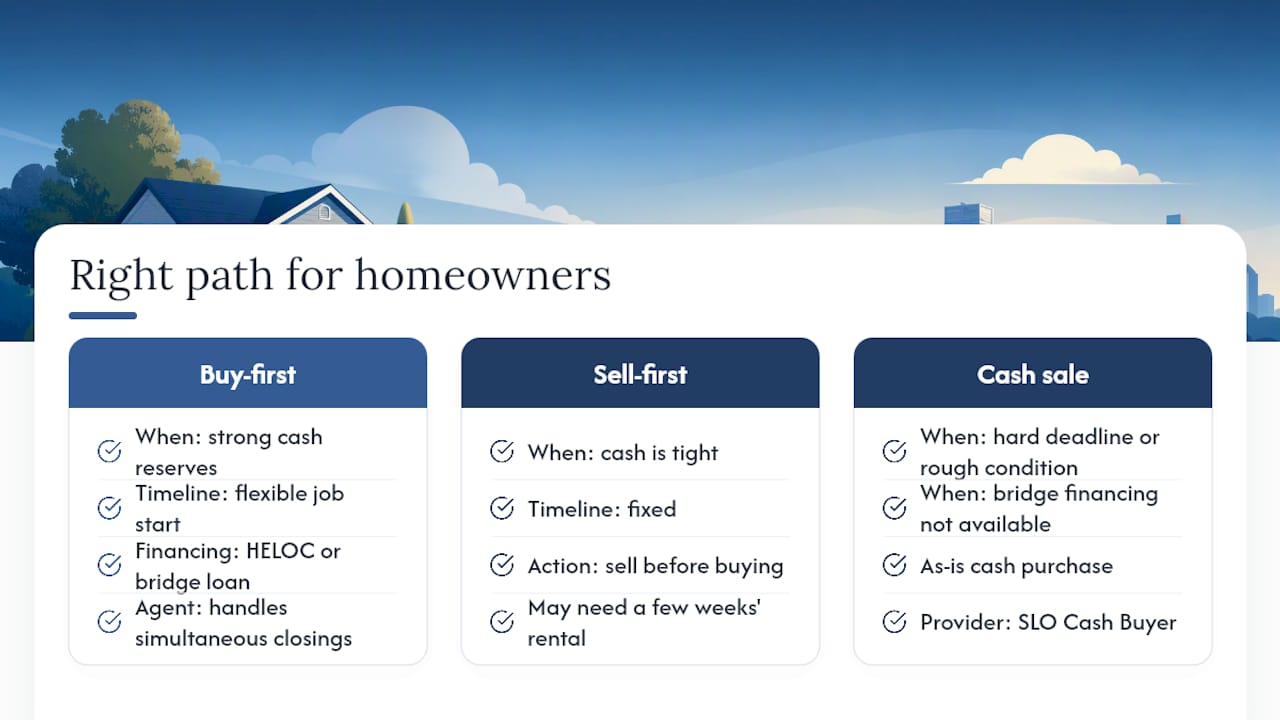
Most homeowners overthink the buy-first vs. sell-first decision and underthink the contract language. If you have strong cash reserves and a flexible job start, buying first with a HELOC or bridge loan is workable — but only if your agent is experienced with simultaneous closings and your lender has confirmed your DTI holds up. If cash is tight or your timeline is fixed, selling first is almost always the safer call, even if it means a few weeks in a short-term rental.
For homeowners in San Luis Obispo County who are facing a hard deadline, a home in rough condition, or a situation where bridge financing simply is not available, a cash sale through SLO Cash Buyer - San Luis Obispo County Home buyer is the most reliable way to close the gap. The speed and certainty of an as-is cash purchase remove the timing risk that causes most dual-mortgage situations in the first place. When the numbers on a traditional sale work and the timeline is flexible, work with lenders and agents to align closings. When they do not, call us.
SLO Cash Buyer - San Luis Obispo County home buyer: skip the timing risk entirely
Relocating under a tight deadline and worried about carrying two payments? SLO Cash Buyer - San Luis Obispo County Home buyer buys homes as-is in San Luis Obispo County for cash, with no repairs, no agent fees, and no drawn-out negotiations. While a traditional sale takes 30–60 days to close, we can often close in a matter of weeks, which means your current mortgage is paid off before your new one starts.

This is the practical alternative when bridge financing is out of reach, your home needs work you cannot fund, or your job start date simply will not wait. We handle the details, you get a fair cash offer and a clear closing date. Visit SLO Cash Buyer to request your no-obligation cash offer today and find out how fast we can close on your timeline.
Sources
- How to buy and sell a home at the same time | Rocket Mortgage
- Selling Your House for a Job Relocation: A Complete Guide - Redfin
- Fidelity: Buying and selling a house at the same time
For an immediate cash-offer evaluation in San Luis Obispo County, visit SLO Cash Buyer.
This article is general information, not a substitute for advice from a qualified financial advisor. Consult a qualified financial professional about your own circumstances before acting on anything here.