
Yes, you can usually sell your house during bankruptcy, but the sale is conditional, not automatic. Chapter 7 lets a trustee force a sale only when nonexempt equity exists; Chapter 13 requires a formal motion under 11 U.S.C. § 363 that can reshape your repayment plan. Before you list your home or sign anything, talk to your bankruptcy attorney. That one call determines whether you're free to move forward or need court approval first.
TL;DR:
- Selling your home during bankruptcy depends on your equity and whether the trustee abandons it or requires a sale to pay creditors.
- Court approval is required for sales during Chapter 13, with motions needing detailed documentation, valuation evidence, and proper notice to creditors.
- Selling just before filing risks allegations of fraudulent transfers unless you document fair value, use proceeds for exemptions, and maintain thorough records.
- Nonexempt equity left after legal exemptions gets allocated to creditors or your repayment plan, which influences how much you may retain from the sale.
- Using cash buyers in urgent situations can streamline sales, avoid financing delays, and help meet court deadlines when timing is critical.
Table of Contents
- Selling a House During Chapter 7 Bankruptcy
- Selling Your Home During Chapter 13 Bankruptcy
- Red Flags of Selling Before You File
- Filing the Motion to Sell: What Courts Expect to See
- How Sale Proceeds Get Divided
- Timeline and Checklist for Sellers
- Practitioner Notes on Fast Bankruptcy Sales
- Listing and Marketing Your Home During Bankruptcy
- How Bankruptcy Affects Buyer Financing and Buyer Concerns
- Tax Implications of Selling During Bankruptcy
- When the Trustee Objects to a Sale or Exemption Claim
- Preparing and Filing the Motion: Documents You'll Need
- Handling Liens and Mortgages During the Sale
- What This Process Actually Rewards
- Get a Cash Offer While You Sort Out the Court Process
- Sources
- FAQ
Selling a House During Chapter 7 Bankruptcy
The moment you file Chapter 7, your home becomes part of the bankruptcy estate, and the trustee reviews it for value. What happens next depends almost entirely on your equity.
If your home's equity falls fully within your state's homestead exemption, the trustee typically has no reason to touch it. Once the trustee abandons the property or your case closes, you can sell it the same way any homeowner would. But abandonment isn't automatic. Property remains part of the estate until the case closes or a trustee formally files an abandonment notice, so don't treat silence from the trustee as a green light.
- Nonexempt equity is the trigger. If there's enough left after exemptions to pay unsecured creditors something, the trustee can move to sell.
- If the trustee intends to sell, they control pricing, marketing, and the buyer, not you.
- Selling shortly before filing invites fraudulent transfer scrutiny under the look back period, so document fair market value carefully if that's your situation.
Pro Tip: Get a written equity calculation from your attorney before listing anything. "I think I'm under the exemption" isn't the same as a documented number the trustee will accept.
Selling Your Home During Chapter 13 Bankruptcy
Chapter 13 works differently because your case can run three to five years, and your home stays part of the estate the entire time. Selling mid-plan means asking the court's permission, not just your realtor's.
Here's the practical sequence:
- Your attorney files a motion to sell under 11 U.S.C. § 363, laying out the sale price, buyer, and how proceeds will be distributed.
- Creditors and the trustee receive notice under Federal Rule of Bankruptcy Procedure 2002, commonly 21 days, during which they can object.
- If no one objects (or the court overrules objections), a judge signs an order authorizing the sale.
- The title company reviews that signed order, since most title companies won't close without it.
The trustee's job at each step is checking whether the sale serves creditors fairly. Proceeds get applied in order: secured liens and closing costs first, then your exemption amount, then whatever's left over. That leftover amount usually increases payments to unsecured creditors, though in some cases it's enough to pay off your plan early. A Chapter 13 guide notes that outcomes here vary widely depending on how much nonexempt equity the sale generates.
Red Flags of Selling Before You File
Selling your house right before filing can look like an attempt to hide assets from creditors, even when your intentions are perfectly honest. Trustees examine three things closely: timing, whether you received fair value, and what you did with the money afterward.
Spend the proceeds on a vacation or an unlisted transfer to a relative, and you've handed the trustee a reason to claw the sale back. Use the money to pay down a secured lien or convert it into exempt assets, and you're on much firmer ground.
- Get a real appraisal or broker price opinion before closing, not after.
- Keep every document: contract, closing statement, wire confirmations.
- Apply proceeds toward exempt property or secured debt rather than letting cash sit in a general account.
- Never sell to a friend or relative without third-party valuation backing the price.
Nolo's guidance on pre-filing sales is blunt about this: sloppy documentation is what turns an innocent sale into a fraudulent transfer fight. If a sale is coming and bankruptcy is even a possibility, loop in an attorney first.
Filing the Motion to Sell: What Courts Expect to See
Getting court approval isn't a rubber stamp exercise, but it's also not mysterious once you know the checklist. Whether your attorney files the motion (Chapter 13) or the trustee does (Chapter 7), the court wants the same core information.
- Statutory basis. The motion cites 11 U.S.C. § 363 as authority to sell estate property, and if liens attach, it must show the sale meets one of § 363(f)'s conditions for selling free and clear of those liens.
- Supporting documents. Expect to attach the signed purchase contract, current mortgage payoff statements, an itemized list of liens, estimated closing costs, and a proposed distribution of net proceeds.
- Valuation evidence. An appraisal or comparative market analysis backs up the sale price, especially important if the buyer is a relative or the price seems below market.
- Notice period. Rule 2002 requires roughly 21 days' notice to creditors and the trustee, though local court practice can extend that window.
- Signed order. Once approved, the court issues an order authorizing the sale, and your title company will not release funds at closing without a copy in hand.
Courts have denied § 363 motions where the filer failed to identify affected lienholders clearly enough. Sloppy paperwork here doesn't just slow you down; it can sink the sale entirely.
Pro Tip: Send your title company the draft motion before you file it. They'll flag missing lien information now instead of the week you're supposed to close.
How Sale Proceeds Get Divided
Once a sale closes, the money doesn't go straight into your pocket. It moves through a set order that protects secured creditors first and unsecured creditors last.
- Mortgage and any junior liens get paid off first.
- Closing costs, agent commissions if applicable, and title fees come next.
- Your homestead exemption amount goes to you.
- Whatever nonexempt equity remains goes to the estate, benefiting creditors or your Chapter 13 plan.
Say a home sells for $400,000 with a $250,000 mortgage payoff, $20,000 in closing costs, and a $50,000 homestead exemption. That leaves $80,000 in nonexempt equity that flows to creditors or your plan, not to you directly. Change the exemption amount, and the whole split shifts.
Homestead exemption figures vary significantly from state to state, and some states let married couples filing jointly double the exemption. Because that number single handedly determines what you walk away with, confirm your state's current exemption amount with your attorney before you count on any specific payout.
Timeline and Checklist for Sellers
Expect the process to take longer than a typical sale. Build in several weeks at minimum for motion preparation, the notice period, a possible hearing, and title company review, longer if creditors object or your local court has a backlog.
- Consult your bankruptcy attorney before signing any listing agreement or purchase contract.
- Confirm your equity position and exemption coverage.
- Order a title search early to catch liens you may have forgotten about.
- Add "subject to bankruptcy court approval" language directly into the purchase contract.
- Loop in the trustee and title company as soon as you have an accepted offer, not after.
Common mistakes that blow up closings: skipping trustee notification, accepting an offer from an insider without an independent valuation, or locking in a closing date before the order authorizing sale is signed. Title companies won't budge on that last point.
Pro Tip: Tell your real estate agent up front that this is a bankruptcy sale. Agents who haven't handled one before often set closing timelines that ignore the court approval window entirely.
Practitioner Notes on Fast Bankruptcy Sales
Homeowners in bankruptcy often need speed more than top dollar. SLO Cash Buyer purchases homes as-is in San Luis Obispo, CA, without requiring repairs or charging hidden fees, which matters when court deadlines are tight. That approach has helped homeowners stop a foreclosure auction by closing before the trustee's clock runs out.
Listing and Marketing Your Home During Bankruptcy
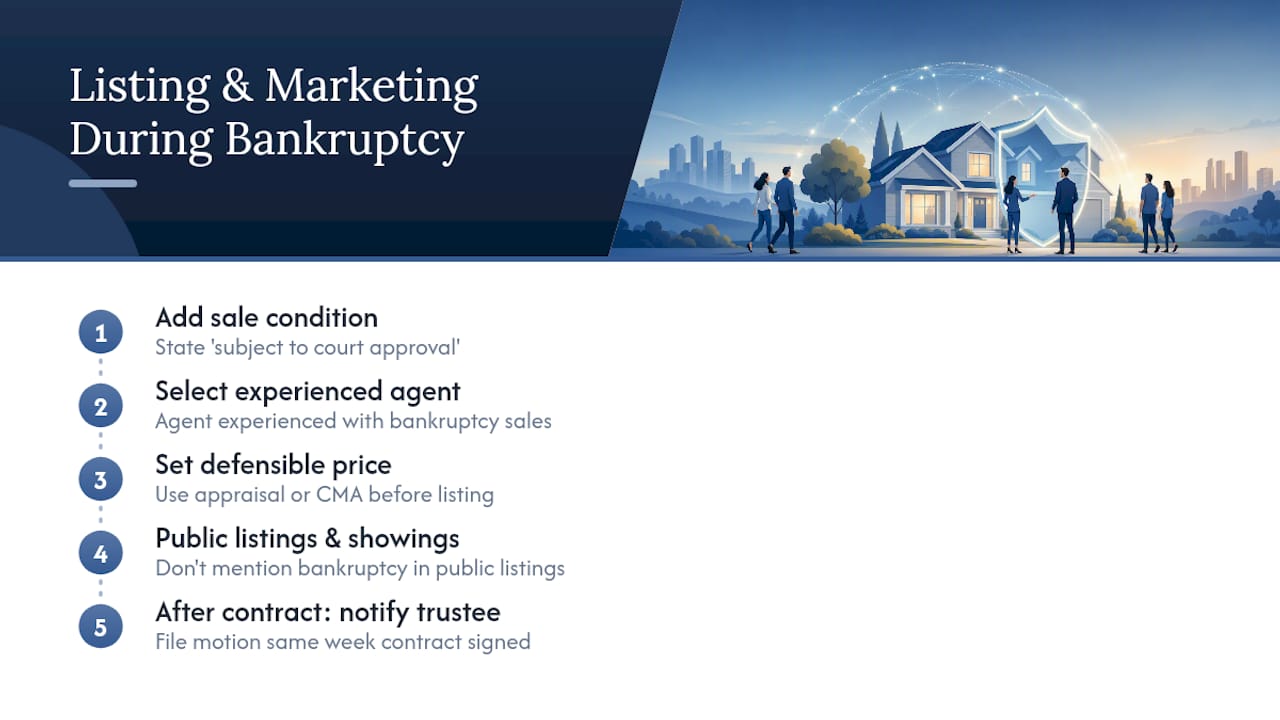
You can list your home while your bankruptcy case is open, but a few practical rules change how you market it. First, your listing agreement and any marketing materials should note the sale is subject to bankruptcy court approval. Real estate agents unfamiliar with bankruptcy sales sometimes promise a closing date that ignores the notice period entirely, so choose someone who has handled this before or is willing to coordinate closely with your attorney.
Pricing needs to reflect realistic market value, not a discount to move quickly. A below-market price draws trustee scrutiny, especially in Chapter 7, where the trustee is watching for anything that shortchanges creditors. An appraisal or comparative market analysis before you list gives you a defensible number if anyone questions the price later.
Open houses and showings proceed normally. The bankruptcy filing doesn't need to appear in public listing descriptions, and most agents keep that detail out of MLS remarks entirely. What does need early attention is disclosure to serious buyers once you're under contract, since the purchase agreement itself should state the sale depends on court approval.
Avoid accepting a full-price offer and then sitting on it for weeks before telling your trustee. Delays between contract acceptance and motion filing eat into your notice period and can push your closing date past what your buyer is willing to wait for. Get the motion moving the same week you have a signed contract.
How Bankruptcy Affects Buyer Financing and Buyer Concerns
Bankruptcy on the seller's side doesn't affect a buyer's ability to get a mortgage. Their lender is underwriting the buyer's credit and income, not yours. Where friction actually shows up is buyer confidence: some buyers get nervous when they hear "bankruptcy" and worry the deal will fall apart or drag on indefinitely.
The fix is straightforward communication. Explain early that the sale requires a court order and that title companies routinely close these transactions once that order is issued. Buyers using conventional or FHA financing sometimes have their own closing deadlines tied to rate locks, so flag the bankruptcy timeline as soon as you're under contract rather than after their lender starts asking questions.
Cash buyers sidestep this friction almost entirely. No lender means no rate lock deadline, no appraisal contingency tied to financing, and no risk of a buyer's loan falling through while you're waiting on a signed order. That's a meaningful advantage when your case timeline is already tight and every week of delay adds cost.
If a financed buyer does get cold feet, having your attorney or trustee available to answer a direct question, or even provide a short letter confirming the motion status, usually resolves it faster than letting the buyer's agent speculate.
Tax Implications of Selling During Bankruptcy
Selling your home while in bankruptcy doesn't erase normal tax rules around home sales. If you've owned and lived in the property as your primary residence for at least two of the last five years, the standard capital gains exclusion still generally applies, shielding much of the gain from tax for most sellers.
Where bankruptcy adds complexity is around canceled debt. If your mortgage lender forgives any portion of your loan balance as part of the sale, that forgiven amount can sometimes count as taxable income outside of bankruptcy. Inside an active bankruptcy case, however, discharged debt is typically excluded from taxable income under federal tax rules covering bankruptcy discharge, which is one reason timing the sale relative to your discharge date matters.
Because tax treatment depends on your specific numbers, filing status, and case chapter, this is not a place to guess. Loop in a tax professional alongside your bankruptcy attorney before closing, particularly if any debt is being forgiven as part of the transaction rather than paid in full.
When the Trustee Objects to a Sale or Exemption Claim
Objections happen more often over exemption amounts than over the sale itself. A trustee might argue your claimed homestead exemption is too high, that the sale price is below market, or that the buyer's relationship to you raises fairness concerns.
If a trustee contests your exemption claim, you generally have a limited window to respond, and the burden often falls on you to prove the exemption applies as claimed. Supporting documentation matters here: proof of residency, purchase records, and an independent valuation all strengthen your position.
If the objection targets the sale price rather than the exemption, getting a second, more current appraisal can resolve it quickly. Courts are generally willing to approve a sale once the numbers are defensible, since a stalled sale rarely benefits creditors either.
In rarer cases, a trustee may propose marketing the property themselves rather than approving your buyer, especially if they believe a higher price is achievable. This is where having a documented, arm's length offer with a serious buyer already in hand strengthens your position substantially. A trustee is far less likely to reject a solid offer than to gamble on a hypothetical better one.
Preparing and Filing the Motion: Documents You'll Need
Beyond the core attachments covered in the motion to sell itself, a few supporting pieces make the filing go smoother. Gather your most recent mortgage statement showing the exact payoff amount, a preliminary title report identifying every recorded lien, and your signed purchase agreement with the buyer's financing contingency (or lack of one) clearly stated.
Your attorney will draft the motion using your district's local form or template, since requirements vary somewhat by jurisdiction even though the underlying statute is federal. The U.S. Courts bankruptcy forms page hosts official forms your attorney may reference, though most districts have their own motion templates built around local rules.
Once filed, the clerk schedules the notice period, and your attorney serves notice on creditors and the trustee per Rule 2002. If no objections arrive within that window, many courts allow the order to be entered without a hearing. If an objection does arrive, expect a short hearing where your attorney presents the valuation evidence and proposed distribution.
Keep a checklist taped to your file: payoff statement, title report, purchase contract, proposed distribution, valuation support, and proof of service on all creditors. Missing any one of these is the most common reason motions get continued rather than approved on the first pass.
Handling Liens and Mortgages During the Sale
Every recorded lien against the property needs to be identified and addressed before closing, not discovered at the title company's desk the week you're supposed to sign. A preliminary title report early in the process catches judgment liens, HOA liens, or old contractor liens you may not remember.
Your first mortgage typically gets paid off directly from sale proceeds at closing, same as a non-bankruptcy sale. Junior liens, like a home equity line or second mortgage, get paid in the order they were recorded, which is why the lien list attached to your motion to sell matters so much. If liens exceed what the sale generates, that's a signal the sale needs restructuring before you file, not after.
For homes with tax liens or other liens complicating a quick sale, understanding payoff timing before you're under contract prevents surprises at the closing table. Selling free and clear of a lien under § 363(f) requires meeting specific statutory conditions, and the motion must spell out which condition applies for each lienholder.
What This Process Actually Rewards
Most articles on this topic focus on whether selling during bankruptcy is legal. That's the wrong question. It's almost always legal, given the right approval. The real question is whether you have the documentation and lead time to get that approval before your circumstances force a worse outcome, like a foreclosure auction proceeding on its own schedule regardless of your bankruptcy case.
The homeowners who come out ahead aren't the ones who found a clever legal loophole. They're the ones who called their attorney the day they got a serious offer, ordered a title search before they needed one, and treated the trustee as a partner to loop in early rather than an obstacle to work around. Conventional advice tends to overweight the statute and underweight the paperwork discipline that actually gets a motion approved on the first try.
If there's one thing worth prioritizing above all else, it's lead time. Every delay in this process, whether from a missing lien list or a buyer whose financing falls through, gets measured in weeks you may not have.
— Abel
Get a Cash Offer While You Sort Out the Court Process
When your bankruptcy timeline is racing against a foreclosure auction or a repayment plan deadline, a financed buyer's rate lock and appraisal contingency are exactly the kind of delay you can't afford. A local cash home buyer purchases homes in as-is condition in San Luis Obispo, CA, without requiring repairs, cleaning, or charging hidden fees, which can simplify coordination for your attorney around a court-ordered closing date.

What that looks like in practice: a clear, written cash offer with an estimated payoff and closing timeline your attorney can attach directly to a motion to sell, plus coordination with your title company so the signed order authorizing sale arrives before your closing date, not after. Read more about how the Cash Offer program works, or if you'd rather list with a licensed agent for top dollar, that option is available too. Reach out through the get a cash offer page for a no-obligation conversation about your specific timeline.
Sources
- Selling property before filing for bankruptcy — Nolo
- Federal Rule of Bankruptcy Procedure 2002 — Cornell LII
- What happens if you sell your house during Chapter 13? — LegalClarity
- Observed
This article is general information, not a substitute for advice from a qualified lawyer. Consult a qualified legal professional about your own circumstances before acting on anything here.
FAQ
Can I Sell My House During Bankruptcy Without the Trustee's Approval?
In Chapter 7, you can sell freely only after the trustee formally abandons the property or your case closes. In Chapter 13, you generally need court approval through a motion to sell under 11 U.S.C. § 363 before closing.
Do I Still Own My Home After Filing Chapter 7?
Yes, you retain legal title, but the home technically becomes part of the bankruptcy estate the trustee reviews. If your equity is fully covered by your state's homestead exemption, the trustee typically abandons the property and you keep full control.
How Much Cash Can I Keep When Filing Chapter 7?
The amount depends on your state's homestead exemption and how much nonexempt equity exists after paying liens and closing costs. Ask your attorney for your state's current exemption figure, since it varies widely and directly determines your payout from any sale.
What Is the 90 Day Rule for Chapter 7?
This generally refers to the lookback period trustees use when reviewing pre-filing transfers and payments for signs of preference or fraud. Selling property in that window without proper documentation of fair market value can invite the kind of scrutiny Nolo warns about, so keep every valuation record if a sale happened close to your filing date.
How Long Does Bankruptcy Affect My Credit?
A Chapter 7 filing generally stays on your credit report for several years, while Chapter 13 typically stays for a shorter period from the filing date. Selling your home during the case doesn't extend that timeline, though rebuilding credit often starts as soon as your discharge is final.