
The fastest way to stop foreclosure in California is to act on three fronts at once: submit a complete loss-mitigation application to your servicer, reinstate or redeem your loan if you can gather the funds, or file bankruptcy to trigger an automatic stay. California's Homeowner Bill of Rights and the newer AB 2424 rules add extra pause points most homeowners don't know exist. Whichever path fits your situation, speed and paperwork accuracy matter more than anything else right now.
TL;DR:
- Submitting a complete loss-mitigation application more than 37 days before sale can trigger federal protections and potentially postpone the auction.
- Acting within the five business days prior to sale or pursuing bankruptcy, especially Chapter 13, offers the fastest ways to stop auction proceedings.
- Accurate documentation and following the specific deadlines are crucial to maintain eligibility for foreclosure pause options and avoid losing rights.
- Filing a cash sale or deed in lieu requires timely execution and verification of buyer credibility to effectively prevent foreclosure.
- Seeking free help from HUD-certified counselors, legal aid, or county agencies improves chances of successfully navigating the foreclosure process.
Table of Contents
- Immediate Steps to Take in the Next 24 to 72 Hours
- What Are California's Key Foreclosure Deadlines?
- Which Loss-Mitigation Options Should You Request?
- Can Bankruptcy or a Lawsuit Stop the Sale Immediately?
- How a Cash Sale or Deed in Lieu Can Stop the Auction
- Where Can You Get Free, Trustworthy Help?
- A Local Perspective on Weighing Your Options
- How SLO Cash Buyer Can Help You Stop Foreclosure Fast
- Sources
Immediate Steps to Take in the Next 24 to 72 Hours
Once you know a sale date exists, every hour counts. Here's the order that protects the most options.
- Confirm your exact sale date. Pull the Notice of Trustee Sale from your county recorder's office or check the notice mailed to you. Sale dates get postponed often, so verify it again the morning of.
- Call your servicer and ask for the single point of contact. Under California's Homeowner Bill of Rights, your servicer must assign one person to your file. Get that name and direct line in writing.
- Assemble a complete loss-mitigation package. You'll typically need two months of pay stubs, two years of tax returns, a hardship letter, a budget worksheet, and your two most recent bank statements. Federal Regulation X protections only kick in once your application is deemed complete, so missing one document can cost you weeks.
- Ask about reinstatement or redemption. Reinstatement means paying the past-due amount plus fees; redemption means paying the full loan balance. Ask your servicer for the exact reinstatement figure in writing.
- Call a HUD-certified housing counselor today. They're free, and they know exactly what your servicer's loss-mitigation desk expects to see.
- Log every call. Date, time, name of the representative, and what was promised.
Pro Tip: Send your loss-mitigation documents by a method that gives you a delivery confirmation, and follow up by phone within 48 hours to confirm your file shows "complete." A complete file received but not logged as complete does nothing to protect you.
What Are California's Key Foreclosure Deadlines?
California's foreclosure timeline runs on strict clocks, and missing one closes a door you can't reopen.
- Notice of Default (NOD) recorded: starts a mandatory waiting period before a Notice of Trustee Sale can even be filed, under Cal. Civ. Code § 2924c.
- Reinstatement window: you have the right to cure the default and stop the process entirely during this period.
- Notice of Trustee Sale filed: sets the actual auction date, typically at least 21 days out.
- Five business days before sale: your last legal window to reinstate, if your lender agrees to accept it.
- 37 days before sale: the deadline for submitting a complete loss-mitigation application to trigger federal dual-tracking protections, according to Regulation X guidance.
AB 2424, passed in 2024, added another layer: if you deliver a bona fide listing agreement or signed purchase agreement within the statute's specified timeframe, your servicer must postpone the sale to let that transaction close. The law also sets minimum-bid requirements for the initial trustee sale date, which can work in your favor if you're trying to buy time for a short sale or cash offer.
Missing the 37-day completeness window doesn't end your options, but it does mean that specific federal pause won't apply to the sale already scheduled.
Which Loss-Mitigation Options Should You Request?
Servicers generally offer four paths, and each fits a different situation.
- Loan modification: restructures your rate, term, or principal balance. Realistic timelines run several weeks to a few months for a decision, and you'll need to show stable income to qualify.
- Forbearance or repayment plan: pauses or reduces payments temporarily, then tacks the missed amount onto future payments. This works only if your hardship is genuinely short-term; otherwise you're just delaying a bigger problem.
- Short sale: you sell the home for less than you owe, and the lender agrees to release the lien. This takes lead time, often several weeks, so it only works if you start before a sale date is close.
- Deed in lieu of foreclosure: you hand the property back to the lender directly, avoiding the auction but also any remaining equity.
If your servicer denies your request, ask for the denial in writing and the specific reason. You can appeal most denials, especially if you can show a documented change in circumstances since you applied.
Pro Tip: Keep every denial letter. A pattern of vague or contradictory denials is exactly the kind of evidence a housing counselor or attorney needs to challenge a servicer's handling of your file under HBOR.
Can Bankruptcy or a Lawsuit Stop the Sale Immediately?
Filing bankruptcy is the single fastest way to halt a scheduled sale. The moment your petition is filed, an automatic stay takes effect and stops the trustee from proceeding, usually within hours.
- Chapter 13 lets you keep the home and repay missed payments over three to five years. This is the stronger option if you have steady income and just need time.
- Chapter 7 typically only delays the sale by a few weeks to months while the case processes, since it doesn't include a repayment plan for arrears.
- Challenge notice defects. If your Notice of Trustee Sale wasn't mailed, posted, or published correctly, that can be grounds for a temporary restraining order. This requires fast, well-documented evidence and usually an attorney.
- Find urgent help now through a local legal aid clinic or a bankruptcy attorney referral service if you're within days of a sale.
How a Cash Sale or Deed in Lieu Can Stop the Auction
Selling for cash before the auction date works because it removes the reason for the sale entirely, the lender gets paid off, and the trustee cancels. Under AB 2424, delivering a signed purchase agreement within the statute's timeframe can force a postponement, giving your closing enough runway to finish. Timing is everything here: the agreement needs to reach your servicer with enough lead time to matter, not the week of the sale.
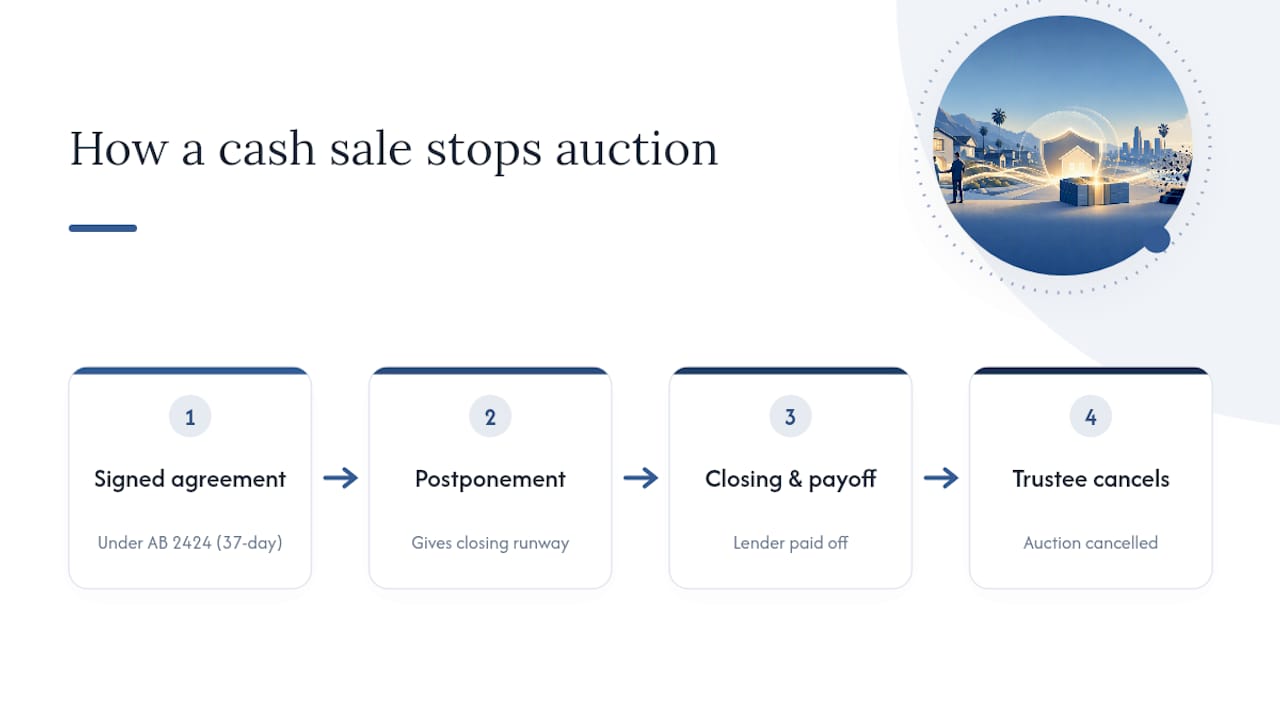
The trade-offs are real. You'll likely net less than a full market-value sale, you're on a tighter schedule for relocating, and if there's a large gap between your loan balance and the sale price, deficiency exposure or credit impact is possible depending on your loan type. Before signing with any cash buyer, verify they can show proof of funds, a physical business address, and reviews you can independently check. Walk away from anyone who wants you to sign the deed before you've seen an actual purchase agreement.
Our step-by-step breakdown of how a cash offer stops an auction and this SLO County case study on a two-week cash sale walk through what that timeline actually looks like locally.
Pro Tip: If you're weighing a deed in lieu against a cash sale, read through the deed-in-lieu trade-offs first. A cash sale usually preserves more of your remaining equity than simply handing the keys back.
Where Can You Get Free, Trustworthy Help?
Real help exists, and none of it should cost you money up front.
- HUD-certified housing counselors review your file, help assemble loss-mitigation paperwork, and negotiate with servicers on your behalf at no cost. Find one through HUD's counselor directory.
- County consumer protection offices, like the Los Angeles County DCBA, offer foreclosure-prevention counseling and complaint intake for servicer misconduct.
- Legal aid clinics provide free representation for HBOR violations and emergency filings.
Watch for these scam signs: anyone demanding an up-front fee before doing any work, guarantees that they can "stop your foreclosure no matter what," and pressure to sign over your deed immediately without a written purchase agreement. Bring your NOD, your loan statements, and a list of every call you've logged to any counseling or legal appointment.
A Local Perspective on Weighing Your Options
A fast cash sale makes the most sense once you're inside that final stretch before a sale date and loan modification isn't going to close in time. Even then, call a free counselor first. Document every call and letter starting today. Whatever you decide, decide with a paper trail behind you.
— Abel
How SLO Cash Buyer Can Help You Stop Foreclosure Fast
A fast cash sale can be an alternative to a drawn-out short sale or loan modification fight when your trustee sale date is close and you need certainty, not more paperwork rounds. Cash home buyers purchase homes as-is in San Luis Obispo County for cash, which means no repairs, no cleaning, no agent commissions, and no waiting on a buyer's financing to fall through.

This route fits homeowners who've already tried loss mitigation, who don't have the cash to reinstate, or who simply need a closing date locked in before the trustee's clock runs out. It's not the right call if a modification is realistically going to close in time, since you'd keep more equity that way. But if you're weeks from auction and need a sure thing, cash sales can sometimes close quickly. Call us or request a cash offer through our San Luis Obispo home-buying page, and bring your Notice of Default or Notice of Trustee Sale so we can move fast on your timeline.
This article is general information, not a substitute for advice from a qualified financial advisor. Consult a qualified financial professional about your own circumstances before acting on anything here.
Sources
- Your rights in a nonjudicial foreclosure | California Courts | Self Help Guide
- If I can't pay my mortgage loan, what are my options? | CFPB
- AB 2424 (mortgages: foreclosure) — Assembly Banking and Finance committee analysis
- How to Stop Foreclosure on My Home: Your 2026 Legal Guide - Consumer Attorneys
- Avoiding a Foreclosure – Consumer & Business (Los Angeles County)