
A deed in lieu of foreclosure is a voluntary transfer of your property title directly to your lender to avoid a formal foreclosure proceeding. You hand over the deed; the lender cancels the foreclosure process. It sounds clean, but the details matter enormously.
Here is what you need to know right now:
- It ends your mortgage obligation but still damages your credit. A deed in lieu is a major derogatory event that can stay on your credit report for an extended period, even though it is generally slightly less harmful than a completed foreclosure.
- Deficiency and tax risks are real unless you get them waived in writing. If your home is worth less than you owe, the lender may still pursue the difference. The IRS may also treat canceled debt as taxable income.
- Lenders can and do say no. If there are junior liens, title problems, or the lender believes foreclosure serves them better, they will decline. Expect negotiation, and prepare for alternatives.
Your immediate next step: call your loan servicer today and ask for a loss-mitigation evaluation. Then contact a HUD-approved housing counselor or a real estate attorney before you sign anything.
Pro Tip: HUD-approved housing counselors offer free or low-cost guidance. Find one at the HUD website before you contact your servicer, so you walk into that conversation prepared.
Key Takeaways
A deed in lieu of foreclosure ends your mortgage through a voluntary title transfer, but it still damages your credit, carries tax and deficiency risks, and requires a written waiver to fully protect you.
| Point | Details |
|---|---|
| Credit impact is serious | A deed in lieu can drop your score 50–125 points and stays on your report for seven years. |
| Get the deficiency waiver in writing | Without a signed waiver, your lender may still sue you for the remaining loan balance after the transfer. |
| Tax exposure is real | Canceled debt can be taxable income; consult a tax professional about Form 1099-C and insolvency exclusions. |
| Counseling before you sign | A HUD-approved housing counselor can review all loss-mitigation options at no cost before you commit. |
| SLO Cash Buyer as a fast alternative | SLO Cash Buyer - San Luis Obispo County Home buyer offers as-is cash purchases in San Luis Obispo County for homeowners who need a quick, clean exit. |
Table of Contents
- How does a deed in lieu actually work?
- Who qualifies for a deed in lieu?
- How does deed in lieu compare with foreclosure and short sale?
- What are the real pros and cons of a deed in lieu?
- How does a deed in lieu affect your credit, taxes, and deficiency liability?
- What makes a lender accept or reject a deed in lieu?
- What paperwork and timeline should you expect?
- What are the alternatives to a deed in lieu?
- Is a cash sale a practical alternative for San Luis Obispo homeowners?
- How do you protect yourself before signing a deed in lieu?
- A fast, as-is cash offer for San Luis Obispo homeowners
- Sources
How does a deed in lieu actually work?
The process moves in a predictable sequence, though the timeline varies widely depending on your lender, your loan type, and how clean your title is.
- Contact your loan servicer. Call or write to request loss-mitigation options. Ask specifically about a deed in lieu and get the name and direct contact of the loss-mitigation department.
- Submit a hardship letter. Explain in writing why you cannot keep the home or sell it at market value. Be specific: job loss, medical bills, divorce, or another documented hardship.
- Gather and submit your financial package. Lenders require recent pay stubs, two years of tax returns, bank statements, a list of assets and liabilities, and a completed financial worksheet. FHA servicers must also run a Deficit Income Test (DIT) before approving a deed in lieu.
- Lender orders a property appraisal or BPO. The lender needs to know what the property is worth before deciding whether accepting the deed makes financial sense for them.
- Title review. A title company checks for junior liens, unpaid taxes, HOA assessments, and any encumbrances. This step is where many deed-in-lieu requests stall or fail.
- Lender issues a written approval. If everything checks out, the servicer sends a formal deed-in-lieu agreement. Read every line. The deficiency waiver language is the most important clause.
- Signing and recording. You sign the deed and the agreement at a closing appointment. The deed is then recorded with the county, transferring title to the lender. Under HUD regulations at 24 CFR § 1005.755, servicers must file the deed for record in a timely manner.
- Vacate the property. Most agreements require you to leave the home in broom-clean condition by a specified date. Some lenders offer relocation assistance, sometimes called "cash for keys."
Typical timeline: From first contact to recorded deed, expect anywhere from 60 days to six months. Title issues, junior lien negotiations, or a slow appraisal can push that longer. FHA loans add extra steps because servicers must evaluate a pre-foreclosure sale before moving to a deed in lieu.
Once the deed is recorded, you no longer own the home. The loan is generally closed out, but whether the remaining balance is forgiven depends entirely on what your written agreement says.
Who qualifies for a deed in lieu?
Not every homeowner in default will qualify. Lenders look at a specific set of conditions before they will even consider the request.
Common eligibility requirements:
- The property must typically be your primary residence, though some lenders consider investment properties case by case.
- You must demonstrate a genuine financial hardship, not just a preference to walk away.
- You must be in default or facing imminent default, with documented inability to make payments.
- The home must be free of junior liens, or those lienholders must agree to release their claims. A second mortgage, a HELOC, or a contractor's lien can block the entire transaction.
- You must provide a complete financial package: income documentation, tax returns, bank statements, and a signed hardship letter.
- You must show you have made a good-faith effort to sell the property at market value, typically for 90 days or more.
FHA-specific rules: Under HUD Mortgagee Letter 2013-23, FHA servicers are required to evaluate a homeowner for a pre-foreclosure sale (short sale) before approving a deed in lieu. The servicer must complete a Deficit Income Test and verify that the borrower meets program criteria. This means FHA borrowers often face a longer, more document-intensive process than those with conventional loans.
Title and lien issues are the most common deal-breakers. If a second lender, a tax authority, or an HOA holds a lien on the property, the primary lender will not accept a deed that comes with strings attached. You would need to negotiate releases from every lienholder, which can take weeks and may not succeed.
A deed in lieu requires the mortgagor to convey all interest in the property to the mortgagee, as the Legal Information Institute at Cornell Law explains. That means the title must be clean enough for the lender to accept it without inheriting someone else's debt.
How does deed in lieu compare with foreclosure and short sale?
These three paths all lead to losing the home, but the experience, timeline, and financial aftermath differ in ways that matter.
| Factor | Deed in Lieu | Short Sale | Foreclosure |
|---|---|---|---|
| Credit score impact | Roughly 50–125 point drop; major derogatory | Similar to deed in lieu; major derogatory | Typically the most damaging; major derogatory |
| Reporting duration | 7 years on credit report | 7 years on credit report | 7 years on credit report |
| Public court record | No court proceedings | No court proceedings | Yes, public court record |
| Timeline to complete | 60 days to 6 months | 3 to 6 months (buyer-dependent) | 6 months to 3+ years (state-dependent) |
| Deficiency risk | Possible unless waived in writing | Possible unless waived in writing | Possible in recourse states |
| Homeowner control | Moderate; negotiated exit | Moderate; requires buyer and lender approval | Low; lender drives the process |
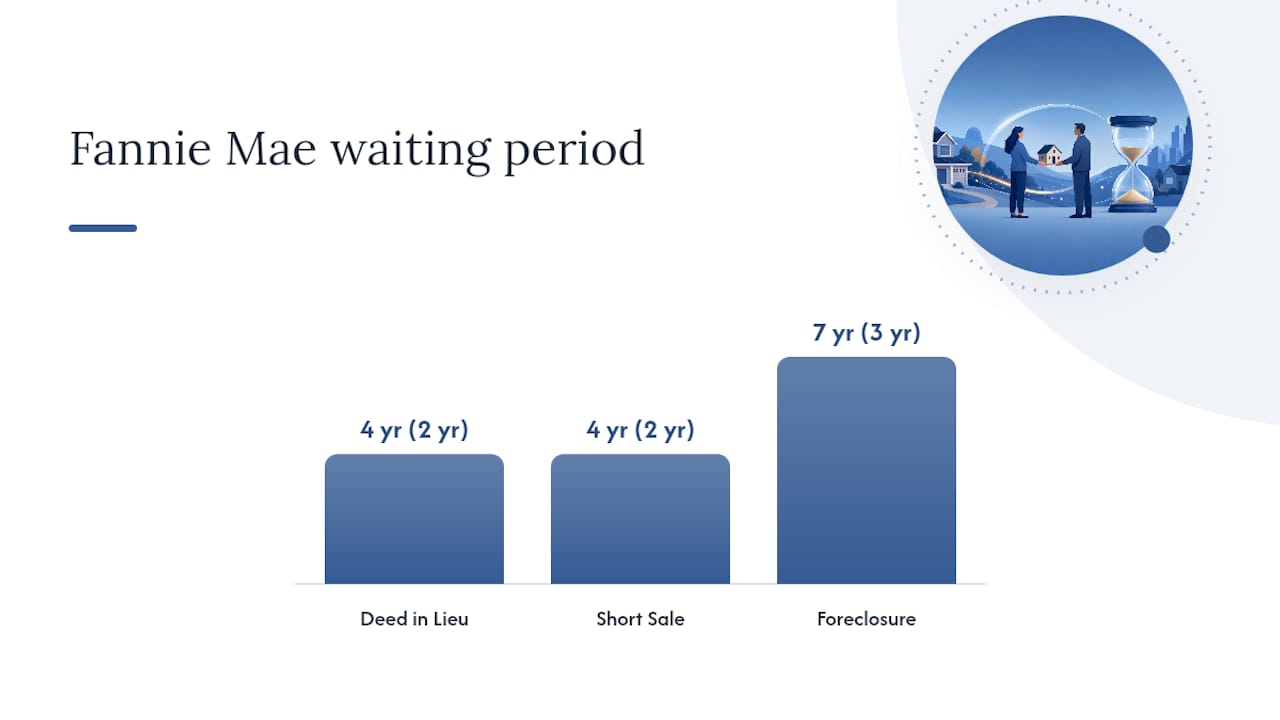
| Fannie Mae waiting period | 4 years (2 years with extenuating circumstances) | 4 years (2 years with extenuating circumstances) | 7 years (3 years with extenuating circumstances) |
A few things stand out in that comparison. Foreclosure is the slowest and most public option, and it carries the longest waiting period before you can qualify for a conventional mortgage again. A deed in lieu and a short sale are roughly equivalent on credit damage, but a deed in lieu is typically faster because you do not need to find a buyer.
Short sales make more sense when your home has equity or when the market is strong enough that a buyer can close quickly. Lenders sometimes prefer short sales because they get cash rather than a property they need to manage and resell. A deed in lieu appeals to lenders when the property is in good condition, the title is clean, and foreclosure costs would be high.
The bottom line for most homeowners: if speed and a clean exit matter most, a deed in lieu is worth pursuing. If you want to maximize any remaining equity or have time to find a buyer, a short sale may serve you better.
What are the real pros and cons of a deed in lieu?
Benefits for the homeowner:
- No court proceedings, no public foreclosure auction, and no sheriff showing up at your door.
- Faster resolution than a full foreclosure, which can drag on for years in some states.
- Possible relocation assistance ("cash for keys") negotiated as part of the agreement.
- A negotiated, written exit that gives you some control over the timeline.
- Slightly less credit damage than a completed foreclosure, according to Experian.
Drawbacks to weigh carefully:
- You lose the home. There is no redemption period after the deed is recorded.
- Credit damage is still severe: a 50 to 125 point drop that stays on your report for seven years.
- Without a written deficiency waiver, the lender can still sue you for the difference between what you owed and what the property sells for.
- Canceled debt may be taxable income, triggering a Form 1099-C from the lender.
- Lenders can reject the request, leaving you back at square one with less time before foreclosure.
A practical scenario: Imagine you owe $420,000 on a home now worth $310,000. Foreclosure is 90 days away. You have no junior liens and the title is clean. A deed in lieu lets you hand over the property, negotiate a deficiency waiver, and walk away without a public court record. That is a sensible trade in that situation, even knowing the credit hit.
Pro Tip: Before you sign the deed-in-lieu agreement, confirm the deficiency waiver language is explicit and in writing. A verbal promise from a servicer representative means nothing once the deed is recorded. If the agreement does not include a clear deficiency release, ask for it in writing or consult an attorney before proceeding.
How does a deed in lieu affect your credit, taxes, and deficiency liability?
This is where homeowners most often get surprised, and where the stakes are highest.
Credit reporting
A deed in lieu appears on your credit report as a serious derogatory event. According to LegalClarity's credit analysis, it can lower your credit score by roughly 50 to 125 points, depending on your starting score and overall credit profile. The entry stays on your report for seven years under the Fair Credit Reporting Act.
Waiting periods before you can qualify for a new mortgage vary by loan program:
- Fannie Mae conventional loan: 4-year waiting period; 2 years with documented extenuating circumstances.
- FHA loan: 3-year waiting period from the date of the deed transfer.
- VA loan: Generally 2 years, though lenders may apply their own overlays.
Tax consequences
When a lender forgives debt through a deed in lieu, the IRS may treat that forgiven amount as taxable income. The lender typically sends a Form 1099-C reporting the canceled debt. Whether you actually owe tax on it depends on several factors: whether the loan was recourse or non-recourse, whether you were insolvent at the time of the transfer, and whether any other exclusions apply.
Recourse loans (where the lender can pursue you personally for the balance) create the most tax exposure. Non-recourse loans generally do not. The insolvency exclusion can eliminate the tax liability if your total debts exceeded your total assets at the time of the deed transfer, but you must document that carefully on IRS Form 982.
Tax law in this area is genuinely complex. Get advice from a CPA or tax attorney before you close, not after you receive the 1099-C.
Deficiency judgments
A deficiency is the gap between what you owed and what the lender recovers when they sell the property. Without a written waiver, lenders in most states can pursue that amount through a civil lawsuit. State law varies significantly: some states prohibit deficiency judgments after a deed in lieu; others allow them freely. A written deficiency release in your deed-in-lieu agreement is the only reliable protection.
| Consequence | What it means for you | How to protect yourself |
|---|---|---|
| Credit score drop | 50–125 points; 7-year reporting period | Cannot be avoided; minimize by resolving other debts |
| Form 1099-C | Canceled debt may be taxable income | Consult a tax professional; check insolvency exclusion |
| Deficiency judgment | Lender sues for remaining balance | Negotiate written deficiency waiver before signing |
| Mortgage waiting period | 2–4 years before new conventional loan | Rebuild credit aggressively after the deed transfer |
What makes a lender accept or reject a deed in lieu?
Lenders are not doing you a favor when they accept a deed in lieu. They are making a business calculation. Understanding that calculation helps you address their concerns directly.
Reasons a lender will typically accept:
- The property is in good condition and marketable in the current local market.
- There are no junior liens, unpaid taxes, or title defects that would complicate resale.
- The appraised value is reasonable relative to the outstanding loan balance.
- Foreclosure costs in your state are high (attorney fees, court costs, carrying costs during a long process).
- You have demonstrated a genuine hardship and cooperated fully with documentation requests.
Reasons a lender will typically reject:
- Junior lienholders refuse to release their claims, making the title unmarketable.
- Environmental problems (underground storage tanks, contamination) create liability the lender does not want.
- The property is in poor condition and the lender calculates that foreclosure plus renovation costs less than accepting a damaged asset.
- The lender believes the local market is strong enough that foreclosure will recover more of the balance.
- You have not made a documented effort to sell the property first.
What you can do to improve your chances:
- Get written releases from every junior lienholder before you submit your application.
- Provide a current, professional appraisal or comparative market analysis to support your case.
- Document your intent to vacate and provide a specific move-out date.
- Keep the property maintained and clean throughout the process.
- Respond to every servicer request within 24 to 48 hours to show good faith.
Most lenders treat a deed in lieu as a last-resort loss-mitigation tool, not a first offer. Expect the servicer to push back, ask for more documentation, or suggest alternatives before they approve it.
What paperwork and timeline should you expect?
Getting organized early prevents the most common delays. Here is what lenders typically require and when each piece matters.
Document checklist:
- Hardship letter (signed, dated, specific about the financial event)
- Two most recent pay stubs for all borrowers on the loan
- Two years of federal tax returns (all pages)
- Two to three months of bank statements (all accounts)
- Government-issued photo ID for all borrowers
- Current mortgage statement and loan number
- Property deed and any title documents you have
- HOA statements and any lien documentation
- Signed authorization for the servicer to order a payoff statement and appraisal
Realistic timeline:
- Weeks 1 to 2: Initial servicer contact, hardship letter submission, document gathering.
- Weeks 3 to 5: Servicer reviews financial package; orders appraisal or BPO.
- Weeks 6 to 10: Title review; junior lien negotiations if applicable.
- Weeks 10 to 16: Lender issues written approval or denial; deed-in-lieu agreement drafted.
- Weeks 16 to 20: Signing appointment; deed recorded with county.
FHA loans add time because of the mandatory pre-foreclosure sale evaluation and the Deficit Income Test. Under HUD Mortgagee Letter 2013-23, servicers must complete specific verification steps before approving a deed in lieu, which shifts the documentation burden onto the borrower and extends the timeline.
Pro Tip: Never rely on verbal commitments from a servicer. Every agreement, every waiver, and every timeline commitment must be in writing and signed by an authorized representative of the lender. Oral promises do not survive staff turnover or servicer transfers.
What are the alternatives to a deed in lieu?
A deed in lieu is one tool in a larger toolkit. Depending on your situation, another option may serve you better.
- Loan modification: The servicer restructures your loan terms (lower rate, extended term, reduced principal in rare cases) so you can afford the payments. Best when you want to keep the home and have stable income. Credit impact is lower than a deed in lieu, but approval is not guaranteed.
- Forbearance: The servicer temporarily reduces or pauses your payments. Best for short-term hardships like a medical event or job loss with a clear recovery path. Does not solve long-term unaffordability.
- Short sale: You sell the home for less than you owe, with lender approval. Best when the market is active and you have time to find a buyer. Similar credit impact to a deed in lieu but takes longer. Lenders must generally evaluate this option before a deed in lieu for FHA loans.
- Bankruptcy: Chapter 7 or Chapter 13 can pause foreclosure and discharge or restructure debt. Best when you have multiple debts overwhelming your income. Significant credit impact and legal complexity; requires an attorney.
- Traditional sale: If you have any equity, selling at market value pays off the mortgage and avoids all derogatory reporting. Best when the home is worth more than you owe and you have time.
- Cash sale to a local buyer: Selling as-is to a cash buyer closes in days or weeks, not months. Best when speed matters most and you cannot afford repairs or a traditional listing. You likely receive less than market value, but you avoid foreclosure, court proceedings, and the uncertainty of a deed-in-lieu negotiation.
A HUD-approved housing counselor can walk through every one of these options with you at no cost. Contact one before you commit to any path.
Is a cash sale a practical alternative for San Luis Obispo homeowners?
For homeowners who need to resolve a mortgage default quickly and cannot wait months for a deed-in-lieu negotiation, selling to a local cash buyer is worth understanding as a concrete option.
Practical advantages:
- Closes in days or weeks, not months, which can stop a foreclosure timeline before auction.
- Purchased as-is: no repairs, no cleaning, no staging.
- No agent commissions or hidden fees eating into your proceeds.
- A clean payoff of your mortgage at closing, which eliminates the deficiency question entirely if the sale price covers the balance.
What you must verify before signing:
- Get a written payoff statement from your servicer showing the exact amount needed to close the loan.
- Confirm in writing how the buyer will handle lien payoffs at closing, including any junior liens.
- Review the purchase agreement for any unexpected fees, holdbacks, or contingencies.
- Ask for a clear, written closing timeline with a specific date.
The honest tradeoff: A cash sale will almost certainly net you less than a traditional market sale. In a strong market like San Luis Obispo County, that gap can be meaningful. But if foreclosure is imminent and a deed in lieu is stalled or rejected, a cash sale that pays off the mortgage cleanly may be the best available outcome. You avoid the credit damage of foreclosure, avoid the uncertainty of a deed-in-lieu negotiation, and walk away with a clear title transfer on your terms.
Before using sale proceeds to pay off other debts, consult a housing counselor or attorney to understand how that affects any remaining deficiency exposure or tax liability.
Pro Tip: A quick cash sale can stop a foreclosure auction before it happens. If your servicer has already set an auction date, ask a cash buyer for a written offer and timeline immediately, then share that with your servicer as part of your loss-mitigation request.
How do you protect yourself before signing a deed in lieu?
The deed-in-lieu agreement is a legal contract. Once you sign and the deed is recorded, your options narrow dramatically. These steps protect you before you reach that point.
Protective checklist:
- Demand a written deficiency waiver as a condition of signing. If the lender will not provide one, consult an attorney about your state's deficiency laws before proceeding.
- Request a written payoff statement from your servicer showing the exact loan balance, accrued interest, and fees as of the expected closing date.
- Consult a HUD-approved housing counselor before submitting your application. They can review your options and flag issues you might miss.
- Hire a real estate attorney to review the deed-in-lieu agreement before you sign. The cost is small relative to the liability you could be accepting. Learn more about when to involve an estate attorney in a property transaction.
- Confirm in writing how the lender will report the event to the credit bureaus. Ask specifically whether they will report it as "settled" or "deed in lieu" and what that means for your file.
- Identify every lienholder on the property and get written confirmation of their release before the closing date.
Key questions to ask your servicer:
- Will you forgive the full deficiency balance, and will that be in the written agreement?
- How will you report this transaction to Equifax, Experian, and TransUnion?
- Who else must sign off, including any junior lienholders or mortgage insurance companies?
- What is the exact timeline from approval to recording, and what happens if it slips?
Red flags that should stop you from signing:
- The servicer refuses to put the deficiency waiver in writing.
- You are pressured to vacate the property before a written agreement is signed.
- The payoff figures change between conversations without explanation.
- A third party charges unexpected fees to "process" or "facilitate" the deed in lieu.
Any one of these signals is a reason to pause, get legal advice, and protect yourself before moving forward.
What this situation actually asks of you
Facing a mortgage default is one of the most stressful things a homeowner can go through. The paperwork feels endless, the servicer calls feel threatening, and the options can seem equally bad. I want you to know that the path forward exists, even when it does not feel that way.

The most important thing you can do right now is not to pick the right option. It is to stop making decisions alone. Call your servicer and ask for loss-mitigation options in writing. Contact a HUD-approved housing counselor before you agree to anything. If you are in San Luis Obispo County and speed matters most, a local cash sale through SLO Cash Buyer - San Luis Obispo County Home buyer is one real, practical route that can close quickly and cleanly.
You deserve a clear exit, not just the least bad one. Get the written protections, get the counseling, and then make the call.
A fast, as-is cash offer for San Luis Obispo homeowners
If you are facing foreclosure and a deed-in-lieu negotiation feels too slow or uncertain, SLO Cash Buyer - San Luis Obispo County Home buyer offers a direct alternative: a cash purchase of your home in any condition, with no repairs, no agent fees, and a closing timeline you control.

The process is straightforward. You request an offer, we review the property, and you receive a written cash offer with a clear closing date. If the sale price covers your mortgage payoff, you walk away with a clean title transfer and no deficiency exposure. There are no hidden fees and no pressure.
This is not legal or tax advice, and a cash sale is one option among several worth evaluating with a housing counselor or attorney. But for homeowners in San Luis Obispo County who need speed and certainty, it is a path worth knowing about.
Request your written cash offer today and see what a fast, as-is sale looks like for your specific situation.
Sources
These government and legal resources cover the official rules, definitions, and program requirements for deed in lieu and related topics.
- What is a deed-in-lieu of foreclosure?
- Updated Pre-Foreclosure Sale (PFS) and Deed in Lieu (DIL) of Foreclosure Requirements (Mortgagee Letter)
- Home foreclosure and debt cancellation
- What Is a Deed in Lieu of Foreclosure? - Experian
- Does a Deed in Lieu Affect Your Credit Score? - LegalClarity
This article is general information, not a substitute for advice from a qualified financial advisor. Consult a qualified financial professional about your own circumstances before acting on anything here.