
Yes, you can sell a house with liens on it, but you cannot hand a buyer clear title until those liens are paid off, negotiated down, or officially released. Most liens get resolved right at closing out of your sale proceeds, provided there is sufficient equity to cover them; federal tax liens and large judgments sometimes need extra paperwork and lead time. Your very first move should be ordering a preliminary title report or a county records search so you are aware of any liens before you list.
TL;DR:
- Most liens are resolved at closing out of sale proceeds if there is sufficient equity, but federal tax liens or large judgments may require extra paperwork and time.
- Involuntary liens such as tax liens, judgment liens, mechanic's liens, HOA liens, and child support liens can surprise sellers late in the transaction and must be paid or released before closing.
- A property sells only with a clear title if all liens are paid, negotiated down, or officially released, with priority dictated by the recording date, affecting how sale proceeds are distributed.
- Sellers should order a preliminary title report or search county records early to identify all liens, verify amounts with payoff letters, and confirm releases after payment before closing.
- Quick resolution paths like cash sales or short sales are often necessary when total liens outweigh home value, especially for looming foreclosure or mounting unpaid debts.
Table of Contents
- What Is a Lien, and Which Types Show Up on Home Sales?
- How Liens Block Buyer Financing and Determine Who Gets Paid First
- How Do You Find and Verify Every Lien Before You List?
- How Do You Actually Get Liens Resolved So the Sale Can Close?
- What Happens at the Closing Table When Liens Are in Play?
- What If Your Liens and Mortgage Exceed What Your House Is Worth?
- What We've Learned Handling Liened Properties in San Luis Obispo County
- Sell Your Liened House Fast, Without Untangling the Paperwork Yourself
- Where to Verify Lien Rules and Forms Yourself
- Sources
What Is a Lien, and Which Types Show Up on Home Sales?
A lien is a legal claim against your property that a creditor files to secure a debt. It doesn't take your home away, but it attaches to the title and creates what real estate professionals call a "cloud on title" — a defect that has to be cleared before you can transfer clear title to a buyer. Think of it as a claim sitting quietly in the county records, waiting to be paid.
Liens split into two broad categories, and the difference matters a lot when you're trying to sell.
Voluntary liens are ones you agreed to. Your mortgage is the most obvious example: you borrowed money, and the lender recorded a lien against the property as collateral. These are expected and almost always get paid off automatically at closing.
Involuntary liens are the ones that catch sellers off guard, because you didn't sign up for them, they showed up because of unpaid debts or legal judgments. According to the National Association of Realtors, involuntary liens are the biggest surprise for sellers precisely because they're often discovered only when the buyer's title company runs its own search, sometimes weeks into a transaction that's already moving.
Common types you'll encounter:
- Tax liens — filed by the IRS or your state and county for unpaid income or property taxes.
- Judgment liens — filed by a creditor after winning a lawsuit against you.
- Mechanic's liens — filed by contractors or subcontractors who did work on your home and weren't paid in full.
- HOA liens — filed by a homeowners association for unpaid dues or assessments.
- Child support liens — filed by a state agency for unpaid family support obligations.
Mechanic's liens and HOA liens tend to surprise sellers the most. You might have paid a roofer in full, but if that roofer subcontracted the job and never paid their crew, the subcontractor can sometimes still file a lien against your home. HOA liens can also snowball fast, since some associations tack on interest and legal fees that balloon a $600 unpaid assessment into a $4,000 problem within a year.
How Liens Block Buyer Financing and Determine Who Gets Paid First
Lenders and title insurers will not let a deal close with an unresolved lien on the property, full stop. A mortgage lender is underwriting a loan secured by the home, and if there's a competing claim against that same asset, the lender's collateral position is compromised. Title insurers face the same problem: they can't issue a clean policy over an existing title defect, so most buyer-side mortgages simply cannot fund until the lien is cleared.
Liens also follow a strict pecking order. The rule is "first in time, first in right," meaning whichever lien was recorded first generally gets paid first from sale proceeds, as LegalClarity explains. Your mortgage, recorded years ago, usually sits ahead of a judgment lien filed last month. This priority order decides not just who gets paid, but whether there's anything left for you.
Three scenarios play out in practice:
Full equity. Your home sells for more than every lien combined. Escrow pays everyone off in priority order at closing, and you walk away with the remainder. This is the easiest and most common outcome.
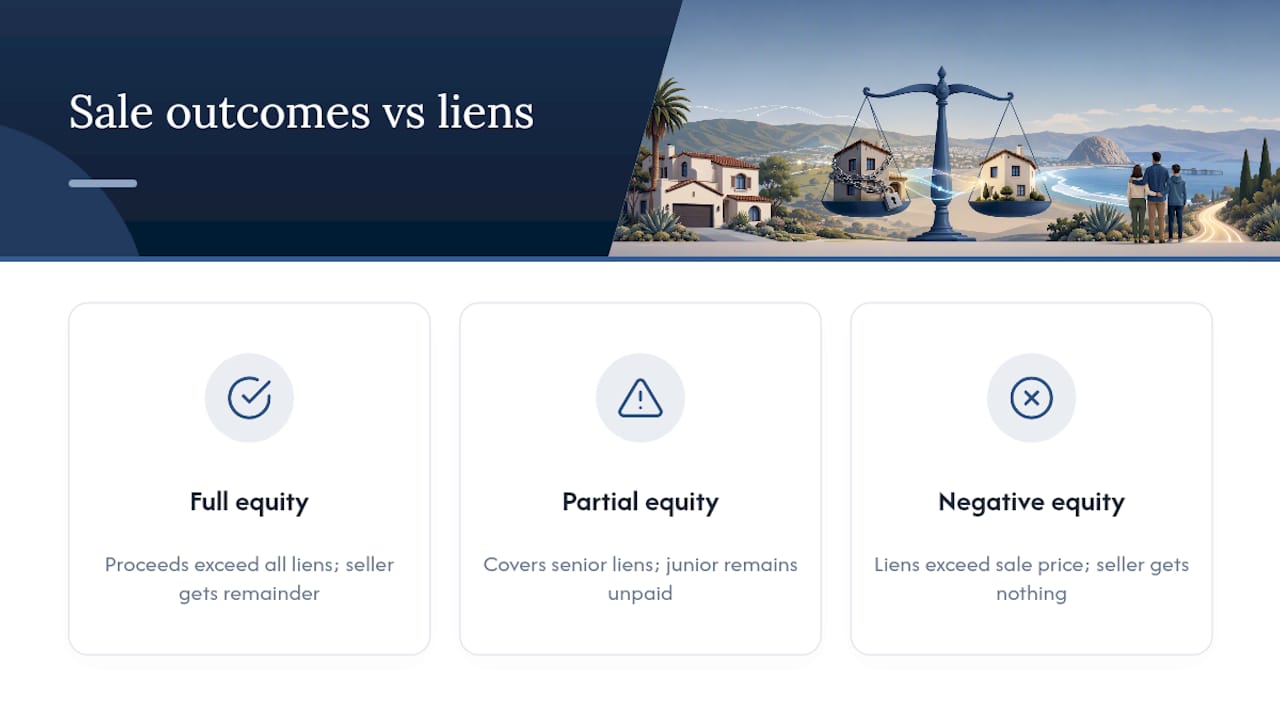
Partial equity. Sale proceeds cover the higher-priority liens (mortgage, tax lien) but come up short for lower-priority ones (a small judgment, an HOA balance). You'll need to negotiate with the junior lienholder or bring cash to closing to make up the gap.
Negative equity. Total liens exceed what the home will sell for. This is where short sales, negotiated settlements, or a cash sale become real options rather than backup plans.
Pro Tip: Don't assume your mortgage is the only voluntary lien in play. If you took out a home equity line of credit or a second mortgage, that's a separate lien with its own place in the payoff line, and it needs its own payoff letter.
How Do You Find and Verify Every Lien Before You List?
You want to know what's recorded against your home before a buyer's lender finds out for you. Two paths get you there:
- Order a preliminary title report. A title company runs a full search of public records and returns every recorded lien, judgment, and encumbrance tied to your property. This search typically incurs a cost within a moderate range (https://www.opendoor.com/articles/can-you-sell-a-home-with-a-lien-on-it) and can surface issues four to six weeks earlier than waiting for the buyer's own title work.
- Search county recorder records yourself. Most county recorder offices post searchable indexes online. This costs nothing but takes more legwork, and you need to know how to read what you find.
- Pull your own credit report. Judgment liens and some tax liens show up here, giving you a second cross-check against what the title search returns.
When you're reading a lien document, four fields matter most: the lien amount, the date it was recorded, the claimant's name, and the legal description of the property. A mismatched legal description or an outdated amount is often your first clue that a lien might be resolvable through correction rather than payment.
Once you've confirmed a lien exists, request a payoff letter from the lienholder. This document states the exact amount owed as of a specific date, including any per-diem interest that accrues daily until the debt is settled. Payoff amounts on tax liens and judgments often creep up by the day, so an outdated payoff letter can leave a gap at the closing table that nobody budgeted for.
After you pay any lien, don't assume the job is done. Confirm the recorded lien release, sometimes called a satisfaction, actually appears in the county index. Title companies typically require this recorded release before issuing an owner's policy, and delays in recording are common enough that you should follow up rather than wait passively.
How Do You Actually Get Liens Resolved So the Sale Can Close?
Most liens get handled the same straightforward way: escrow requests a payoff letter from each lienholder, calculates the payoff amounts into the settlement statement, and disburses funds directly to each creditor at closing before you see a dime. For a standard mortgage and a small judgment with enough equity behind them, this process is close to automatic.
Where it gets more hands-on is negotiation. Lienholders, especially those holding judgment liens or old medical debt, will sometimes accept less than the full amount owed to get paid faster and avoid a longer collection fight. If you go this route, get everything in writing. A verbal agreement to "settle for less" means nothing at the closing table, and you need to confirm whether the creditor is issuing a full satisfaction or just a partial release that preserves their right to chase you for the remaining deficiency later. That distinction changes what you owe after the sale closes, so don't skip reading the fine print.
Federal tax liens follow their own rulebook, and this is where sellers most often get blindsided by timing.
- The IRS requires a Certificate of Discharge, filed using Form 14135, to remove a federal tax lien from a specific property so the sale can proceed.
- You need to submit that application well in advance of your closing date to allow sufficient processing time. Filing late may cause a closing delay that could jeopardize the sale.
- If you're on a Fresh Start installment agreement, you may qualify for a lien withdrawal instead of a mere discharge. According to IRS guidance on federal tax liens, a withdrawal removes the public notice of the lien entirely, which can help your credit more than a discharge that only clears the one property.
- The IRS more often waits to collect at the time of sale or refinance rather than foreclosing outright, though Nolo notes foreclosure is still possible when there's sufficient equity and a large unpaid balance.
Pro Tip: If you have a federal tax lien, call the IRS Centralized Lien Operation the moment you accept an offer, not the week before closing. The 45-day clock starts when your application is complete, not when you first call, and any missing paperwork resets it.
For liens that are simply wrong, filed against the wrong legal description, the wrong owner, or a debt that was already paid, you're not stuck negotiating with a legitimate creditor. A quiet-title action or a court-ordered release can strike an invalid lien from the record. In active disputes where you need to close before litigation resolves, posting a surety bond is a practitioner's move that lets the lien drop off the title while the underlying dispute plays out separately.
What Happens at the Closing Table When Liens Are in Play?
The title company does its work long before closing day. Its search identifies every recorded lien and lists them as "exceptions" on the title commitment, which is the document that tells everyone, buyer, lender, and seller, exactly what needs to be cleared before the deal can fund.
On closing day itself, escrow's settlement statement lays out the disbursement order: highest-priority liens get paid first, then junior liens, then any remaining proceeds come to you. This is the same "first in time, first in right" priority rule playing out with real dollars.
Lenders require title insurance precisely because an unresolved lien can sink a buyer's mortgage approval at the last minute. No title company will insure over a known exception it hasn't cleared, and no lender will fund a loan the title company won't insure.
Your job doesn't end when you sign the closing papers. Walk through this checklist afterward:
- Verify recorded releases within 30 to 60 days. Check the county recorder's index yourself rather than trusting that paperwork was filed automatically.
- Follow up immediately if a release is missing. Contact the lienholder or the title company that handled the payoff and request confirmation of the recording.
- Keep copies of every payoff letter and release for your own records, since a missing release years later can complicate a future refinance or sale for whoever owns the property next.
If you're closing on a tight timeline where a payoff and a discharge both need to land the same day, ask your escrow officer about a simultaneous closing structure to keep everything synchronized.
What If Your Liens and Mortgage Exceed What Your House Is Worth?
When total debt against your property outpaces what buyers will realistically pay, you have four real paths forward, and they carry very different timelines.
- Short sale. Your lender agrees to accept less than the full mortgage balance to allow the sale to close. You'll need to submit a hardship package documenting your financial situation, and approval can take weeks to months depending on the lender's backlog.
- Deed in lieu of foreclosure. You hand the property back to the lender directly instead of selling it. This avoids a foreclosure filing on your record, but you may still face deficiency exposure depending on your state and loan terms, so read the agreement carefully before signing.
- Cash buyer sale. A cash buyer purchases the home as-is, often coordinating payoff letters and lien releases directly through escrow rather than requiring the extended approval process a short sale demands. The tradeoff is typically a lower sale price in exchange for speed and certainty.
- Bankruptcy consultation. Speaking with an attorney about Chapter 7 or Chapter 13 can change how certain liens, particularly judgment liens, are treated, and in some cases can help you avoid an eventual foreclosure filing entirely.
If foreclosure is already looming, timing becomes everything. A fast cash offer can sometimes stop an auction that a short sale's slower approval process would never catch in time. For readers dealing specifically with back taxes, this guide on selling with tax liens walks through a similar payoff workflow in more detail.
What We've Learned Handling Liened Properties in San Luis Obispo County
Sellers almost always underestimate how much lead time a lien resolution needs, especially federal tax liens with that 45-day discharge window. The mistake we see most often isn't ignorance of the lien itself, it's waiting until an offer is already accepted to start the paperwork, which turns a manageable timeline into a scramble.
A cash sale earns its keep specifically in these situations. When we buy a property as-is, we can coordinate directly with lienholders on payoff letters and confirm releases get recorded, without the extra weeks a traditional buyer's mortgage underwriting adds on top of the lien resolution itself. That combination matters most for sellers facing a foreclosure clock, a mounting HOA balance, or multiple liens eating into thin equity.
That said, a cash sale isn't the right call for everyone. If you have significant equity after your liens are paid and time isn't working against you, listing traditionally will likely net you a higher price. We'd rather tell you that upfront than pretend one path fits every seller.
— Abel
Sell Your Liened House Fast, Without Untangling the Paperwork Yourself
SLO Cash Buyer - San Luis Obispo County Home buyer exists for exactly the situation this article just walked through: a home with liens, a payoff amount that needs coordinating, and a clock that's already ticking. Instead of waiting on short sale approval or juggling payoff letters between three different creditors on your own, we handle that coordination directly through escrow while making you a fair cash offer on the home as-is.

Before your first call with us, gather any payoff letters you already have, your most recent mortgage statement, and any notices from lienholders. That's enough for us to give you a real cash offer, no repairs, no cleaning, and no agent commissions eating into what you walk away with. If you're sitting on a liened property in San Luis Obispo County and need a clear path to closing, request your cash offer here and let's figure out your fastest way to clear title.
Where to Verify Lien Rules and Forms Yourself
For federal tax lien procedures and Form 14135 instructions, go directly to the IRS's guidance page. For lien type primers, check NAR's lien overview or Nolo's property lien encyclopedia. Your county recorder's online portal remains the fastest way to confirm exactly what's recorded against your specific property today.
This article is general information, not a substitute for advice from a qualified financial advisor. Consult a qualified financial professional about your own circumstances before acting on anything here.