
When you sell a house with a solar lease, you have three practical paths: transfer the lease to the buyer, buy it out yourself, or prepay it so the buyer inherits a paid-off system. The fastest way to avoid a stalled closing is to call your solar provider's transfer team today and get a written payoff quote and transfer timeline. If speed and certainty matter more than squeezing out top dollar, a cash sale can sidestep most of this entirely.
TL;DR:
- Starting the transfer or buyout process early, ideally 30 to 60 days before listing, significantly reduces closing delays caused by lease approval or title issues.
- Addressing the UCC-1 filing promptly with a lien release or formal payoff can prevent title holds from delaying closing.
- Homes with owned solar systems tend to sell at a price premium, whereas leased systems rarely add value and can complicate or slow the sale.
- If a buyer refuses to assume the lease or credit issues arise, paying off the lease yourself or selling for cash offers a faster, more certain closing.
- Prioritizing certainty and on-time closing often outweighs maximizing sale price when dealing with lease transfer hurdles.
Table of Contents
- What Are Your Options When You Sell a House With a Solar Lease?
- How Do You Start the Solar Lease Transfer Process?
- What Title Issues and UCC-1 Filings Can Delay Closing?
- Does a Leased Solar System Hurt Your Home's Value?
- What If the Buyer Won't Assume the Solar Lease?
- Who Handles What: Agent, Title Company, and You
- When Does a Cash Sale Make More Sense Than Fighting the Lease?
- The Real Lesson in Selling With a Solar Lease
- Want a Faster, Simpler Way to Sell With a Solar Lease?
- Primary Sources and Further Reading
- Sources
- FAQ
What Are Your Options When You Sell a House With a Solar Lease?
Every homeowner with a leased system faces the same three doors: transfer, buyout, or prepay. Which one fits depends on how much cash you have on hand, how badly you want a clean closing, and whether your buyer can pass a credit check.
Transfer means the buyer takes over your lease or power purchase agreement exactly as it stands. This costs you the least out of pocket, but it adds a dependency you don't control: the leasing company has to approve the new homeowner, and that means a credit check and paperwork timeline that runs on the lessor's schedule, not yours.
Buyout means you pay off the system before or at closing, so the buyer gets a home with owned solar. This tends to widen your buyer pool and can simplify the appraisal, but early-lease buyouts are sometimes restricted or priced high because of tax-equity financing rules built into the original lease.
Prepay splits the difference. You pay the remaining lease value in a lump sum, calculated as a net present value, and the buyer takes over a system with zero future payments. It's a common compromise because it removes the credit-check hurdle entirely while costing less than a full ownership buyout.
- Transfer: lowest upfront cost, but buyer approval can stall or kill the deal
- Buyout: cleanest title, broadest buyer appeal, but can be expensive or unavailable early in a lease
- Prepay: buyer gets a zero-payment system, seller avoids the credit-check bottleneck
How Do You Start the Solar Lease Transfer Process?
Waiting until you're under contract to deal with your lease is how closings get delayed by weeks. Start these steps as soon as you decide to list.
- Call your provider's transfer or home-sale team first. Sunrun's documented process, for example, starts online, moves through a service transfer form, and requires the buyer to pass a credit check before closing paperwork is finalized. Ask for that timeline in writing.
- Request a written payoff or prepayment quote. Get the exact dollar figure and ask directly what credit standards a buyer will need to meet.
- Gather your documents now: the lease or PPA itself, the interconnection agreement, net-metering paperwork, any system warranty, and details on the UCC-1 filing tied to your account.
- Loop in your real estate agent, title company, and escrow officer immediately, and open the transfer application 30 to 60 days before your target closing date.
Pro Tip: Ask your provider for the transfer timeline in writing, not just verbally. A vague verbal promise of "a couple of weeks" has caused more blown closing dates than any other single miscommunication in solar-lease sales.
What Title Issues and UCC-1 Filings Can Delay Closing?
A UCC-1 financing statement is how the leasing company protects its financial interest in the equipment on your roof. It isn't technically a lien against your real property, but it shows up on a standard title report, and title companies flag it every time. If it isn't addressed, it can hold up a mortgageable, clean title right at the closing table.
Resolving it usually means requesting one of three documents from your lessor: a lien release, a subordination agreement, or a formal payoff letter. Ask for these the moment you list, because turnaround can run one to several weeks depending on the provider.
If your buyer fails the lessor's credit check, you have options that don't require restarting the whole sale:
- Pre-screen serious buyers before they make an offer, so credit issues surface early
- Offer to prepay the lease yourself using sale proceeds
- Keep a backup buyer in your pocket in case the first deal falls through
Does a Leased Solar System Hurt Your Home's Value?
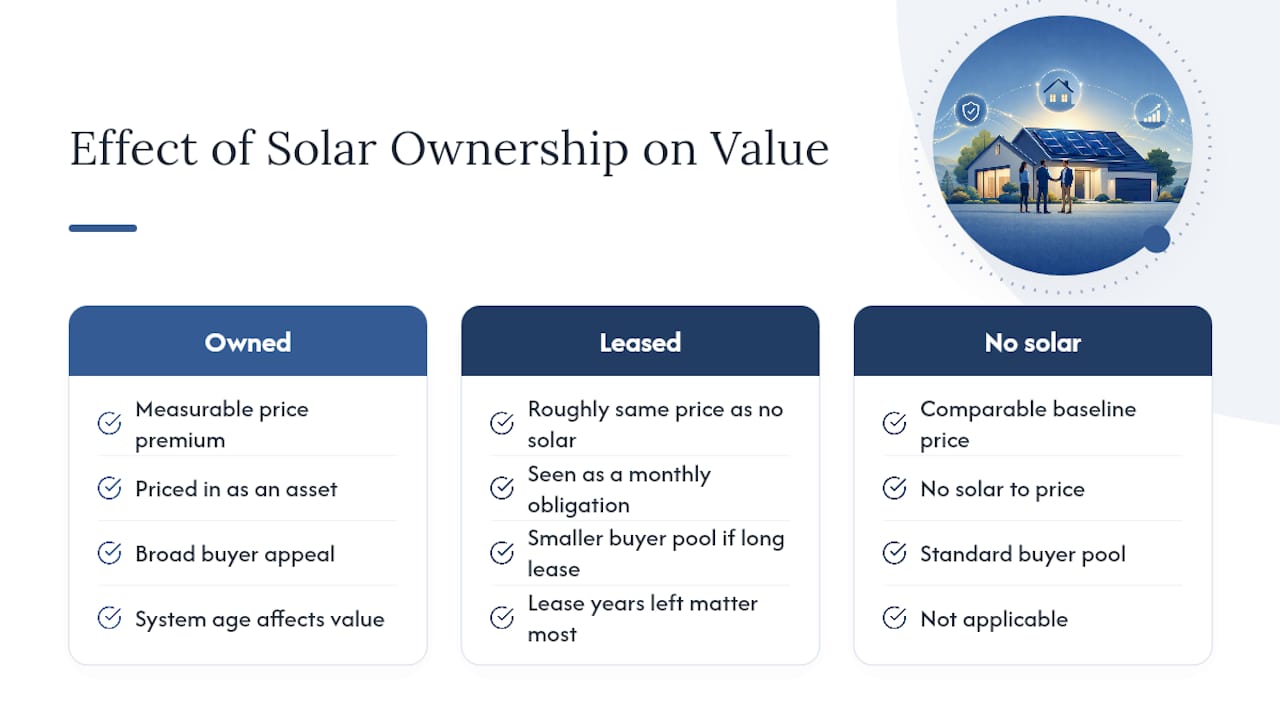
Owned solar systems tend to carry a real price premium at resale. Leased systems generally don't. Berkeley Lab's research on solar and home prices found that homes with owned solar sold for measurably more in many markets, while homes with third-party-owned, leased systems sold for roughly the same price as comparable homes with no solar at all.
Why the gap? Appraisers can price an owned system into the home's value the way they'd price a renovated kitchen. A lease is a monthly obligation attached to the house, not an asset baked into it, so it doesn't add value the same way. System age matters too: a lease with years left and built-in payment escalators tends to shrink your buyer pool more than a system nearing its lease-end buyout window.
What If the Buyer Won't Assume the Solar Lease?
Not every buyer wants to inherit someone else's contract, and you shouldn't count on one who will. Have a backup plan ready before you list.
- Prepay the remaining lease value out of your sale proceeds, handing the buyer a system with no future payments attached.
- Explore a fair-market-value or later-term buyout if your lease allows it, then weigh that cost against the owned-solar premium research shows it might recover.
- Remove the system entirely as a last resort. It's expensive and usually the least attractive option.
- Sell for cash if none of the above make financial sense on your timeline. A cash buyer can absorb the lease complication instead of walking away from it.
Who Handles What: Agent, Title Company, and You
Nobody should be guessing who's responsible for which piece of this. Divide it clearly from day one.
- Your agent adds the lease details to disclosures and MLS listings, explains the arrangement to prospective buyers, and coordinates early credit pre-screening.
- Title and escrow request payoff or release letters, confirm the UCC-1 status on the title report, and manage any subordination paperwork with the lessor.
- You track every written quote you receive, start the transfer application early, and hand your documents to escrow before they're asked for twice.
When Does a Cash Sale Make More Sense Than Fighting the Lease?
Sometimes the math doesn't favor waiting out a buyer's credit approval. If you're facing foreclosure, major repairs beyond the solar issue, or a hard deadline to relocate, certainty is worth more than chasing top dollar. A cash buyer typically asks for your lease documents, current payoff figures, and basic property details, then gives you a firm timeline instead of a hope-so timeline.
The Real Lesson in Selling With a Solar Lease
Most guidance on this topic treats the solar lease as a paperwork inconvenience to muscle through. That's backwards. The lease is often the single biggest variable determining whether your closing happens on schedule or drags into a second or third extension.
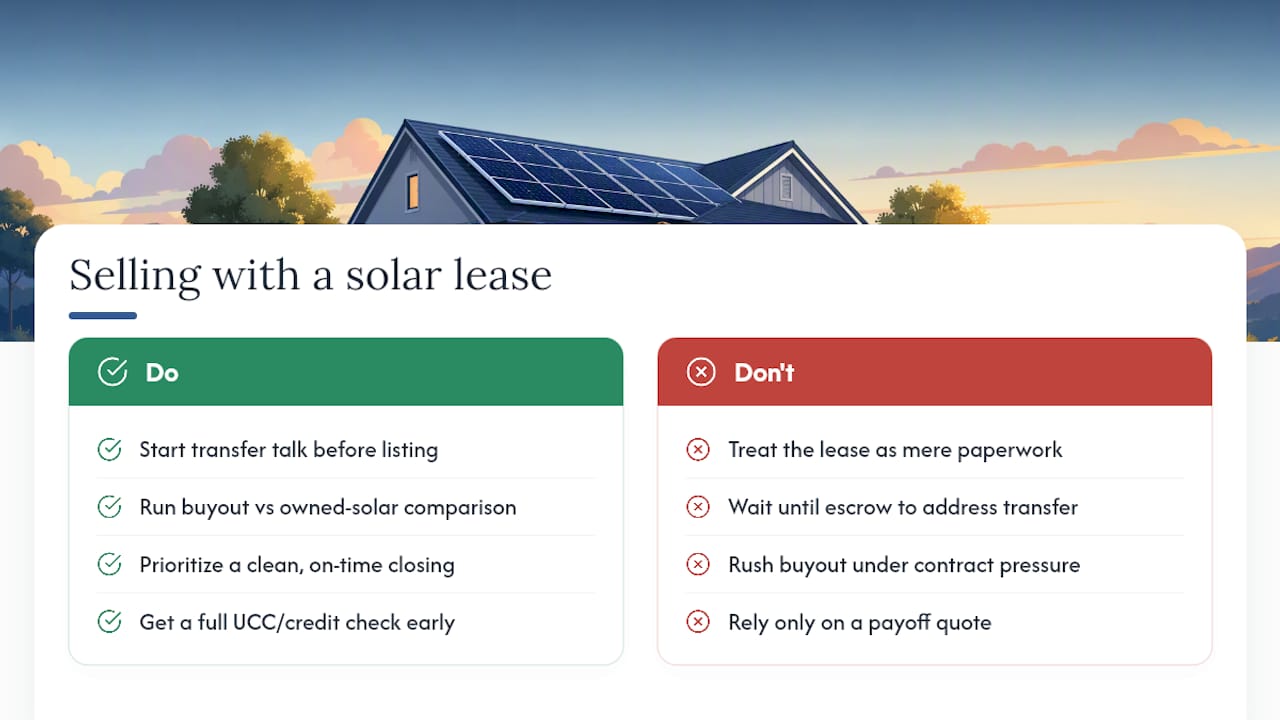
The conventional advice, get a payoff quote and move on, undersells how much a UCC-1 filing or a failed credit check can unravel a deal that looked solid two weeks earlier. What the research actually supports is starting the transfer conversation absurdly early, before you've even listed, and treating the buyout math as a real financial comparison against the owned-solar premium documented by Berkeley Lab, not a rushed decision made under contract pressure.
If you take one thing from this: prioritize certainty over optimizing for an extra few thousand dollars in sale price. A clean, on-time closing beats a theoretically better outcome that falls through in week five.
— Abel
Want a Faster, Simpler Way to Sell With a Solar Lease?
Chasing lease transfer approvals, UCC-1 releases, and buyer credit checks takes weeks you might not have. You can get a cash offer on your home as-is, lease and all, with no repairs, no cleaning, and no hidden fees eating into your proceeds.

Here's how it works. You submit your property details and your lease documentation, we review the payoff or transfer status directly with your provider, and you get a written cash offer with a closing timeline that's actually yours to choose. No waiting on a buyer's credit approval. No guessing whether the UCC-1 gets cleared in time. If foreclosure, major repairs, or a tight relocation deadline has you needing a sale that closes on schedule, request your cash offer from SLO Cash Buyer and see the number before you commit to anything.
Primary Sources and Further Reading
For deeper detail, see Berkeley Lab's price-premium research, Solar.com's seller guide, Sunrun's transfer process, and Realtor.
This article is general information, not a substitute for advice from a qualified financial advisor. Consult a qualified financial professional about your own circumstances before acting on anything here.
Sources
- Selling the Sun: price premium analysis — LBNL
- Solar
- Service transfer: buying a Sunrun solar home — Sunrun
- Realtor
FAQ
What happens if I sell my house with leased solar panels?
You'll typically transfer the lease to the buyer, buy it out yourself, or prepay it before closing. Each option affects your timeline and your buyer pool differently, so start the conversation with your provider as soon as you list.
Can you get out of a solar lease contract?
Yes, usually through a buyout or prepayment of the remaining contract value, though early-lease buyouts can be restricted or costly due to the tax-equity financing structure many leases use.
Should I buy a house that has leased solar panels?
It depends on the lease terms, remaining balance, and whether you're comfortable with a credit-check transfer process, since leased systems don't carry the same resale premium as owned solar systems.
Is it difficult to sell a house with solar panels?
Owned solar generally sells easily and can add value. Leased solar adds extra steps like buyer credit checks and UCC-1 title clearance, which can slow things down if you don't start the transfer process early. If avoiding that friction matters more than maximizing price, a cash sale through a buyer like SLO Cash Buyer sidesteps the lease-transfer process entirely.