Rental property appreciation is simply the increase in a property's market value over time, and it usually makes up the largest piece of your total return if you hold long enough. The catch is that it stays on paper until you sell or refinance. Here's the bottom line: appreciation works alongside two other forces you already control.
- Cash flow puts money in your pocket every month
- Principal paydown builds equity with every mortgage payment
- Appreciation grows in the background, often the biggest wealth driver of the three
Key Takeaways
Rental property appreciation is unrealized market value growth that, combined with principal paydown, often produces the largest share of long-term total return, but only for investors who underwrite conservatively and hold long enough to capture it.
| Point | Details |
|---|---|
| Appreciation is one of four return sources | Cash flow, principal paydown, appreciation, and tax benefits together make up total return. |
| Two types exist | Natural appreciation comes from the market; forced appreciation comes from renovations and NOI improvements you control. |
| Compounding rewards patience | A 5% versus 2% annual rate over 10 years can nearly triple the equity gain on the same property. |
| Underwrite at 0% appreciation first | If cash flow alone doesn't work, appreciation shouldn't be the reason you buy the deal. |
| Selling beats waiting in some cases | SLO Cash Buyer - San Luis Obispo County Home buyer offers landlords facing repairs, problem tenants, or high carrying costs a fast, as-is cash sale instead of holding for uncertain appreciation. |
Table of Contents
- What Is Rental Property Appreciation and Why It Drives Total Return
- Natural Appreciation vs. Forced Appreciation: What's the Difference?
- What Factors Actually Drive Property Value Growth?
- How Do You Calculate Appreciation's Effect on ROI?
- How Landlords Force Appreciation Through Property Improvements
- When Is It Risky to Count on Appreciation?
- When Landlords Choose to Sell Instead of Waiting for Appreciation
- How Are Appreciation Gains Taxed When You Sell?
- How Has Property Appreciation Trended Historically Across Regions?
- Does Inflation Help or Hurt Rental Property Appreciation?
- How Does Rental Property Appreciation Compare to Stocks and Other Assets?
- How Should Appreciation Factor Into Your Underwriting?
- Why I Tell Investors to Underwrite Conservatively
- When Selling for Cash Beats Waiting on the Market
- Where to Check Appreciation Data Before You Buy or Sell
- Sources
What Is Rental Property Appreciation and Why It Drives Total Return
Ask any experienced landlord where the real money gets made, and most will tell you it's not the monthly rent check. It's the equity that quietly builds while tenants pay down your mortgage and the market does its thing. Total return on a rental property comes from four distinct sources working together, not one number on a spreadsheet.
- Cash flow. Rent collected minus expenses and mortgage payment, paid to you now.
- Principal paydown. Every mortgage payment shifts a little more of the loan balance into your pocket, functioning as forced savings you'd never build on your own.
- Appreciation. The property's market value grows as the market or the property itself improves.
- Tax benefits. Depreciation and other deductions reduce your taxable income along the way.
Pro Tip: A property earning modest monthly cash flow can still deliver outstanding total return if appreciation and paydown are doing their job. Don't judge a deal on cash flow alone.
Over a 7 to 10 year hold, appreciation frequently produces the largest single share of total return, especially once you factor in how equity growth compounds year over year rather than adding up in a straight line.
Natural Appreciation vs. Forced Appreciation: What's the Difference?
Appreciation splits into two distinct categories, and knowing which one you're counting on changes how you should invest. Natural, or market, appreciation happens without you lifting a finger — it's driven by broader economic forces beyond any single owner's control.
- Natural appreciation rises from population growth, job creation, low housing supply, or falling interest rates that pull more buyers into the market.
- Forced appreciation comes from what you do to the property: a kitchen remodel, converting a garage into a rentable unit, or simply raising rents to match market rates after a lease turns over.
The distinction matters because forced appreciation is the one lever you can actually pull. Increasing a property's net operating income through renovations or better management doesn't just raise your rent roll. It raises the property's appraised value under cap-rate math, often by a multiple of the NOI gain itself.
What Factors Actually Drive Property Value Growth?
Forecasting appreciation isn't guesswork if you know where to look. Market-level and property-level signals both matter, and separating the two keeps you from confusing a citywide trend with a block-specific opportunity.
Market-level drivers to watch:
- Job growth and population trends in the metro area
- Constrained housing supply relative to demand
- Interest rate movement, which affects buyer purchasing power
- Rising construction costs, which make new competing supply more expensive to build
These forces shape long-term price trends at the regional level, but appreciation doesn't distribute evenly even within the same city.
Property-level drivers worth checking block by block:
- School district quality and ratings
- Proximity to transit and major employers
- Zoning flexibility for future use changes
- Visible neighborhood reinvestment, like new retail or infrastructure
Pro Tip: Pull historical price data from the FHFA's housing price index before assuming a national trend applies to your neighborhood. Metro averages routinely mask what's happening two zip codes over.
How Do You Calculate Appreciation's Effect on ROI?
Appreciation compounds the same way interest does, which means small annual differences turn into large gaps over a full hold period. The formula is straightforward: future value equals current value multiplied by (1 plus the annual rate), raised to the number of years held.
Run the same $400,000 property through three scenarios over 10 years:
- 0% appreciation. Value stays at $400,000. Your entire return comes from cash flow and paydown alone.
- 2% annual appreciation. Value climbs to roughly $488,000, adding nearly $88,000 in equity with zero extra work.
- 5% annual appreciation. Value reaches about $652,000, more than $250,000 in gained equity on the same purchase.
The gap between 2% and 5% isn't linear. It nearly triples because compounding rewards patience disproportionately in the later years of a hold. Historical national averages often land near 3% annually, though local outcomes vary widely, so treat any single figure as a scenario input, not a promise. Leverage amplifies this further: if you put 20% down, that equity gain represents a return on a much smaller cash investment than the property's full price.
How Landlords Force Appreciation Through Property Improvements
You don't have to wait on the market to build equity. Some of the highest-return moves cost very little relative to the value they unlock, while others require real capital and patience.
Start with low-cost, high-impact work: fresh paint, updated fixtures, and curb appeal improvements often return more in appraised value than they cost, especially on a property that's been neglected for years.

Operational fixes matter just as much. Reducing vacancy, screening tenants carefully to avoid turnover, pushing legal rent increases at renewal, and adding ancillary income like storage or parking fees all raise NOI directly.
Bigger swings, like adding a unit or reconfiguring square footage, carry real upside but come with permitting risk and higher upfront cost.
Pro Tip: Rank every project by payback period, not just total cost. A $3,000 upgrade that adds $150 in monthly rent pays for itself in 20 months, and that NOI bump scales into a larger jump in appraised value once you apply the market's cap rate.
When Is It Risky to Count on Appreciation?
Appreciation is the least predictable of the four return buckets, and treating it as guaranteed is how landlords get burned. Market cycles turn, and when interest rates stay elevated, appreciation becomes less reliable because higher borrowing costs shrink the pool of qualified buyers pushing prices up.
- Plan for a minimum hold of 7 to 10 years, or longer, before betting heavily on appreciation to carry your return.
- Keep cash reserves on hand so a soft market doesn't force a bad-timing sale.
- Set a clear exit trigger in advance: a target price, a maximum vacancy threshold, or a repair cost ceiling that tells you it's time to sell rather than wait.
A deal that only works if appreciation shows up isn't a deal. It's a bet.
When Landlords Choose to Sell Instead of Waiting for Appreciation
Not every hold period ends well, and plenty of landlords reach a point where selling now beats waiting for a market that may or may not cooperate. Common triggers include:
- A property needing repairs that would cost more than the equity gained by waiting
- A problem tenant situation draining time and money faster than rent covers it
- Rising carrying costs or a looming foreclosure timeline that limits your options
- Simply wanting out of landlording without the hassle of listing, repairs, or selling a tenant-occupied home
A cash sale locks in the equity you already have instead of risking it on an uncertain forecast.
How Are Appreciation Gains Taxed When You Sell?
Appreciation only becomes a taxable event when you sell or refinance, which is one reason it's called "unrealized" gain while you hold the property. Once you sell, the profit above your adjusted cost basis is generally taxed as a capital gain, and the rate depends heavily on how long you owned the property.
Hold a rental for one year or less and any gain gets taxed at your ordinary income rate, the same bracket that applies to your salary. Hold it longer than a year, and the gain typically qualifies for long-term capital gains rates, which run lower than ordinary income tax for most investors. That distinction alone is a strong argument for the 7 to 10 year hold periods that make appreciation strategies work in the first place.
There's a wrinkle specific to rental property called depreciation recapture. Every year you own a rental, you likely claimed depreciation deductions that lowered your taxable rental income. When you sell, the IRS "recaptures" that benefit by taxing the recaptured portion at a different rate, up to 25%, separate from your regular capital gains rate on the rest of the appreciation.
Investors looking to defer taxes on appreciation gains often explore a 1031 exchange, which allows you to roll proceeds from a sold rental into a new one without immediately triggering the capital gains or recapture tax bill. The rules around timelines and like-kind property are strict, and a mistake can void the exchange entirely, so this is a conversation for a tax professional, not a DIY project.
A cash sale doesn't change these tax mechanics. Whether you sell to a traditional buyer or a cash buyer, the same capital gains and recapture rules apply based on your hold period and depreciation history.
How Has Property Appreciation Trended Historically Across Regions?
Appreciation doesn't move at a single national speed. It moves in waves that hit different metros at wildly different times, and the gap between the best and worst-performing regions in any given decade can be enormous.
The figure most often cited as a "normal" long-term national average sits around 3% annually, but that number smooths over decades of booms, corrections, and flat stretches that looked nothing alike from the inside. A coastal metro with severe supply constraints can post years of appreciation well above that average, while a market with abundant land and easy permitting for new construction can sit flat for years even during a national upswing.
Regional differences don't stop at the metro line, either. Studies using granular, neighborhood-level data have found substantial variation in appreciation even within the same city, driven by local supply and demand dynamics, school boundaries, and reinvestment patterns that a citywide average simply can't capture.
That's why pulling metro-wide statistics and calling it research is a mistake. The FHFA's housing price index breaks data down to the regional level, letting you compare your specific market against the national baseline rather than assuming your street behaves like the headline number. If you're evaluating a rental purchase, spend the extra hour cross-referencing local comps against these broader indices.
Does Inflation Help or Hurt Rental Property Appreciation?
Inflation and rental appreciation tend to move in the same direction, and that relationship is one of the strongest arguments landlords make for holding real estate through inflationary periods.
When the cost of labor, materials, and land rises, the cost to build new housing rises with it. That makes existing homes relatively more valuable because replacing them gets more expensive, one of the construction-cost pressures that feeds directly into appreciation. At the same time, rents tend to climb alongside general price levels, which supports the income side of your return even as your mortgage payment on a fixed-rate loan stays flat.
That fixed-rate detail matters more than most new investors realize. If you financed your rental with a 30-year fixed mortgage, inflation effectively erodes the real value of your debt over time while your rental income and the property's nominal value both climb. You're paying back a loan with dollars that buy less every year, while collecting rent priced in today's dollars.
The flip side is interest rates. Central banks typically raise rates to fight inflation, and higher rates cool buyer demand, which can slow appreciation even while replacement costs keep climbing. That tension is exactly why 2026's rate environment has made appreciation less predictable than it was during the ultra-low-rate years of the last decade. Inflation supports the case for appreciation over the long run, but it doesn't guarantee it shows up on your specific timeline.
How Does Rental Property Appreciation Compare to Stocks and Other Assets?
Every asset class grows in its own way, and rental property's version of growth looks nothing like a stock portfolio's.
Stock market gains show up as pure price appreciation on paper, with dividends as a smaller secondary layer, and you can sell a share in seconds without needing a buyer to tour the property first. Rental property appreciation, by contrast, comes bundled with cash flow, principal paydown, and tax benefits, and none of it is liquid until you sell or refinance. That illiquidity cuts both ways. You can't panic sell a rental in a market dip the way you might dump a stock, which forces a longer time horizon, but it also means you're not watching your net worth swing daily on a screen.
Bonds and savings accounts offer something rental property appreciation doesn't: near-certainty. A treasury bond's return is locked in at purchase. Rental appreciation is a forecast, not a guarantee, shaped by local job growth, supply constraints, and interest rates that can shift over your hold period.
Where rental property pulls ahead is the leverage. A stock investor buying $100,000 of shares owns exactly $100,000 of exposure. A rental investor putting $100,000 down on a $500,000 property owns the appreciation on the full $500,000, not just their equity slice. That leverage is also why a downturn hurts more, since losses get magnified the same way gains do. Real estate isn't a replacement for a diversified portfolio, but it's one of the few common asset classes where a modest cash outlay controls a much larger appreciating asset.
How Should Appreciation Factor Into Your Underwriting?
The biggest underwriting mistake new investors make is running the numbers assuming appreciation will bail out a mediocre cash flow deal. Professional underwriting flips that logic: appreciation is treated as a bonus, never the foundation.
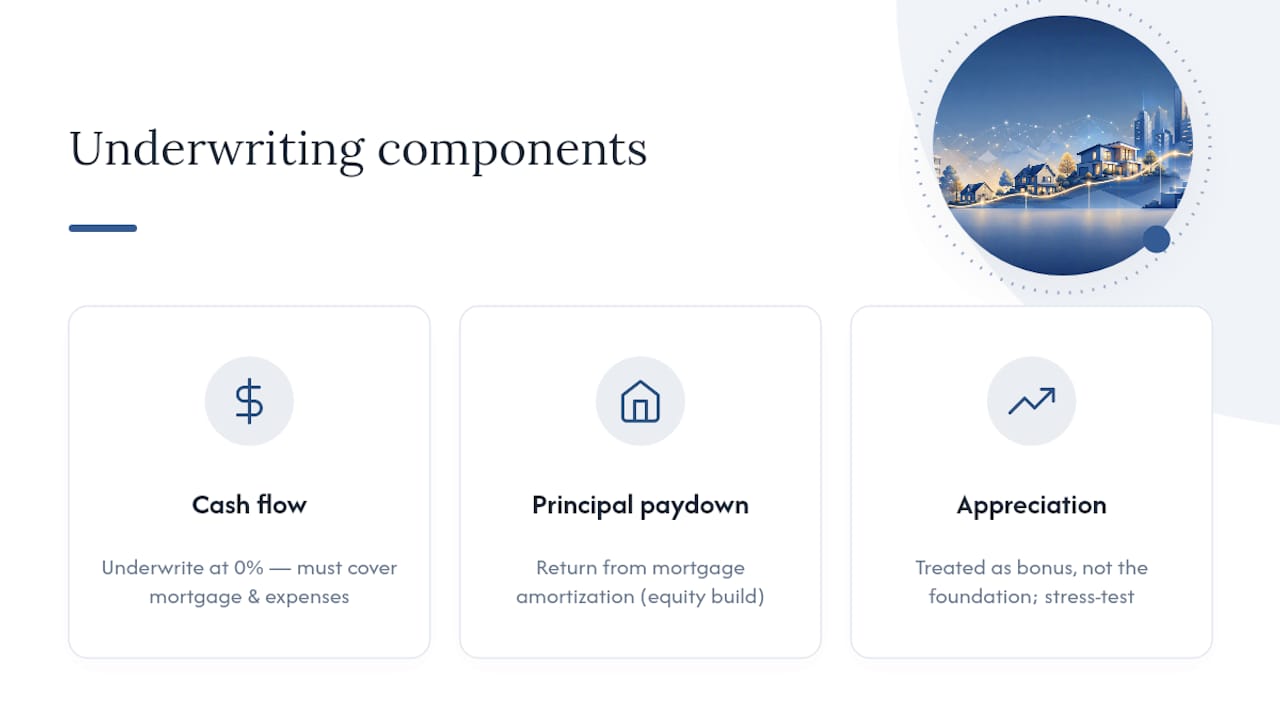
Start by underwriting the deal at 0% appreciation. If the cash flow and principal paydown alone make the numbers work, appreciation becomes pure upside rather than a rescue plan.
Then check what happens if rates rise further or the local market flattens for two or three years. Does the property still cover its mortgage and expenses? If not, your reserves need to be larger, or the deal needs a lower purchase price. This is also where checking a market's specific factors affecting rental value pays off before you commit capital, since local comps tell you far more than a national average ever will.
Why I Tell Investors to Underwrite Conservatively
The investors who get burned aren't the ones who ignore appreciation. They're the ones who underwrite it as a certainty. I've seen the same pattern play out across market cycles: someone buys on the assumption that "it always goes up," and the deal only makes sense if that assumption holds.
Underwrite to cash flow and paydown first. Let appreciation be the reward for patience, not the reason you signed the deal. If you're a landlord weighing whether to hold or sell, our resources on selling rental property walk through that decision in more depth.
When Selling for Cash Beats Waiting on the Market
If you've read this far and realized your property isn't positioned for the appreciation math to work in your favor, you're not stuck. SLO Cash Buyer - San Luis Obispo County Home buyer offers landlords in San Luis Obispo County a way out that doesn't depend on market timing at all: a fair cash offer on your property as it sits today, with no repairs, no cleaning, and no agent commissions eating into your equity.

That matters most for the landlords this article has been talking about all along, the ones facing costly repairs, a problem tenant situation, or carrying costs that make waiting for the next appreciation cycle a losing bet. Instead of listing, repairing, and hoping the market cooperates on your timeline, you get a straightforward offer and a closing date that fits your situation, not a buyer's mortgage approval schedule. If a major repair bill is the only thing standing between you and selling, that's exactly the gap a cash sale closes. Reach out to SLO Cash Buyer - San Luis Obispo County Home buyer today and get a no-obligation cash offer on your property, whatever condition it's in.
Where to Check Appreciation Data Before You Buy or Sell
The FHFA's housing price index gives you decades of regional price history to compare against any market you're considering. Redfin's market guides translate those trends into plain-language context for buyers and sellers, while Investopedia's real estate explainers are worth bookmarking whenever a term like cap rate or NOI needs a quick, reliable definition.
Sources
- What Is Appreciation in Real Estate? | Redfin
- Cash flow vs appreciation: which wins in 2026? | TrueCap
- Factors affecting the real estate market | Investopedia
- What is appreciation? | Deal Run
- FHFA housing price index datasets | FHFA