
A seller concession is a credit the seller agrees to pay toward the buyer's allowable closing costs or prepaid items at closing. It reduces how much cash the buyer needs to bring to the table, and it comes straight out of the seller's proceeds. Before you ask for one or agree to one, here are the four things that matter most:
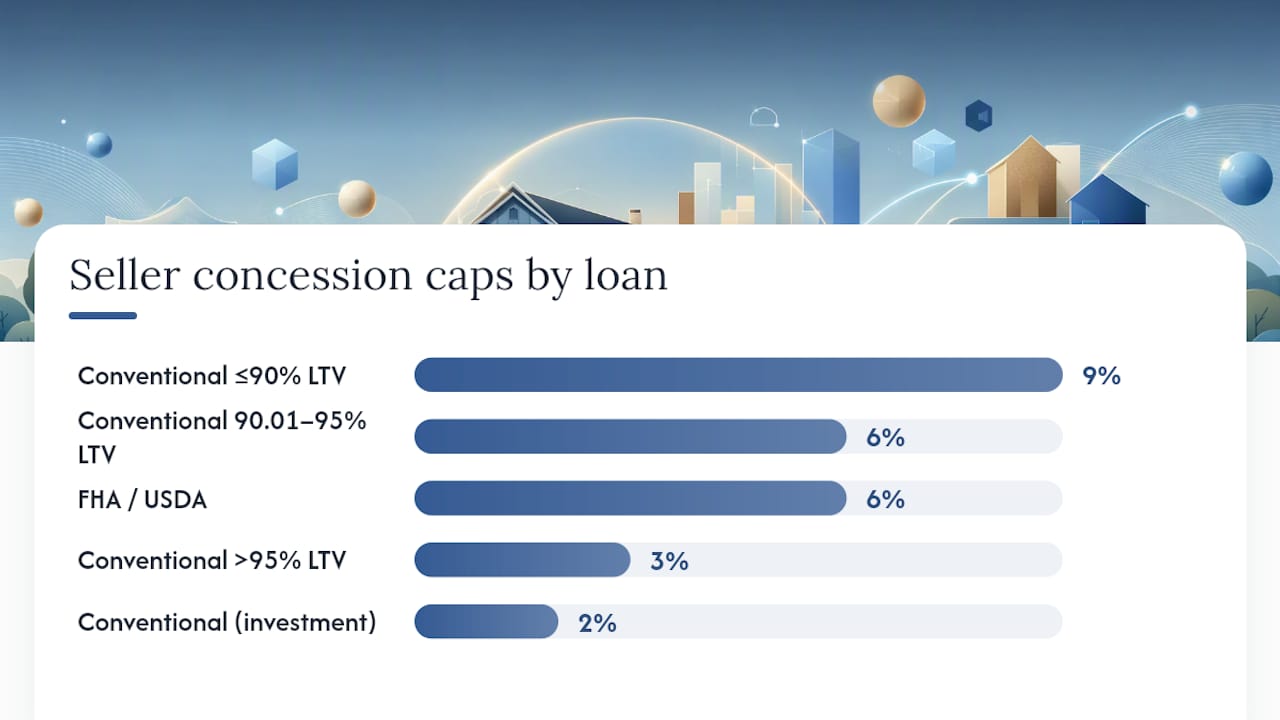
- Lender caps apply. Conventional loans cap seller concessions at 9%, 6%, or 3% of the lower of the sales price or appraised value, depending on your loan-to-value ratio and occupancy type. FHA and USDA loans cap contributions at 6% of the sales price. VA loans allow sellers to cover ordinary closing costs without a fixed cap, but limit broader concessions to 4% of the home's reasonable value.
- Concessions cannot fund the buyer's down payment or cash reserves. Per Credible's homebuyer guide, unused credit is not refunded to the buyer either.
- Excess credits get reclassified. If the concession exceeds what the buyer actually owes in closing costs, the surplus is treated as a sales concession and deducted from the sales price before the lender calculates the loan-to-value ratio.
- Everything is negotiated in the purchase contract. Concessions do not happen automatically; they require specific language in the offer.
Table of Contents
- What can seller concessions actually pay for?
- What are the loan-type caps on seller concessions?
- Who benefits from seller concessions, and what are the trade-offs?
- Worked examples: concessions, appraisals, and seller net proceeds
- Common mistakes and red flags to watch for
- What should you do next if you want seller concessions?
- Key Takeaways
- When concessions make sense and when they don't
- Authoritative sources and where to verify loan-specific rules
What can seller concessions actually pay for?
Seller concessions cover a defined list of costs. Knowing what's in and what's out prevents surprises at the closing table.
Eligible items:
- Loan origination fees
- Appraisal fee
- Title insurance and recording fees
- Escrow and settlement charges
- Prepaid items (homeowners insurance, prepaid interest, property tax escrow)
- Discount points / mortgage rate buydowns
Ineligible items:
- The buyer's down payment
- Cash reserves required by the lender
- Cash back to the buyer after closing
A seller-paid rate buydown is one of the most effective uses of concession space. If a buyer asks the seller to pay two discount points on a $350,000 loan, that credit reduces the buyer's interest rate for the life of the loan (or a set term, in a temporary buydown). The buyer gets a lower monthly payment; the seller pays the points at closing.
One important callout: if the concession exceeds the buyer's actual closing costs, the excess is not pocketed. Fannie Mae's IPC rules require that excess financing concessions be reclassified as sales concessions and deducted from the sales price, which can reduce the loan amount and force the buyer to bring more cash.
What are the loan-type caps on seller concessions?
Every loan program sets its own ceiling on how much a seller can contribute. The table below summarizes the key rules.
| Loan Program | Max Financing Concession | Calculation Base | Key Restriction |
|---|---|---|---|
| Conventional (LTV ≤ 90%) | 9% | Lower of sales price or appraised value | Cannot fund down payment or reserves |
| Conventional (LTV 90.01%–95%) | 6% | Lower of sales price or appraised value | Cannot fund down payment or reserves |
| Conventional (LTV above 95%) | 3% | Lower of sales price or appraised value | Cannot fund down payment or reserves |
| Conventional (investment property) | 2% | Lower of sales price or appraised value | All occupancy types |
| FHA / USDA | 6% | Sales price | Excess reduces purchase price before LTV |
| VA (ordinary closing costs) | No fixed cap | Reasonable value | Seller pays standard closing costs only |
| VA (broader concessions) | 4% | Home's reasonable value | Items beyond ordinary closing costs |
Fannie Mae's Selling Guide on interested party contributions defines financing concessions separately from sales concessions and explains exactly how the sliding scale applies. Fannie Mae also updated its Selling Guide in 2025 to clarify IPC definitions, revise lender-incentive treatment, and increase a lender-incentive threshold to $2,500, with implementation for loans with note dates on or after September 3, 2025.
When a concession exceeds the program cap, the lender doesn't simply ignore the excess. Fannie Mae's Desktop Underwriter job aid shows how underwriters reclassify the surplus as a sales concession and recalculate the LTV using the reduced sales price. That can shrink the loan amount and require the buyer to cover the gap. Per LegalClarity's summary of IPC limits, this reclassification applies across conventional, FHA, and investment-property loans.
Who benefits from seller concessions, and what are the trade-offs?
Concessions are not a win for everyone in every situation. Here's how the math and the incentives actually line up.
Buyer benefits:
- Lower cash-to-close, which matters most for buyers who are cash-light but income-qualified
- Ability to buy down the mortgage rate using the seller's credit
- Preserved cash reserves, which can strengthen the overall loan file
Buyer downsides:
- If the concession is rolled into a higher offer price, the buyer pays more interest over the life of the loan
- Appraisal risk: if the home doesn't appraise at the inflated offer price, the deal can stall
Seller benefits:
- Broader buyer pool, especially in a slower market where buyers struggle with upfront costs
- Faster sale without dropping the headline price
Seller downsides:
- Reduced net proceeds, since the credit comes directly out of what the seller walks away with
- Potential underwriting delays if the concession is structured incorrectly
Pro Tip: Before accepting an offer with a concession, calculate your actual net proceeds: take the agreed sale price, subtract the concession credit, subtract your own closing costs (agent commission, title fees, transfer taxes), and compare that number across competing offers. A higher headline price with a large concession can net you less than a lower offer with no concession. See the full closing costs breakdown for sellers to run the numbers accurately.
Worked examples: concessions, appraisals, and seller net proceeds
These three scenarios show how concessions play out in real transactions. The figures are illustrative; confirm all numbers with your lender and agent.
Example A: Clean conventional concession A buyer offers $350,000 on a home listed at $350,000 and asks the seller to credit $5,000 toward closing costs. The LTV is 94% (3.5% down is not applicable here; assume 5% down = $17,500 down, loan of $332,500). LTV is about 95%, so the cap is 3% of $350,000 = $10,500. The $5,000 credit is within the cap. The seller nets $350,000 minus $5,000 minus their own closing costs.
Example B: Roll-in strategy with appraisal shortfall A buyer offers $355,000 (above the $350,000 list price) and asks for a $5,000 seller credit. The property appraises at $350,000. The lender now bases the loan on $350,000. The seller credit must be recalculated against the appraised value, and the buyer may need to renegotiate the credit or bring additional cash to cover the gap.
Example C: FHA with excess concession A buyer offers $300,000 on an FHA loan and asks for $20,000 in seller concessions. The 6% FHA cap allows up to $18,000. The $2,000 excess is treated as an inducement and reduces the purchase price to $298,000 before the lender calculates LTV, per HUD Handbook 4000.1 guidelines. The buyer's loan amount drops, and they may need to cover the difference.
| Scenario | Offer Price | Concession | Appraised Value | Seller Net (before seller closing costs) | Lender Consequence |
|---|---|---|---|---|---|
| A: Conventional, clean | $350,000 | $5,000 | $350,000 | — | None; within cap |
| B: Roll-in, appraisal gap | $355,000 | $5,000 | $350,000 | Renegotiated | Credit recalculated to appraised value |
| C: FHA, excess concession | $300,000 | $20,000 | $300,000 | — | $2,000 excess reduces purchase price to $298,000 |
Common mistakes and red flags to watch for
Even experienced buyers and sellers get tripped up by these. Knowing them in advance saves you a delayed closing or a renegotiated deal.
Common misconceptions:
- "Seller concessions are free money." They are not. The credit comes from the seller's proceeds or is baked into a higher purchase price the buyer pays over time.
- "I can use the concession for my down payment." You cannot. Lender rules across all programs prohibit this.
- "If I don't use all the credit, I get the difference back." Unused credit is not refunded. It either reduces the sales price or is lost.
Red flags that should trigger a lender check:
- The concession amount is larger than your estimated closing costs
- The seller or agent suggests inflating the purchase price to "cover" the concession without confirming the appraisal will support it
- Contract language is vague (e.g., "seller pays all closing costs" with no dollar cap)
- Your lender has not confirmed the concession in writing before you submit the offer
- You're in a cooling market and the roll-in strategy depends on an aggressive appraisal
If any of these appear, pause and call your lender before moving forward. A quick conversation can prevent a deal-killing surprise at the closing table.
What should you do next if you want seller concessions?
Whether you're a buyer trying to reduce upfront costs or a seller evaluating an offer, these steps keep the process clean.
- Calculate seller net proceeds before signing. Use the home closing process checklist to account for every cost on both sides.
Pro Tip: Ask your lender to pre-approve the financing concession allowance in writing before you finalize the offer. This one step eliminates the most common underwriting surprise and gives both parties confidence the deal will close as written.
Key Takeaways
Seller concessions reduce buyer cash-to-close but are capped by loan program, cannot fund the down payment, and must be confirmed with your lender before the offer is submitted.
| Point | Details |
|---|---|
| Definition | A seller credit toward the buyer's allowable closing costs or prepaids, negotiated in the purchase contract. |
| Lender caps apply | Conventional loans cap concessions at 3%–9% based on LTV; FHA/USDA cap at 6%; VA caps broader concessions at 4%. |
| Down payment is off-limits | Concessions cannot fund the buyer's down payment or cash reserves under any loan program. |
| Excess gets reclassified | Any concession above the program cap is deducted from the sales price before the lender calculates LTV. |
| Confirm before you offer | Always verify the allowable concession amount and eligible items with your lender in writing before submitting. |
When concessions make sense and when they don't
Seller concessions are one of the most practical tools in a real estate negotiation, but they're not always the right move. Here's my honest read on when they work and when they backfire.

For buyers who are income-qualified but cash-light, a seller concession can be the difference between closing and walking away. Using that credit to buy down the mortgage rate is especially smart in a higher-rate environment: the seller pays a one-time cost, and the buyer saves on every monthly payment for years. That's a genuine win for both sides when the market allows it.
For sellers, the calculus is different. In a slow market, offering a concession broadens your buyer pool without dropping your headline price, which matters for comps and appraisals. But in a competitive market, accepting an offer with a large concession can cost you more than simply lowering the price, especially if the concession triggers an appraisal review or underwriting delay.
The roll-in strategy, where a buyer offers above asking to "cover" the concession, is the one I'd caution most people against in a cooling market. It depends entirely on the appraisal supporting the inflated price. When it doesn't, the deal stalls, and both sides lose time.
My recommendation for buyers: confirm your lender's exact allowable items and get an itemized cost estimate before you write the offer. For sellers: compare offers on net proceeds, not headline price. A $400,000 offer with a $12,000 concession nets you less than a $395,000 offer with no concession, and the math is easy to miss in the excitement of a higher number.
If you're a San Luis Obispo County homeowner who'd rather skip the concession negotiation entirely, SLO Cash Buyer - San Luis Obispo County Home buyer purchases homes as-is for cash, with no agent fees, no repair requests, and no closing cost credits to negotiate. Sometimes the cleanest deal is the right one.

Authoritative sources and where to verify loan-specific rules
Lender-specific overlays can be stricter than program guidelines, so always confirm current rules directly with your lender. These sources are the authoritative starting points:
- Interested party contributions (IPCs) — Fannie Mae Selling Guide
- Selling Guide updates — Interested party contributions and lender incentives
- Excess interested party contributions — job aid (Fannie Mae)
- What Are Seller Concessions? A Homebuyer's Guide
- Seller concessions
- HUD program offices — FHA guidance (reference to HUD Handbook 4000.1)
- U.S. Department of Veterans Affairs — VA funding fee and closing costs
- Seller concessions and interested party contribution limits
This article is general information, not legal or financial advice. Confirm current program rules and concession limits with your lender or a licensed real estate professional before finalizing any offer.