
A cash offer is a no-mortgage purchase where a buyer pays the full price upfront, and yes, you can often get one today. The process moves fast: many sellers receive an estimate quickly and close within a few weeks. Here is what to know before you request it:
- Speed: Closing typically takes 7–21 days versus 30–60 days for a financed sale
- Price tradeoff: Cash buyers often pay a discount; in 2025, all-cash purchases averaged about a 9% discount compared to financed sales, and about 28% of recent home sales were all-cash, so this is a well-worn path
- No obligation: Most reputable buyers provide a free estimate with no pressure to accept
- Proof of funds: Always ask for a bank statement or bank letter confirming the buyer has the full purchase amount before you sign anything
The fastest next step is to submit your property address, a few photos, and your desired close date to a local cash buyer. You will usually hear back the same day.
Table of Contents
- How does the cash-offer process work from request to close?
- What does a cash offer actually cost you in net proceeds?
- When is a cash offer the smart choice for you?
- How to get a cash offer today — what to prepare
- How to compare multiple cash offers and spot red flags
- When cash offers really cost you — and when they do not
- Is a cash offer right for you?
- Key Takeaways
- What we see every day at SLO Cash Buyer
- Get a no-obligation cash offer from SLO Cash Buyer
- Useful sources and further reading
- The part most sellers get wrong about cash offers
How does the cash-offer process work from request to close?
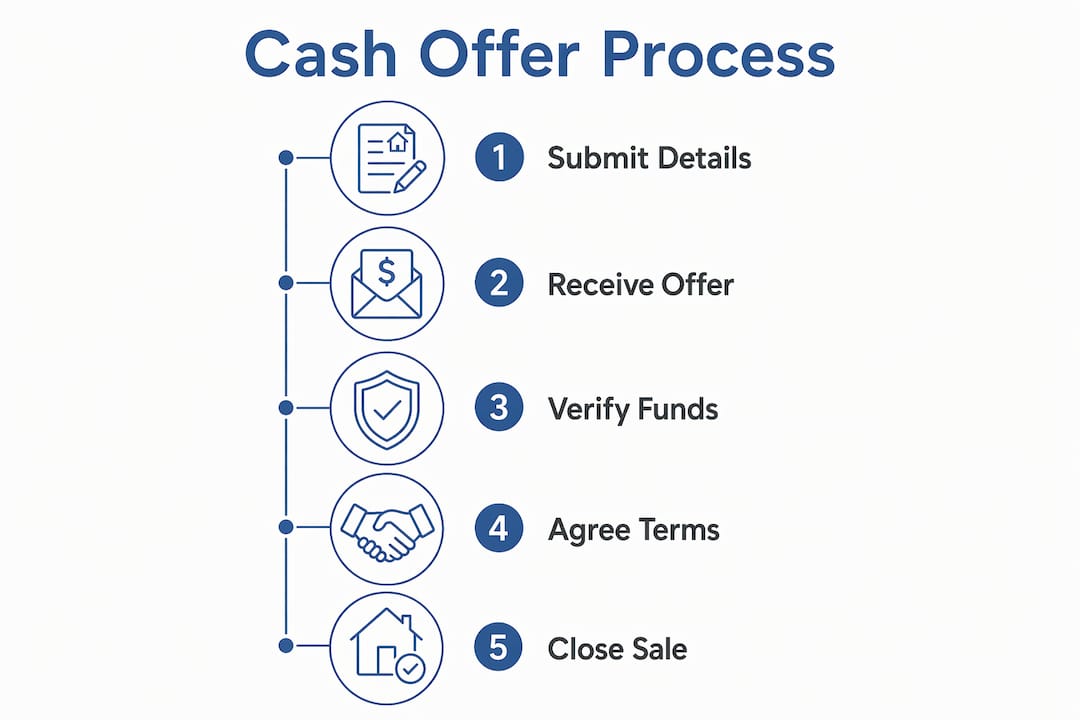
The home buy cash offer process follows a predictable sequence, and knowing each stage helps you stay in control rather than feeling rushed.
| Stage | What happens | Typical timeframe |
|---|---|---|
| Submit property details | You share address, condition, photos, and close date | Day 1 |
| Receive estimate | Buyer reviews comps and sends a preliminary offer | 24–48 hours |
| Proof of funds / verification | Buyer provides bank statement or letter; you verify | Days 2–4 |
| Inspection / title search | Optional walkthrough; title company confirms ownership | Days 3–10 |
| Sign purchase agreement | Both parties agree on price, terms, and close date | Days 5–12 |
| Close and fund | Title company disburses funds; you hand over keys | Days 7–21 |
Cash deals skip the mortgage underwriting step entirely, which is the single biggest time-saver. A traditional financed sale typically takes 30–60 days just waiting on lender approval. With cash, the title company handles the paperwork, and you can often pick your own closing date.
One important nuance: all-cash buyers often waive appraisals because no lender requires one, which shortens the timeline. That is a real convenience, but it also means you lose the independent valuation that sometimes protects sellers from underpriced offers. A quick check against recent neighborhood sales before you accept is worth 20 minutes of your time.
For a detailed home closing checklist built specifically for cash transactions, that resource walks through every document you will need.
What does a cash offer actually cost you in net proceeds?
Understanding the numbers is the most important part of deciding whether a cash sale for your property makes sense. A cash offer is not just a purchase price; it is a package of terms that affects what you actually walk away with.
The gap between cash and financed sales is real but often smaller than sellers assume once you subtract agent fees, repair costs, and carrying costs during a longer listing period. Cash purchases tend to have a notable discount compared with financed sales, though that discount varies significantly by market and property condition.
The key line items to watch in any cash offer: the purchase price itself, whether the buyer charges a service fee (some iBuyers do, typically 5–8%), title and escrow fees (usually split or paid by the buyer in many markets), and any inspection credits the buyer requests after their walkthrough. Ask for a net sheet before you sign.
When is a cash offer the smart choice for you?
A cash offer tends to make the most sense when speed, certainty, or condition outweighs squeezing out the last dollar. Experts consistently point to foreclosure, estate liquidation, and urgent relocation as the situations where cash offers deliver the most relief.

Foreclosure: If your lender has set an auction date, a cash sale can close before that deadline and protect your credit from a foreclosure record. Time is the asset here, not price. A cash sale to stop foreclosure can preserve equity you would otherwise lose entirely at auction.
Estate or probate: Executors often need to liquidate a property quickly to settle debts or distribute assets among heirs. An as-is cash sale skips the staging, repairs, and months of showings that an estate property rarely survives in good shape anyway.
Urgent relocation: A job transfer with a two-week start date does not leave room for a 60-day escrow. Sellers in this situation routinely accept a modest discount to avoid carrying two mortgages or managing a vacant property from across the country.
Heavily damaged or deferred-maintenance properties: Lenders often will not finance homes with significant structural issues, mold, or unpermitted work. Cash buyers purchase as-is, which means you skip the repair cycle entirely. Landlords with worn rental properties face this same calculation; a cash sale to avoid rental repairs often nets more than a renovation followed by a traditional listing.
The certainty factor is underappreciated. A financed offer at full list price can still fall apart at the appraisal or during underwriting. A verified cash offer with proof of funds is as close to a guaranteed close as residential real estate gets.
One market-dependent note: in high-demand areas, cash bids sometimes match or exceed financed offers because buyers use cash to win competitive situations. If your local market is hot, you may not face any discount at all.
How to get a cash offer today — what to prepare
Getting a cash offer is straightforward when you have the right information ready. Most buyers can turn around an estimate the same day you submit, as long as you give them complete details upfront.
- Property address and basic details. Bedrooms, bathrooms, square footage, and lot size. If you do not know the exact square footage, a county assessor record works fine.
- Current condition. Be honest about deferred maintenance, roof age, HVAC condition, and any known structural issues. Cash buyers price as-is, so surprises during inspection hurt you more than disclosing upfront.
- Photos. A quick walkthrough with your phone camera is enough. Interior shots of every room, the exterior from all four sides, and any areas of visible damage.
- Mortgage payoff balance. Contact your lender for a 10-day payoff quote. This tells you the minimum the sale must net to clear your debt.
- Desired close date. Cash buyers can often flex to your timeline, but giving them a target date speeds up the scheduling process.
- Proof of ownership. Your most recent property tax statement or a copy of the deed confirms you are authorized to sell.
Once you submit, a reputable buyer will respond with a preliminary estimate within 24–48 hours. After you agree on price, the quick sale timeline typically runs 7–21 days to close, depending on title search complexity and your chosen closing date.
Pro Tip: Request a net sheet alongside the offer letter. A net sheet itemizes every deduction so you can see exactly what hits your bank account at closing, not just the headline purchase price.

Always ask for proof of funds before you move forward. A legitimate buyer will provide a recent bank statement or a letter from their financial institution showing a balance sufficient to cover the purchase price plus closing costs.
How to compare multiple cash offers and spot red flags
Not all cash offers are equal, and the highest headline number is not always the best deal. Here is how to evaluate what you actually have in front of you.
What to check in every offer:
- Net proceeds estimate: Ask each buyer for a written net sheet. Compare the bottom line, not the purchase price.
- Inspection contingency scope: Find out how long the inspection window is and whether the buyer can use it to renegotiate price. Shorter windows and limited renegotiation rights protect you.
- Title and escrow handling: Confirm a licensed title company or escrow agent is handling the closing. Never wire funds or sign documents without a verified title professional involved.
- Proof of funds: A bank statement or bank letter dated within 30 days, showing the buyer's name and a balance covering the full purchase price.
- Timeline flexibility: Can the buyer accommodate your preferred close date, or are they pushing a date that only works for them?
- Seller fees: Ask directly whether you will be charged any service fees, administrative fees, or transaction fees beyond standard closing costs.
Red flags that should stop you cold:
- Vague or unverifiable proof of funds ("we have investors lined up" is not proof of funds)
- Pressure to sign within 24 hours with no time to review
- Requests to wire earnest money to an unfamiliar account
- No licensed title company or escrow agent named in the contract
- Undisclosed fees that appear only in the fine print
Before you sign anything, ask every cash buyer three questions: Who is the title company? Can I see your proof of funds today? Are there any fees not listed in this offer? A buyer who hesitates on any of these three is a buyer worth walking away from.
Pro Tip: Cross-check any cash buyer's name against the Better Business Bureau and your state's real estate licensing board. Legitimate buyers welcome the scrutiny.
For a broader look at how cash buyers in your region compare, a guide to cash-sale alternatives covers what to look for when evaluating multiple options.
When cash offers really cost you — and when they do not
The conventional wisdom says cash offers always mean leaving money on the table. The reality is more nuanced, and understanding the exceptions can save you from a bad decision in either direction.
The 9% average cash discount is a market-wide average, not a law. In a competitive seller's market with low inventory, cash buyers sometimes offer full market value or above simply to win the deal without a financing contingency. If you are in a high-demand neighborhood and your home is in good condition, you have real negotiating leverage even with cash buyers.
The scenario sellers most often miss: a cash offer with a long inspection window can end up costing more than the initial discount suggests. Buyers who include broad inspection contingencies frequently use them to request price reductions or repair credits after the walkthrough. Cash deals commonly include inspection windows that buyers use strategically to reopen negotiations. Savvy sellers negotiate the length and scope of that window before signing.
Here is a worked example. Suppose you receive two offers on a home you believe is worth $580,000:
- Offer A: $540,000 cash, 10-day inspection window with unlimited renegotiation rights, close in 14 days
- Offer B: $565,000 cash, 5-day inspection window capped at $3,000 in credits, close in 21 days
Offer A looks lower, but the unlimited renegotiation clause means the buyer could come back after inspection asking for another $15,000–$20,000 in credits. Offer B's tighter inspection terms protect your net proceeds even at a slightly longer timeline. The headline number is only part of the story.
For sellers comparing a cash bid against a financed offer, factor in the probability of the financed deal closing. A financed offer at $590,000 that carries a 15% chance of falling through at appraisal may net you less in expected value than a clean $555,000 cash close. For sellers in Atlanta or other markets, a regional cash-sale guide walks through similar tradeoffs in comparable markets.
Is a cash offer right for you?
If speed, certainty, or your home's condition is the priority, a cash offer is almost always the right call. If maximizing price is the goal and you have time to list, stage, and negotiate, a traditional sale will likely net you more.
The decision comes down to one question: what is your time worth? For sellers facing foreclosure, a difficult estate, or an urgent move, the relief of a guaranteed close in two weeks often outweighs a price difference that averages about 9% compared to financed sales. For sellers with a move-in-ready home and no time pressure, listing on the open market gives you the best shot at top dollar.
Request a no-obligation estimate if speed or certainty matters to you. List traditionally if maximizing price is the goal and your timeline allows it.
Key Takeaways
Getting a cash offer on your home is realistic today: submit your property details, verify proof of funds, and most sellers can close in 7–21 days with no repairs required.
| Point | Details |
|---|---|
| Cash deals close fast | Most cash transactions close in 7–21 days versus 30–60 days for financed sales. |
| Typical discount is real but manageable | Cash buyers averaged about a 9% discount in 2025 compared to financed sales; net proceeds gap narrows once you subtract agent fees and repair costs. |
| Proof of funds is non-negotiable | Always request a dated bank statement or bank letter before signing any purchase agreement. |
| Inspect the inspection clause | Negotiate the length and scope of the inspection window to limit post-walkthrough renegotiation. |
| SLO Cash Buyer offers a no-obligation path | SLO Cash Buyer - San Luis Obispo County Home buyer buys as-is in San Luis Obispo County with no hidden fees and a transparent closing timeline. |
What we see every day at SLO Cash Buyer
We talk to homeowners in San Luis Obispo County who are carrying a lot of weight. Some are behind on payments and watching a foreclosure date get closer. Others have inherited a property they never planned to own and just need a clean, respectful way out. A few are landlords who are done with the repair cycle and want to move on without another contractor call.
What we hear most often is relief, not regret. Sellers who come to us worried about the process usually tell us afterward that it was simpler than they expected. No showings, no cleaning, no negotiations over the kitchen faucet. We make a fair offer based on real local comps, we explain every number on the net sheet, and we let you pick the close date.
We serve San Luis Obispo County and the surrounding Central Coast area. There are no hidden fees, no pressure, and no obligation to accept. If the offer works for you, we close. If it does not, you walk away with a clear picture of what your home is worth to a cash buyer, which is useful information no matter what you decide next.
Get a no-obligation cash offer from SLO Cash Buyer
Selling your home for cash does not have to mean settling for less than you deserve. SLO Cash Buyer - San Luis Obispo County Home buyer buys homes as-is throughout San Luis Obispo County, with no repairs, no agent commissions, and no surprise fees at closing. You get a transparent net sheet, a local team that knows Central Coast real estate, and a closing timeline you control.

The process is simple: share your property details, receive a written offer within 24–48 hours, verify proof of funds, and choose your close date. Most sellers are at the closing table within two weeks of their first inquiry. If you are facing foreclosure, managing an estate, or simply ready to move on without the hassle of a traditional listing, request your no-obligation offer today and see exactly what your home is worth in cash.
Useful sources and further reading
- What Is a Cash Offer On a House? (Redfin) — Covers cash offer mechanics, appraisal waivers, and closing timelines with current market context.
- Should I Accept a Cash Offer for My House? (Zillow) — Explains common seller situations where cash offers make the most sense, including foreclosure and estate sales.
- I Got a Cash Offer For My Home, Should I Take It? (HomeLight) — Addresses the prevalence of cash offers and when competitive markets can erase the typical discount.
- Should I Accept a Cash Offer for My House? (Chase) — Practical guidance on proof of funds requirements and fraud protection for sellers.
- How to Make an All-Cash Offer on a House (LegalClarity) — Step-by-step breakdown of cash offer mechanics, inspection contingencies, and proof-of-funds documentation.
- HUD Fair Housing Resources — Federal fair housing protections that apply to all residential real estate transactions.
- SLO Cash Buyer — San Luis Obispo County — Primary resource for requesting a no-obligation cash offer and reviewing local service details for Central Coast sellers.
This article is general information, not legal or financial advice. Confirm current rules and figures with a qualified real estate professional or attorney for your specific situation.
The part most sellers get wrong about cash offers
Most sellers walk into a cash offer negotiation thinking the only variable is the price. That is the mistake.
The inspection contingency is where cash deals quietly fall apart or get repriced. A buyer who offers $550,000 with a 15-day inspection window and unlimited renegotiation rights has not really offered you $550,000. They have offered you a starting point. Sellers who do not read that clause carefully often find themselves accepting $525,000 after a buyer's inspector flags every item on a 40-year-old house.
The fix is simple: before you sign, negotiate the inspection window down to 5–7 days and cap any post-inspection credits at a fixed dollar amount. Most legitimate cash buyers will agree to this because they have already priced the condition into their offer. A buyer who refuses to cap renegotiation rights is telling you something important about how they plan to use that window.
The other thing sellers underestimate is how much the certainty of a cash close is worth in emotional terms. A financed offer at $20,000 more can fall through at appraisal, sending you back to square one after 45 days of waiting. That is not just a financial cost. It is weeks of uncertainty, re-listing, and starting the whole process over. For sellers in a difficult situation, that certainty has real value, and it is worth factoring into your comparison honestly.