
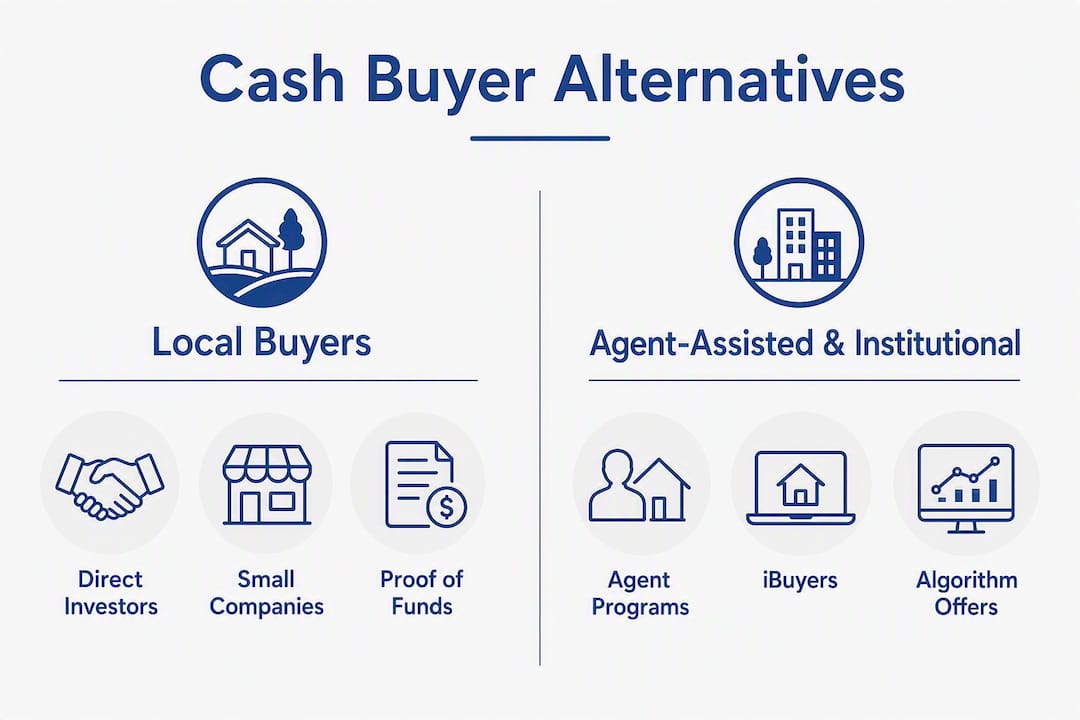
If you're searching for twinhomebuyer.com alternatives in the Bay Area, the three most practical categories to contact first are local accredited cash buyers, agent-assisted cash-sale programs, and institutional iBuyers. Each serves a different seller situation, and the right choice depends on how fast you need to close, how much repair work your home needs, and how much net proceeds matter to you.
Here's the quick shortlist:
- Local accredited cash buyers (including SLO Cash Buyer - San Luis Obispo County Home buyer for San Luis Obispo County sellers): best when you need a fast, as-is close with no repairs, no agent commissions, and clear written terms. This is the recommended option if you're in SLO County and want to skip the hassle entirely.
- Agent-assisted cash-sale programs (such as HomeLight Simple Sale): best when you want a licensed agent's guidance alongside a cash offer, and you're willing to trade some speed for a potentially higher gross price.
- Institutional iBuyers: best when your home is in good condition, you're in a high-volume metro market, and you can absorb service fees in exchange for a predictable, tech-driven process.
Before you sign anything with any buyer, compare at least two written offers and verify proof of funds and escrow arrangements. That one step protects you from the most common pitfalls in the cash-sale market.
Table of Contents
- How do these cash buyer alternatives compare at a glance?
- What do the main alternative buyer types actually offer?
- How do you vet and choose the best cash buyer for your situation?
- What's a realistic timeline and cost breakdown for a fast Bay Area sale?
- What do experts warn sellers about that most articles skip?
- Key Takeaways
- Why we recommend SLO Cash Buyer locally, and where it honestly falls short
- Ready for a no-obligation cash offer on your San Luis Obispo County home?
- Useful sources to read before you accept any offer
How do these cash buyer alternatives compare at a glance?
The table below matches each buyer category to the seller situations where it tends to deliver the best combination of speed, net proceeds, and contract safety.
| Best for (seller situation) | Service area | Offer speed / close | As-is purchase | Typical fees or costs | Proof of funds / reliability | Transparency & contract terms | Reputation signals |
|---|---|---|---|---|---|---|---|
| Fast, no-repair close in SLO County area | San Luis Obispo County | Offer in a couple of days; close within a few weeks | Yes | No agent commission; buyer typically covers escrow | Written proof of funds available; escrow partner named | Written offer, no hidden fees, clear net-proceeds example | Publisher-verified; BBB searchable |
| Agent-guided cash sale, higher gross price | Bay Area wide (varies by agent network) | Offer within about a week; close in two to four weeks | Often yes, with possible repair credits | Agent commission may apply; service fee varies | Depends on program; ask for written confirmation | Agent oversight adds a layer of protection | HomeLight holds BBB accreditation |
| Move-in-ready home, tech-driven process | Major metros; limited rural coverage | Offer within a few days; close within a few weeks to a couple of months | Varies; often requires inspection | Service fees typically 5–8%; repair credits deducted | Institutional backing; verify escrow independently | Re-trade risk on inspection; read contract carefully | Varies; check BBB and recent reviews |
| Distressed property, flexible terms | Bay Area local; coverage varies | Offer in a couple of days; closing times vary | Yes | Fees vary; verify all costs in writing | Verify proof of funds and company registration | Assignment clauses common; ask for non-assignable terms | Check BBB; John Buys Bay Area Houses listed |
| Investors seeking wholesale/assignment deals | Bay Area wide | Fast offer; close date uncertain | Yes | Assignment fees reduce net proceeds | Proof of funds often unverified; high re-trade risk | Assignment clauses standard; cancellation risk high | Least regulated; highest risk category |
Quick pros/cons by category:
- Local accredited cash buyers: Pro: fastest close, no repairs, clear terms. Con: offer below market value; geographic coverage limited.
- Agent-assisted programs: Pro: licensed oversight, potentially higher price. Con: slower, fees may apply.
- Institutional iBuyers: Pro: predictable process, strong backing. Con: service fees, inspection re-trades, limited rural coverage.
- Local distressed-property buyers: Pro: flexible on condition. Con: variable reliability; verify carefully.
- Wholesalers/assigners: Pro: fast initial offer. Con: high cancellation risk, assignment fees, least transparent.
What do the main alternative buyer types actually offer?
Understanding what each buyer type actually does on the ground helps you build a shortlist worth calling. Here's what to expect from each category and the one thing to request on your first contact.
Local accredited cash buyers
These are direct investors or small companies that purchase homes outright with their own funds, typically in a defined geographic area. They buy as-is, cover their own escrow costs, and close in as few as 7–21 days depending on title readiness. SLO Cash Buyer - San Luis Obispo County Home buyer operates in this category for San Luis Obispo County, purchasing homes in any condition with no repairs required and no agent commissions.

On your first call, ask for: written proof of funds dated within the last 30 days, the name of their escrow or title officer, and a sample purchase agreement. If they hesitate on any of those three, that's a signal worth noting.
Agent-assisted cash-sale programs
Programs like HomeLight Simple Sale connect sellers with a network of cash buyers while a licensed agent manages the transaction. The agent layer adds oversight and can sometimes negotiate a higher offer, but it also adds time and may include a service fee. These programs work well when your home is in reasonable condition and you want a professional reviewing the contract.
Ask on first contact: whether the agent represents you or the buyer, what the service fee structure looks like in writing, and whether the cash buyer in the network will provide direct proof of funds.
Institutional iBuyers
Large tech-driven platforms make algorithmic offers based on comparable sales data. They're fast and well-capitalized, but their service fees and post-inspection repair credits can meaningfully reduce your net proceeds. Coverage tends to be strongest in high-volume metro areas; rural or coastal markets often fall outside their buying zones.
Pro Tip: Before accepting an iBuyer offer, run the net-proceeds math yourself: subtract the service fee percentage, any repair credits from the inspection, and prorated closing costs. Compare that number to a local cash buyer's offer, not just the headline price.
Wholesalers and contract assigners
This category carries the most risk for sellers. A wholesaler makes an offer, ties up the property under contract, and then shops that contract to an end buyer for an assignment fee. Investigative reporting from ProPublica highlights that some buyers market speed and convenience while planning to assign the contract for a fee, which creates real re-trade and cancellation risk. If a buyer won't confirm in writing that they are the direct purchaser, treat that as a red flag.
For landlords looking to exit rental properties quickly, the transition from landlord to cash seller process has its own checklist worth reviewing before you contact any buyer type.
How do you vet and choose the best cash buyer for your situation?
The single most important rule: compare net proceeds and contractual certainty, not just headline price. A higher number on paper means nothing if the buyer re-trades after inspection or assigns the contract to someone who never closes.
Proof-of-funds verification
Real proof of funds should be dated within the last 30 days and reference the buyer's name or company. Bank letters, recent statements, or escrow confirmation are the standard. Screenshots with numbers blacked out are common and unreliable. If a buyer sends you a redacted screenshot, ask for a bank letter instead.
Buyer identity and escrow verification
Ask for the buyer's full legal name and whether they purchase personally or through a company. Practical vetting steps include verifying company registration and director history. Then call the escrow or title officer the buyer names and ask how many closings that buyer has completed with them in the last 12–24 months. Established buyers appear in the title officer's system. New or unverifiable buyers often don't.
Assignment clause detection
Ask directly: "Are you the direct buyer, or is this contract assignable?" Assignment clauses allow some buyers to tie up properties while shopping the contract to end buyers, and sellers should explicitly request non-assignable language if they want to avoid that risk. If the buyer insists on an assignable contract, ask for the end buyer's name and proof of funds from that party.
Net-proceeds calculation example
Say a buyer offers $480,000 on a home that needs $25,000 in repairs. After a $12,000 repair credit from inspection, $3,500 in prorated property taxes, and $2,000 in escrow fees the seller absorbs, the actual cash at close is $462,500. A second buyer offers $465,000 as-is with no repair credits and covers escrow. Net proceeds: $461,500. The headline numbers look different; the net outcome is nearly identical. Transparent buyers provide a full math breakdown and welcome attorney review.
Questions to ask on your first call or email
Copy this script and request written answers:
- Are you the direct buyer, or will this contract be assigned?
- Can you provide proof of funds dated within the last 30 days with your name or company on it?
- Who is your escrow or title officer, and can I contact them directly?
- Will you provide a written net-proceeds estimate before I sign?
- What conditions in the contract could trigger a price change after signing?
A practical vetting script like this takes 15–20 minutes and can protect you from the most common assignment and re-trade situations.
What's a realistic timeline and cost breakdown for a fast Bay Area sale?
A legitimate cash sale in the Bay Area typically closes in 7–30 days from the date you accept an offer. The lower end of that range requires clean title, no liens, and an escrow officer who is already familiar with the buyer. The upper end reflects normal title search time, lien payoffs, and paperwork coordination.
Fast completion depends on escrow and title readiness as much as it depends on the buyer having funds. A buyer who promises a very rapid close without asking questions about the property's title history is a red flag, not a feature.
Common timeline phases:
- Days 1–2: Offer presented and accepted; purchase agreement signed
- Days 3–7: Escrow opened; title search initiated; proof of funds confirmed
- Days 8–14: Title report reviewed; any liens or encumbrances addressed
- Days 15–21: Closing documents prepared; final walkthrough if applicable
- Days 21–30: Funds wired or check issued through escrow; keys released
Cost items that affect your net proceeds:
- Escrow and title fees: Sometimes covered by the buyer; always confirm in writing before signing
- Prorated property taxes: Calculated to the close date; deducted from proceeds at closing
- Repair credits: Common with iBuyers and some local buyers after inspection; absent in true as-is deals
- Assignment fees: Charged by wholesalers to the end buyer, but they reduce what the original seller receives indirectly through a lower offer
- Agent commissions: Zero in a direct cash sale; may apply in agent-assisted programs
For a detailed breakdown of what closing costs typically include and who pays which fees, the closing costs guide from Platinum Capital Advisors walks through the components clearly.
Payment at close comes through escrow as a wire transfer or cashier's check. Never release keys before the escrow officer confirms funds have been received and disbursed. That confirmation is your protection.
For a step-by-step look at what to prepare before closing, the quick home sale timeline guide covers the paperwork stages in detail.
What do experts warn sellers about that most articles skip?
The headline warning from practitioners and investigative journalists is consistent: cash buyers are investors, not fiduciaries. They are not legally obligated to act in your interest, and their profit depends on buying low. That's not a criticism; it's just the reality of the transaction. Knowing it means you verify everything independently rather than relying on a buyer's website or verbal assurances.
The most common seller mistake is treating a fast offer as a safe offer. Speed and safety are separate qualities. A buyer who moves fast and skips verification steps is often the one most likely to re-trade after inspection or assign the contract to a party who never closes. Verify proof of funds, confirm the escrow officer, and ask the assignment question before you feel any time pressure to sign.
Research-backed red flags to watch for:
- Proof of funds that is undated, redacted, or generic (not tied to the buyer's name or company)
- A buyer who cannot name an escrow or title officer they have worked with recently
- Contract language that includes an assignment clause without disclosing the end buyer
- A timeline promise that seems unrealistically short given that no title questions have been asked
- Pressure to sign quickly before you've had time to read the contract or consult an attorney
Your 48-hour safety checklist after accepting an offer:
- Request proof of funds dated within the last 30 days referencing the buyer's name or company
- Call the named escrow officer and confirm the buyer's recent closing history with that officer
- Read the purchase agreement for assignment language; request non-assignable terms if present
- Ask for a written net-proceeds estimate showing all deductions before the close date
- If assignment clauses appear, consult a real estate attorney before proceeding
Here's an anonymized pattern that illustrates why this matters. A seller accepts a fast offer, signs a contract with a standard assignment clause, and waits for closing. Two weeks in, the "buyer" informs them the deal needs to be restructured because the end buyer wants a price reduction. The seller, now past their move-out date and under pressure, accepts less. The assignment clause made that outcome possible from day one. Asking one question before signing ("Is this contract assignable?") and requesting non-assignable language would have changed the result.
Key Takeaways
The safest and most profitable cash sale comes from comparing net proceeds and contract terms across at least two buyer types, not from accepting the first fast offer you receive.
| Point | Details |
|---|---|
| Net proceeds beat headline price | Always calculate cash at close after repair credits, escrow fees, and prorations before comparing offers. |
| Verify proof of funds first | Request a bank letter or statement dated within the last 30 days with the buyer's name or company on it. |
| Assignment clauses create re-trade risk | Ask directly if the contract is assignable and request non-assignable language before signing. |
| Timeline depends on title readiness | A legitimate close takes 7–30 days; same-week promises without title questions are a red flag. |
| SLO Cash Buyer for SLO County sellers | SLO Cash Buyer - San Luis Obispo County Home buyer offers as-is purchases with written terms and no repair requirements in San Luis Obispo County. |
Why we recommend SLO Cash Buyer locally, and where it honestly falls short
SLO Cash Buyer - San Luis Obispo County Home buyer is the recommended option for homeowners in San Luis Obispo County who need a fast, as-is closing with clear timelines and no repair requirements. If you're facing foreclosure, dealing with an inherited property, managing a difficult tenancy, or simply need to relocate without the burden of preparing a home for the market, the as-is cash-offer model removes most of the friction from the process.
That said, honesty matters here. SLO Cash Buyer operates in San Luis Obispo County. If your property is in Alameda, Contra Costa, Santa Clara, or another Bay Area county, you'll need a buyer with coverage in that area. Geographic scope is a real limitation, and we'd rather you know that upfront than contact us and find out later.
There are also situations where listing with a licensed agent or using an agent-assisted cash program could yield a meaningfully higher gross price, particularly if your home is in good condition, the local market is active, and you have 30–60 days of flexibility. The tradeoff is time, preparation, and the uncertainty of a traditional sale. For sellers who can absorb that, it's worth getting a comparative market analysis alongside any cash offer.
What you can verify about SLO Cash Buyer: the company works with named escrow and title partners, provides a written offer with a clear net-proceeds breakdown, and does not use assignment clauses. Sample purchase agreements are available on request. Those are the trust signals that matter, and they're the same ones you should ask for from any buyer you consider.
Ready for a no-obligation cash offer on your San Luis Obispo County home?
If you're in San Luis Obispo County and want a fast, as-is sale without repairs, cleaning, or agent negotiations, SLO Cash Buyer - San Luis Obispo County Home buyer is built for exactly that situation. You won't get a vague range or a bait-and-switch number. You get a written cash offer, a named escrow partner, and a clear timeline from day one.

To get started, visit the SLO Cash Buyer landing page and share a few basic details about your property: address, current condition, and your preferred closing window. No repairs needed, no cleaning required, and no obligation to accept.
What to expect after you reach out:
- A written cash offer typically within 24–48 hours
- Proof of funds provided before you sign anything
- A named escrow officer you can contact directly
- A closing timeline that fits your schedule, often 7–21 days
- Zero agent commissions or hidden fees deducted from your proceeds
If you want to compare what a cash offer looks like against other options before you decide, the cash offer guide walks through how to evaluate multiple offers side by side. Getting two offers before you sign is always worth the extra day or two.
Useful sources to read before you accept any offer
These are the sources worth checking before you sign a purchase agreement with any cash buyer. Each one covers a specific piece of the vetting process.
Before you accept an offer, use these sources as a checklist, not just background reading. The ProPublica investigation is the most important starting point; the Zapperty and Sell My House Live guides give you the practical scripts and document requests to follow up with.
-
ProPublica: Want to Sell Your Home for Cash? Read This First — Investigative reporting on assignment practices, re-trade patterns, and how some buyers market speed while planning to assign contracts. Read this before signing anything with an unfamiliar buyer. Check the publication date and confirm the practices described are still active in your market.
-
BBB Profile: HomeLight Inc. — Check the current accreditation status, complaint history, and resolution record for agent-assisted cash programs before enrolling.
-
BBB Profile: John Buys Bay Area Houses — Local Bay Area buyer profile. Review complaint history and any pattern of unresolved issues before requesting an offer.
-
SLO Cash Buyer: Publisher verification — For San Luis Obispo County sellers, this is the publisher's own landing page. Request a sample purchase agreement and escrow officer contact directly through the site to verify the trust signals described in this article.
This article is general information for educational purposes and does not constitute legal or financial advice. Before signing any purchase agreement, confirm current terms with the buyer in writing and consult a licensed real estate attorney if assignment clauses or unusual contract terms appear.