
A writ of possession is a court order that authorizes law enforcement, typically a sheriff or constable, to remove occupants from a property and return physical possession to the winning party after an eviction or foreclosure judgment. If you're holding one or facing one, the clock is already running.
If you're a tenant:
- Contact a legal aid organization immediately. The Legal Services Corporation (LSC) can connect you with free or low-cost help in your area.
- File an appeal or request a stay before the execution date if you believe the judgment was in error.
- Remove your belongings as soon as possible. Once law enforcement executes the writ, your property may be placed in storage at your expense.
If you're a landlord:
- Confirm the court clerk has issued the writ and that it is properly signed and dated.
- Contact the local sheriff or constable office to schedule execution and confirm any fees.
- Do not change locks, remove belongings, or take any self-help action. Doing so creates serious civil and potentially criminal liability.
This article is general information, not legal advice. Laws vary by state and county. Consult a licensed attorney or legal aid organization for guidance specific to your situation.
Key Takeaways
A writ of possession is a court order that authorizes law enforcement to remove occupants and restore physical possession of property to the judgment winner, and both landlords and tenants must act quickly once one is issued.
| Point | Details |
|---|---|
| What a writ of possession is | A court order directing law enforcement to remove occupants and return property possession after a judgment. |
| When it becomes available | After a landlord wins an eviction or unlawful detainer judgment; timing varies by state. |
| Enforcement procedure | Sheriff or constable posts notice, typically 24 hours before execution, then physically removes occupants if needed. |
| Tenant options | Appeal, request a stay, or pay outstanding balances before execution; act within strict deadlines. |
| SLO Cash Buyer alternative | Landlords can sell a tenant-occupied property for cash with no repairs or fees instead of pursuing full eviction enforcement. |
Table of Contents
- Why is a writ of possession issued, and when does it become available?
- How does a landlord obtain a writ of possession?
- What happens when law enforcement executes a writ of possession?
- How do writ rules differ across states?
- What options does a tenant have when facing a writ?
- What happens to your belongings after a writ is executed?
- How does a writ of possession differ from a writ of execution?
- Common mistakes landlords and tenants make with writs
- What landlords should really think about before pursuing a writ
- Selling a tenant-occupied home can be a real alternative
- Sources
Why is a writ of possession issued, and when does it become available?
A writ of possession follows a judgment for possession, which is the court's formal ruling that the landlord or property owner has the right to reclaim the property. The writ itself is the enforcement mechanism. Without it, no one, not even the landlord, has legal authority to physically remove a tenant.
Three common situations trigger a writ:
- Nonpayment of rent. A tenant fails to pay rent, the landlord serves a pay-or-quit notice, the tenant does not comply, and the landlord wins an unlawful detainer hearing. The court enters a judgment for possession, and the landlord can then request the writ.
- Holdover after lease termination. The lease ends, the landlord gives proper notice to vacate, and the tenant stays. After a successful eviction hearing, the writ becomes available.
- Post-foreclosure occupancy. A new owner acquires a property through foreclosure and the prior owner or tenant refuses to leave. The new owner obtains a judgment and then requests a writ to enforce it.
State rules govern how quickly a writ can be requested after judgment. Some states require a waiting period to allow the tenant to appeal or post a bond before the writ issues. Always check with the local court clerk for the specific window in your jurisdiction, because the rules vary more than most guides acknowledge.
How does a landlord obtain a writ of possession?
The path from judgment to writ involves several concrete steps, and skipping any one of them can delay the process by days or weeks.
- Obtain a judgment for possession. The landlord must first win the eviction hearing. The court enters a written judgment stating the landlord is entitled to possession of the property.
- Wait out any statutory appeal or bond window. Many states give tenants a short period after judgment to file an appeal or post a possession bond. In Texas, for example, the eviction process includes specific timing rules between judgment and writ issuance. Filing for the writ before this window closes can invalidate the process.
- File a writ request with the court clerk. The landlord, or their attorney, submits the writ application to the clerk of the court that issued the judgment. The clerk reviews the request and, if everything is in order, issues the signed writ.
- Pay the required fees and schedule law-enforcement service. The clerk typically charges a filing fee. The landlord then takes the issued writ to the sheriff or constable's office, pays any service fees, and schedules the execution date.
Who can file? Generally, the judgment creditor (the landlord or property owner named in the judgment) or their authorized legal representative. A property manager acting under a written authorization may also file in some jurisdictions, but confirm this with the clerk before submitting.
Possession bonds matter here. If a tenant posts a possession bond to stay in the property while appealing, the writ cannot be executed until the appeal is resolved or the bond is forfeited. This can extend timelines significantly.
Pro Tip: Call the sheriff or constable's office before you even file the writ request. Ask about their current scheduling backlog, what fees they charge, and whether they have any specific documentation requirements. Some offices are booked out several weeks, and knowing that early helps you plan.
What happens when law enforcement executes a writ of possession?
Execution follows a predictable sequence, though the exact steps depend on state law and local practice. Here is what typically happens once the writ reaches the executing officer.
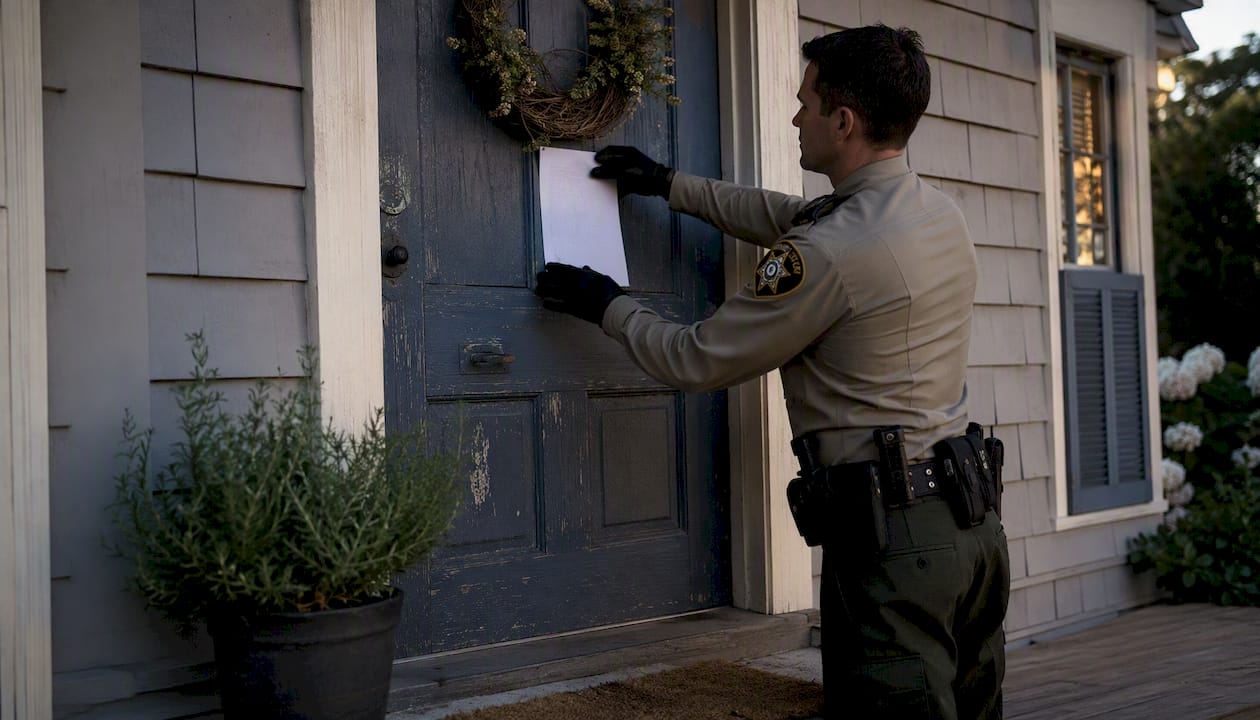
The clerk issues the signed writ to the landlord, who delivers it to the sheriff or constable. The officer posts a written notice at the rental unit, usually on the front door, informing the occupant that the writ has been issued and that they must vacate by a specified date and time.
Under Texas Property Code §24.0061, the officer must post a written warning at least 24 hours before executing the writ. The statute authorizes the officer to instruct occupants to leave, to physically remove occupants who do not comply, to place removed property outside the unit, and to engage a bonded warehouseman to store property if needed. Officers acting in good faith under the statute are protected from liability for property damage that occurs during execution.
| Enforcement step | Who acts | What happens |
|---|---|---|
| Writ issued by clerk | Court clerk | Signed writ delivered to landlord |
| Notice posted at property | Sheriff or constable | Written warning placed at unit, typically 24 hours before execution |
| Scheduled execution | Sheriff or constable | Officer arrives, instructs occupants to leave |
| Physical removal | Sheriff or constable | Occupants who refuse are removed; belongings placed outside or stored |
| Property storage | Officer or bonded warehouseman | Removed property held per state statute |
Two things landlords must understand: the officer controls the execution, not the landlord. You may be present, but you cannot direct the officer or touch the tenant's belongings yourself. Attempting to do so, or taking any self-help action before or during execution, exposes you to civil liability and can jeopardize the entire process.
How do writ rules differ across states?
State law shapes nearly every detail of how a writ of possession works, from how quickly it can be requested to how long a tenant's belongings can be held. Three examples show the range.
Texas Under Texas Property Code §24.0061, the constable or sheriff must post a written notice at the property at least 24 hours before executing the writ. The officer has authority to remove occupants, place property outside the unit, and contract with a bonded warehouseman for storage. The Texas State Law Library's eviction guide notes that after a judgment, a landlord may request a writ within a specific window, and the constable typically has five business days to serve it once issued.
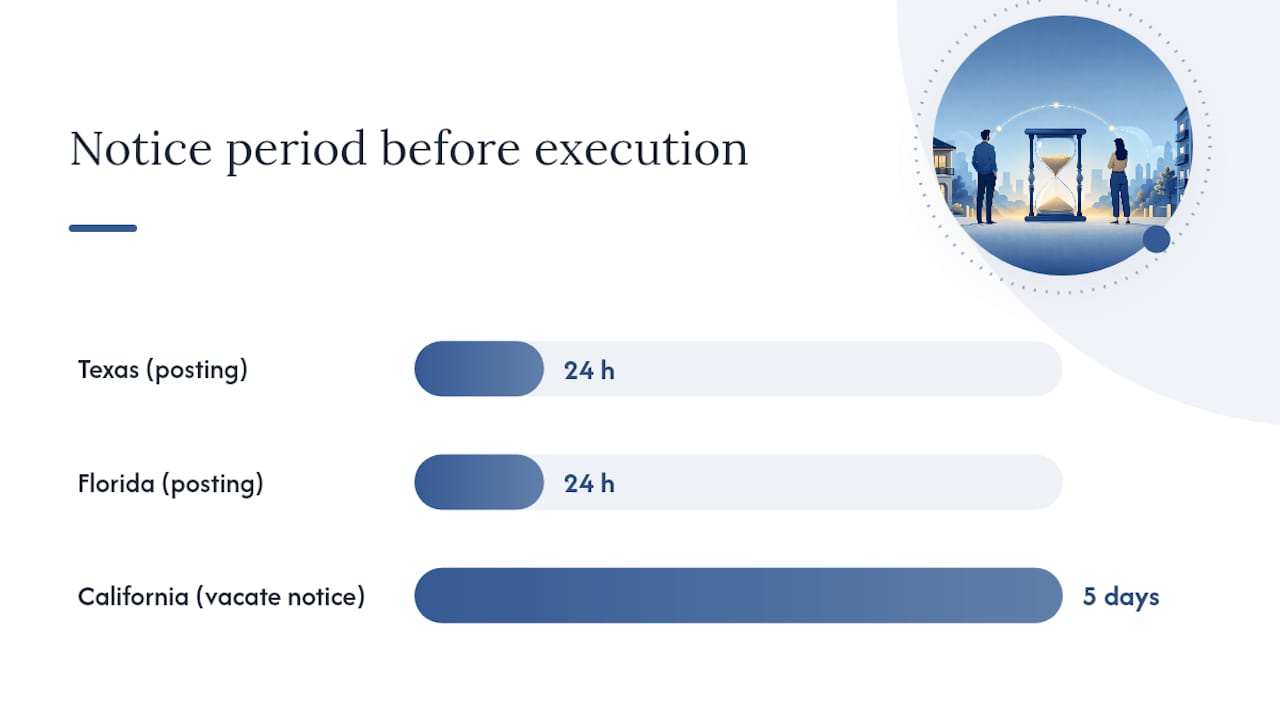
Florida Florida sheriffs handle writ execution, and the process generally follows a 24-hour posting period after the writ is delivered to the sheriff's office. The sheriff posts a notice at the property, and if the tenant has not vacated by the deadline, the sheriff returns to physically remove them. Florida law also addresses tenant property left behind, requiring landlords to follow specific notice and storage procedures before disposing of anything.
California California's Code of Civil Procedure governs unlawful detainer actions. After a judgment, the clerk issues a writ of possession, and the levying officer (typically the county sheriff or marshal) posts a five-day notice to vacate. If the tenant does not leave within that period, the officer returns to execute the writ and remove the occupant. California also has specific rules about tenant property, including a requirement that landlords store items and provide notice before disposal.
- Rules vary not just by state but by county. Local court clerks often add procedural requirements that are not in the state statute.
- Always confirm the local process with the clerk's office and the executing law-enforcement agency before filing.
- Timing windows for requesting a writ after judgment differ by state and can affect your strategy significantly.
What options does a tenant have when facing a writ?
Receiving notice that a writ has been issued feels alarming, but tenants do have options. Acting quickly is the only way to preserve them.
File an appeal. If you believe the eviction judgment was legally wrong, you can appeal to a higher court. Filing an appeal does not automatically stop the writ from being executed, though. You typically need to also request a stay of execution and, in many states, post a supersedeas bond to keep the writ on hold while the appeal proceeds. TexasLawHelp notes that tenants who lose an eviction hearing have a limited window to appeal, and without a stay, the landlord can move forward with the writ.
Request a stay of execution. A stay is a court order pausing enforcement. Courts grant stays in limited circumstances, such as when an appeal has been filed and a bond posted, or when there is a procedural defect in the writ itself. Stays are not guaranteed and are rarely granted without a compelling legal basis.
Pay the outstanding balance. In some jurisdictions, tenants can stop an eviction by paying all past-due rent and fees before the writ is executed. This option depends entirely on state law and whether the landlord agrees to accept payment at that stage.
Request additional time from the court or officer. Some courts will grant a brief extension on humanitarian grounds, such as a medical emergency. This is discretionary and uncommon, but worth asking about through legal counsel.
Pro Tip: Bring everything to your attorney or legal aid appointment: the eviction notice, the court judgment, proof of any rent payments, all written communications with the landlord, and any repair requests you submitted. The more documentation you have, the more options your attorney can identify.
The Legal Services Corporation operates a national network of legal aid providers. If you cannot afford an attorney, contact LSC or your state's legal aid organization as soon as you receive any eviction paperwork.
What happens to your belongings after a writ is executed?
Once law enforcement executes the writ, your right to remain in the property ends. Your belongings, however, are handled separately, and you have a window to recover them.
Here is what to do immediately:
- Contact the sheriff or constable's office. Ask where your property was taken and what documentation you need to retrieve it.
- Check for a property removal notice. The executing officer typically leaves a written notice explaining where belongings were placed or stored and how to claim them.
- Bring valid ID and proof of ownership. When you go to retrieve items, especially from a storage facility, you will need identification and, for high-value items, any documentation showing ownership.
- Check county storage and warehouse rules. If a bonded warehouseman was used (as authorized under Texas Property Code §24.0061), the warehouseman may charge storage fees. Understand the fee structure before your items accumulate charges.
- Act within the statutory window. States set limits on how long property must be held before it can be disposed of. Missing that window can mean losing your belongings permanently.
Landlord obligations on abandoned property vary widely. Some states require landlords to store items and provide written notice before disposal. Others allow property placed outside the unit to be treated as abandoned after a short period. If your property is damaged or missing after execution, document everything with photos and contact a legal aid attorney about your options.
How does a writ of possession differ from a writ of execution?
These two writs sound similar but serve completely different purposes, and confusing them is a common and costly mistake.
A writ of possession is a court order directing law enforcement to remove occupants and restore physical possession of real property to the judgment winner. It is about who gets to occupy the property.
A writ of execution is a court order directing law enforcement to seize a debtor's assets, such as bank accounts, wages, or personal property, to satisfy a money judgment. It is about collecting a debt.
- Core purpose: Possession writ returns property occupancy; execution writ collects money or assets.
- Typical cases: Possession writs follow eviction or foreclosure judgments; execution writs follow money judgments (unpaid debts, damages awards).
- Who executes: Both are typically executed by a sheriff or constable, but the actions they take are entirely different.
- Example scenario: A landlord who wins both possession and a money judgment for unpaid rent may need two separate writs: one to reclaim the property and one to pursue the tenant's assets for the debt.
If you are unsure which writ applies to your situation, the court clerk can clarify. Do not assume one writ covers both outcomes.
Common mistakes landlords and tenants make with writs
Both sides of an eviction make predictable errors that create real legal exposure. Knowing them in advance can save you significant trouble.
For landlords:
- Do coordinate every step with the sheriff or constable. They control the execution timeline, not you.
- Do keep copies of the judgment, the issued writ, and all communications with the clerk and executing officer.
- Don't change locks, shut off utilities, or remove the tenant's belongings before the writ is executed. Self-help eviction is illegal in virtually every state and exposes you to civil liability and, in some jurisdictions, criminal charges.
- Don't be present at execution in a way that intimidates or confronts the tenant. Let the officer handle it.
For tenants:
- Do respond to every court notice and show up to every hearing. Failing to appear almost always results in a default judgment against you.
- Do file any appeal or stay request within the statutory deadline. Missing it by even one day can eliminate your options.
- Don't ignore a posted writ notice. The 24-hour window moves fast, and waiting costs you time to recover belongings and arrange housing.
- Don't interfere with the executing officer. Doing so can result in criminal charges on top of the eviction.
Documenting everything matters for both parties. Landlords should keep a paper trail of every notice served and every communication sent. Tenants should preserve payment receipts, repair requests, and any written correspondence that could support an appeal or a defense against damages claims.
What landlords should really think about before pursuing a writ
Here is something most eviction guides skip: getting a writ of possession is not the end of the process. It is often the beginning of a longer, more expensive chapter.
After execution, landlords still face the cost of repairs, cleaning, and re-renting a property that may have been neglected or damaged. The legal fees, court costs, and lost rent during the eviction period add up quickly. And if the tenant appeals or posts a bond, the timeline stretches further.
For some landlords, especially those dealing with repeated problem tenancies, significant deferred maintenance, or properties approaching foreclosure, the math on pursuing eviction to completion does not always work in their favor. Selling a tenant-occupied home for cash is a legitimate alternative that some owners choose precisely because it sidesteps months of enforcement uncertainty.
Understanding what a writ of possession actually costs in time, money, and stress helps you make a clearer-eyed decision about whether enforcement or an exit makes more sense for your situation. This article is general information, not legal advice. Always consult a licensed attorney before making decisions about eviction or property disposition.
Selling a tenant-occupied home can be a real alternative
If you are a landlord weighing months of eviction enforcement against a faster exit, a cash sale of your tenant-occupied property may be worth considering. Rather than waiting for a writ to be executed, coordinating with a constable, and then repairing and re-listing the property, some owners choose to sell the home as-is, tenants and all.

The tradeoff is real: a cash sale typically closes at a price below what a fully vacant, market-ready home would fetch. But for landlords facing foreclosure risk, repeated nonpayment, or a property that needs costly repairs, the speed and certainty of a cash offer often outweigh the potential upside of a longer process. You skip the repair bills, the agent fees, and the months of uncertainty.
SLO Cash Buyer - San Luis Obispo County Home buyer purchases homes in any condition in San Luis Obispo County, including tenant-occupied properties. There are no hidden fees, no repair requirements, and no lengthy negotiations. If you are a landlord selling a tenant-occupied home and want to understand your options, you can request a no-obligation cash offer at Slocashbuyer. The process is straightforward, and you are under no obligation to accept.
This is not legal advice. SLO Cash Buyer - San Luis Obispo County Home buyer is a cash home buyer, not a law firm. Consult a licensed attorney for guidance on eviction law and your specific situation.
Sources
These resources can help you find statutes, local contacts, and legal aid quickly.
- Texas Property Code §24.0061 — FindLaw
- Writ of possession | Legal Glossary - Barnes Walker
- The Eviction Process - Landlord/Tenant Law - Guides at Texas State Law Library
- Eviction | TexasLawHelp
- Writ of possession law and legal definition | USLegal
For local scheduling, fees, and county-specific procedures, contact your local court clerk's office and the sheriff or constable's office directly. If local rules conflict with what you read online, follow the clerk's instructions and consult a licensed attorney or legal aid provider.
This article is general information, not a substitute for advice from a qualified lawyer. Consult a qualified legal professional about your own circumstances before acting on anything here.