
The fastest lawful ways to remove problem tenants before selling are three: negotiate a voluntary move-out (cash-for-keys), pursue a valid at-fault or no-fault just-cause eviction when the tenant has genuinely breached the lease or a statutory no-fault cause applies, or sell the property occupied to a cash buyer like SLO Cash Buyer - San Luis Obispo County Home buyer. Which path fits your situation depends on your timeline, the tenant's behavior, and whether AB 1482 covers your unit.
- Cash-for-keys fits best when the tenant is a nuisance or you simply need speed and a clean close, and you have no clear legal grounds for eviction.
- At-fault eviction fits when the tenant has not paid rent, violated the lease, or created a documented nuisance, and you have the paper trail to prove it.
- Sell occupied fits when AB 1482 or a local rent-control ordinance blocks vacancy, the lease term is long, or the eviction timeline would blow up your sale.
Your immediate next step: confirm whether AB 1482 or a local rent-control ordinance covers your unit, then consult an eviction attorney before serving any notice. That one call can save you from a wrongful-eviction claim that costs far more than the vacancy premium you were hoping to capture.
Pro Tip: Before you do anything else, pull the lease and check the move-in date. AB 1482 protections kick in after a year of tenancy, and that single fact changes every option on the table.
Table of Contents
- What are the legal limits on removing tenants in California?
- How do notice periods and eviction timelines vary by situation?
- What are your step-by-step options for clearing a problem tenant?
- How do costs and risks compare across your options?
- How do you sell a tenant-occupied property when removal isn't practical?
- What should you document to protect yourself legally?
- Your 7–30 day action checklist
- Why a cash sale is often the most honest choice
- SLO Cash Buyer can close fast, even with a problem tenant in place
- Key Takeaways
- Useful resources for California landlords
What are the legal limits on removing tenants in California?
California law draws a hard line between lawful removal and harassment, and crossing it is expensive. Under the Tenant Protection Act (AB 1482), covered landlords must have an enumerated just cause to terminate a tenancy. "I want to sell the property" is not on that list.
AB 1482 recognizes 11 at-fault causes and 4 no-fault causes:
- At-fault causes include nonpayment of rent, lease violations, nuisance, illegal use, refusal to sign a renewal on similar terms, and subletting without permission.
- No-fault causes include owner move-in (OMI), Ellis Act withdrawal, substantial remodel, and demolition. Each carries its own procedural requirements and relocation assistance obligations.
Shutting off utilities, removing doors, or making repeated unannounced entries to pressure a tenant out are all illegal under California Civil Code Section 1954 and local anti-harassment ordinances. Courts award actual damages, statutory penalties, and attorney fees for these tactics, and some cities add treble damages on top. The financial exposure from a harassment claim routinely exceeds whatever price premium you hoped to gain by forcing a vacancy.
Local rent-control cities layer additional requirements on top of state law. Los Angeles, for example, requires landlords to file buyout agreements with the Los Angeles Housing Department (LAHD) and give tenants a 30-day rescission window. San Francisco has its own buyout disclosure rules. If your property sits in one of these cities, municipal ordinances govern, not just state law.

Pro Tip: Check your city's rent board website before drafting any notice or offer. A buyout agreement that skips a required local disclosure can be voided entirely, leaving you with no agreement and an angry tenant.
How do notice periods and eviction timelines vary by situation?
Notice length depends on the reason for termination and the type of tenancy. California self-help court resources list the required notice types and make clear that serving the wrong notice can end your unlawful detainer case before it starts.
| Notice Type | Common CA Timeframe | Where to Confirm |
|---|---|---|
| 3-Day Pay or Quit (nonpayment) | a few calendar days | CCP §1161; local rent board |
| 3-Day Cure or Quit (lease breach) | a few calendar days | CCP §1161; AB 1482 requires cure opportunity |
| 30-Day Termination (tenancy under 1 year, exempt property) | about a month | — |
| 60-Day Termination (tenancy 1+ year, exempt property) | about two months | —.1 |
| 60-Day Owner Move-In Notice (tenancy 1+ year) | about two months | AB 1482; local ordinance |
| Ellis Act Withdrawal | approximately four months (longer for seniors/disabled) | Local ordinance |
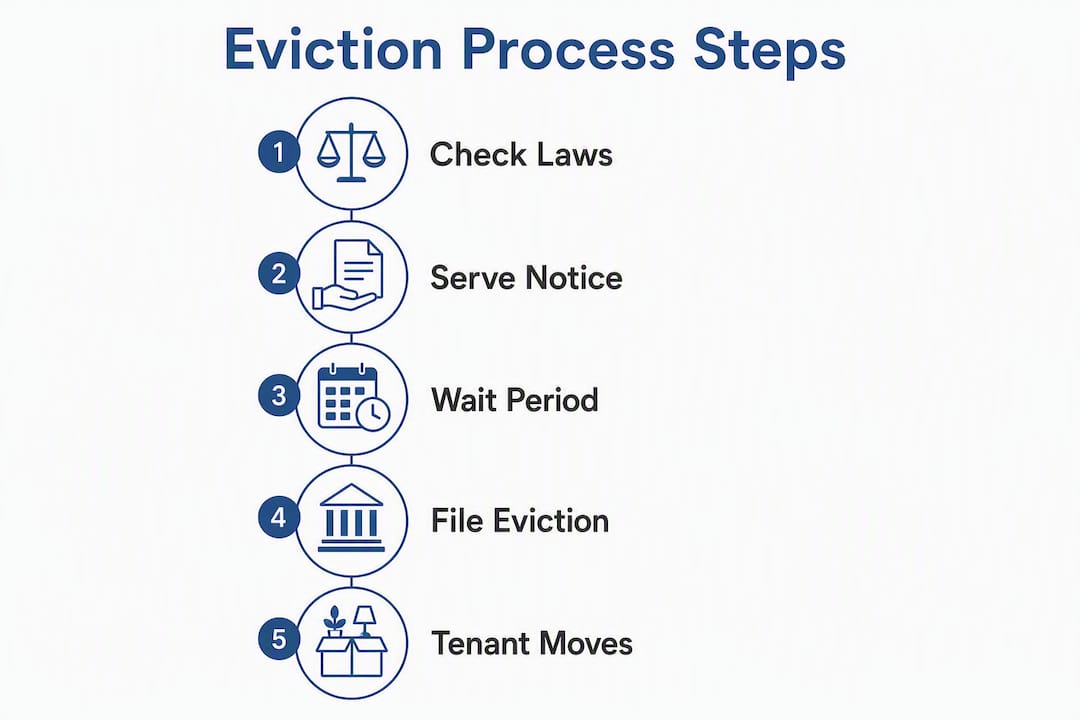
Once the notice period expires without compliance, the eviction timeline typically runs: file an unlawful detainer complaint, serve the summons, wait for the tenant's response (5 business days), attend a court hearing, receive a judgment, obtain a writ of possession, and schedule a sheriff lockout. In practice, contested cases in California often take several months from notice to lockout, and in high-volume courts like Los Angeles Superior Court, delays can extend the process significantly.
- Verify every notice period against the specific statute and your local rent board, because cities like Los Angeles and San Jose have modified timelines.
- Proof of service matters as much as the notice itself. A notice served incorrectly is treated as no notice at all.
- For Ellis Act withdrawals, confirm relocation payment amounts with your local rent board before filing, since amounts are set by local ordinance and updated periodically.
What are your step-by-step options for clearing a problem tenant?
Cash-for-keys: the fastest low-risk path
A cash-for-keys agreement is a voluntary, written contract where the tenant agrees to vacate by a set date in exchange for a payment. California buyout practitioners recommend including eight core terms to protect enforceability:
- A specific move-out date and required condition of the unit
- A payment schedule (often half up front, half on key return)
- A mutual release of all claims
- A clear statement that the agreement is voluntary
- Rescission rights where local law requires them (30 days in LA City)
- A stipulated judgment clause where lawful, so a court can enforce the move-out without a new lawsuit
- Tenant's acknowledgment of the right to consult an attorney
- A filing confirmation if your city requires LAHD or equivalent submission
Hold the final payment until after the rescission window closes and the tenant has actually vacated. Paying in full before the keys are returned is a common mistake that leaves landlords with no leverage.
Present the offer in writing, keep the tone respectful, and never imply the tenant has no choice. Coercive behavior during negotiations can transform a straightforward business transaction into a harassment claim.
At-fault eviction: when you have the paper trail
If the tenant has not paid rent, violated a material lease term, or created a documented nuisance, a statutory eviction may be your fastest path. The playbook:
- Serve the correct notice (3-day pay or quit, 3-day cure or quit, or 3-day unconditional quit for serious violations).
- Document everything: photos, payment records, written complaints, incident logs, and any prior warnings.
- If the tenant does not comply, file an unlawful detainer complaint in the correct superior court.
- Attend the hearing prepared with your notice, proof of service, and evidence file.
- Budget for attorney fees, which can vary widely depending on case complexity, including uncontested and contested scenarios.
If the tenant raises a habitability defense or files a cross-complaint, the timeline and cost can spike quickly. At that point, a negotiated exit often becomes cheaper than continuing to litigate.
Owner move-in (OMI): proceed carefully
OMI is a legitimate no-fault just cause under AB 1482, but it carries serious enforcement risk. You or a qualifying family member must actually move in within 90 days of the tenant vacating and occupy the unit as a primary residence for at least 12 months. Using OMI as a pretext to clear a unit for sale, then listing immediately, exposes you to wrongful-eviction claims and relocation assistance clawbacks. Relocation assistance for OMI is generally the equivalent of a month's rent under AB 1482, though local ordinances may require additional amounts.
Ellis Act: a last resort with long-term strings
Ellis Act withdrawal removes the property from the rental market entirely. It requires a several-month notice period for most tenants (extended for seniors and disabled tenants), relocation payments set by local ordinance, and a multi-year prohibition on re-renting in many jurisdictions. Selling to a buyer who intends to re-rent can violate Ellis Act restrictions and expose both you and the buyer to liability. This path makes sense only when you intend a genuine withdrawal from the rental market.
Sell occupied: skip the fight entirely
If removal before closing is impractical, you can sell the property with tenants in place. The lease transfers to the new owner at closing, the security deposit transfers with written notice to the tenant, and the buyer inherits the tenancy. Investor buyers are often comfortable with this structure, especially when you provide a clean rent roll, lease copies, and recent maintenance records.
Pro Tip: Batch your showing windows into two or three scheduled blocks per week rather than requesting access every other day. Tenants who feel their routine is respected tend to cooperate far more during the listing period.
A practical timeline comparison:
| Option | Realistic Time to Clear or Close | Key Variable |
|---|---|---|
| Cash-for-keys | a few weeks to a couple of months | Tenant willingness and local rescission period |
| At-fault eviction | several months | Court backlog and tenant response |
| Owner move-in | Notice period plus occupancy requirement | OMI eligibility and local rules |
| Ellis Act | Extended notice period | Local relocation payment and re-rental restrictions |
| Sell occupied (cash buyer) | a few weeks to about a month to close | Buyer due diligence and escrow |
How do costs and risks compare across your options?
Choosing between a buyout, an eviction, and an occupied sale comes down to three variables: money out of pocket, time lost, and litigation exposure.
| Dimension | Cash-for-Keys | At-Fault Eviction | Sell Occupied |
|---|---|---|---|
| Time to clear/close | a few weeks to a couple of months | several months | a few weeks to about a month |
| Direct cash outlay | Buyout payment (negotiated) | attorney fees varying by case | Possible price discount |
| Litigation risk | Low if done correctly | Moderate to high if contested | Very low |
| Escrow impact | Minimal | Can delay or kill a sale | Minimal with investor buyer |
| Buyer pool | Full market post-vacancy | Full market post-vacancy | Primarily investors |
Sellers facing AB 1482 coverage sometimes accept a price discount on an occupied sale rather than risk the legal and timeline costs of a contested eviction. When you factor in lost rental income during a prolonged vacancy, attorney fees, and the risk of statutory damages for a wrongful eviction, that discount often looks reasonable.
Risk checklist before you act:
- Missing documentation: no written lease, no payment records, no incident log
- Improper notice service: wrong method, wrong address, or wrong notice type
- Skipping local buyout filing rules (LAHD or equivalent)
- Making verbal representations to buyers about eviction status that differ from the actual situation
- Using OMI or Ellis Act as a pretext when the real intent is to sell vacant
How do you sell a tenant-occupied property when removal isn't practical?
Selling occupied is not a fallback plan. For many landlords dealing with AB 1482-covered units or long fixed-term leases, it is the most sensible first choice. The practical steps for listing an occupied property are straightforward:
- Disclose the tenancy status and lease terms to buyers upfront, in writing.
- Provide the full lease, rent roll, and payment history as part of the listing package.
- Give 24-hour written notice before every showing, as required by Civil Code §1954.
- Offer the tenant a small one-time cooperation incentive (a gift card or a month's partial rent credit) to keep showings running smoothly.
- Transfer the security deposit to the buyer at closing with written notice to the tenant, or return it yourself and document the action in the closing statement.
To attract owner-occupant buyers, consider offering the tenant a buyout as a condition of sale, structured so the buyer funds it at closing. This gives owner-occupants a clear path to possession without requiring you to complete the eviction before listing.
Pro Tip: Include escrow instructions that explicitly confirm the security deposit transfer amount, the date of transfer, and the written notice sent to the tenant. This single clause prevents the most common post-closing dispute in occupied-property sales.
What should you document to protect yourself legally?
Documentation is your defense against a wrongful-eviction or harassment claim, and it needs to be built before you serve the first notice, not after.
Core document checklist:
- Written buyout offer (dated, signed by both parties)
- Signed release of claims (mutual, with voluntary-nature language)
- Proof of payment (wire confirmation, cashier's check copy)
- Served eviction notices with proof of service (process server affidavit or certified mail receipt)
- Showing notices under Civil Code §1954 (keep copies of every one)
- Receipts for relocation assistance payments
- Copies of all written communications with the tenant (email, text, letter)
- LAHD or local rent board filing confirmation for buyout agreements where required
Sample buyout agreement language (key clauses):
- "This agreement is entered into voluntarily by Tenant, who has had the opportunity to consult with legal counsel of their choosing."
- "Landlord shall pay Tenant $[amount] upon execution of this agreement and $[amount] upon surrender of keys and possession on or before [date]."
- "Tenant releases Landlord from all claims arising from or related to the tenancy, known or unknown, as of the date of this agreement."
- "Tenant acknowledges the right to rescind this agreement within [30] days of execution [where required by local law]."
For security deposit transfer, California's DRE guidance requires either returning the deposit to the tenant or transferring it to the new owner in writing. Document the action in the closing statement so both parties have a clear record.
Pro Tip: Use a licensed process server for eviction notices, not certified mail alone. Process server affidavits are harder for tenants to challenge than mail receipts, and a failed service is one of the most common reasons unlawful detainer cases get dismissed.
Consult an eviction attorney before serving any notice and before drafting a buyout agreement in any city with local buyout filing rules. One hour of attorney time up front is far cheaper than defending a wrongful-eviction claim later.
Your 7–30 day action checklist
Getting organized in the first week matters more than most landlords realize. Here is what to do, in order:
Immediate (Days 1–7):
- Pull the lease and confirm the move-in date to determine AB 1482 coverage.
- Check your city's rent board website for local just-cause requirements, buyout filing rules, and relocation assistance amounts.
- Gather all rent payment records, written communications, and any documentation of lease violations or nuisance behavior.
- Contact an eviction attorney for a one-hour consultation before taking any action.
If fast vacancy is your goal (Days 7–21):
- Draft a written cash-for-keys offer with all required terms (move-out date, payment schedule, release, voluntary-nature language).
- Confirm whether your city requires a buyout disclosure and filing with a local housing department before presenting the offer.
- Hold the final payment until the rescission window has closed and the tenant has vacated.
If eviction is the only lawful path (Days 7–30):
- Work with your attorney to select the correct notice type and serve it with proper proof of service.
- Build your evidence file: photos, payment records, incident logs, and prior written warnings.
- Estimate the likely court timeline and communicate it to your real estate agent so the listing schedule reflects reality.
If selling occupied is the plan:
- Prepare a tenant documentation packet: lease, rent roll, payment history, and maintenance records.
- Draft escrow instructions that address security deposit transfer and tenant notice.
- Consider offering the tenant a cooperation incentive for showing access.
Why a cash sale is often the most honest choice
Most landlords I talk to underestimate how much a contested eviction actually costs, not just in attorney fees, but in the months of lost income, the buyer who walks when the closing date slips, and the mental weight of an ongoing legal fight. The math changes fast when you run it honestly.
Selling to a cash buyer when you have a difficult tenant situation is not giving up. It is recognizing that your time and peace of mind have real value, and that a clean, fast close at a fair price often beats a protracted battle for a slightly higher sale price that may never materialize. The 10–15% discount that sometimes comes with an occupied or as-is sale looks very different when you subtract eviction costs, carrying costs during a 4-month court process, and the risk of statutory damages if something goes wrong.
That said, even a cash sale does not exempt you from disclosure obligations. You still need to tell the buyer about the tenancy, transfer the security deposit correctly, and document the tenant's status accurately in the purchase agreement. Cutting corners on documentation because you are selling to an investor is a mistake. The buyer's attorney will find the gaps, and they will use them.
The landlords who navigate this best are the ones who get legal advice early, document everything from day one, and choose their exit strategy based on the actual facts of their situation, not on what they hoped the situation would be.
SLO Cash Buyer can close fast, even with a problem tenant in place
If you are a landlord in San Luis Obispo County facing a difficult tenant situation and a sale deadline, SLO Cash Buyer - San Luis Obispo County Home buyer offers a direct path out. We buy homes as-is, in any condition, with tenants in place. You skip the eviction timeline, the attorney fees, the repair costs, and the uncertainty of a traditional listing that can fall apart when a buyer learns about a tenant dispute.

For landlords who need a fast, low-risk exit, the process is simple: contact us, share the details of your situation (including the tenant status), and we will put together a no-obligation cash offer. We understand that every landlord's situation is different. Some properties have tenants who simply need a fair buyout offer. Others have situations where eviction timelines make a traditional sale impractical. We work with both.
Before you call, gather your lease, rent payment history, and any documentation of tenant issues. That information helps us structure the offer correctly and advise you on the best path forward. You can reach SLO Cash Buyer - San Luis Obispo County Home buyer directly to get started with a no-pressure conversation about your options.
This article provides general information for California landlords and is not legal advice. Eviction law and tenant protections vary by city and county. Consult a licensed California eviction attorney before serving notices or drafting buyout agreements.
Key Takeaways
Selling a tenant-occupied property in California requires choosing between a negotiated buyout, a lawful just-cause eviction, or an occupied sale, and the right choice depends on AB 1482 coverage, your timeline, and your documentation.
| Point | Details |
|---|---|
| AB 1482 limits your options | Intent to sell is not a just cause; you need an enumerated at-fault or no-fault ground to terminate a covered tenancy. |
| Cash‑for‑keys is fastest when done right | A written, voluntary buyout with a release of claims and local filing compliance typically clears a unit in a few weeks to a couple of months. |
| Eviction timelines are long | Contested unlawful detainer cases in California often take several months from notice to sheriff lockout. |
| Occupied sales can save time and money | Sellers sometimes accept a 10–15% price discount to avoid eviction costs, litigation risk, and escrow delays. |
| SLO Cash Buyer closes fast, as-is | SLO Cash Buyer - San Luis Obispo County Home buyer buys occupied properties in San Luis Obispo County with no repairs, no agent fees, and a fast close. |
Useful resources for California landlords
These authoritative sources will help you confirm notice requirements, check local buyout rules, and verify your obligations before taking action.
- Types of eviction notices for landlords, California Courts Self-Help Guide: the state court's plain-language explanation of notice types, service requirements, and what happens when a notice is defective.
- California Code of Civil Procedure §1161b: the statute governing notice requirements for tenants in foreclosure sales; useful for landlords whose property is also in financial distress.
- California DRE guidance on security deposits and moving out: the Department of Real Estate's official guidance on deposit transfer obligations at closing.
- AB 1482 and selling rental property in California: a detailed explanation of which just-cause grounds apply and why sale intent does not qualify.
- Cash-for-keys California landlord guide: a practitioner-level breakdown of buyout agreement terms, LA City filing requirements, and rescission rules.
- Selling a rental property in California with tenants: practical guidance on listing an occupied property, pricing for tenant status, and working with investor buyers.
- Ellis Act and AB 1482 constraints for landlords: an overview of Ellis Act notice periods, relocation payment obligations, and re-rental restrictions.