
A forbearance agreement is a formal, temporary contract where a lender agrees to pause or reduce your loan payments for a set period while you meet specific conditions. It's not debt forgiveness. Every dollar you skip still gets added to what you owe, and the pause usually lasts 3 to 12 months.
Mortgage servicers use it to keep struggling homeowners out of foreclosure long enough to recover. Commercial lenders use it to buy a business time without losing their legal footing. Authorities like the CFPB, Fannie Mae, Freddie Mac, FHA, VA, and HUD all publish rules on how this works, and Bankrate covers the consumer side well too.
- Forbearance pauses payments; it doesn't erase them.
- Terms usually run 3 to 12 months, sometimes extended.
- You still need an exit plan before it ends.
Pro Tip: Think of forbearance as hitting pause on a movie, not turning it off. The story keeps going the moment you press play again.
Key Takeaways
A forbearance agreement pauses or reduces loan payments for a set period without erasing the debt, and borrowers need a repayment plan ready before it ends.
| Point | Details |
|---|---|
| It's a pause, not forgiveness | Deferred payments remain owed and typically last 3 to 12 months. |
| Mortgage vs commercial differs | Mortgages pause payments; commercial deals pause remedies in exchange for collateral or covenants. |
| Get terms in writing | Duration, repayment path, and escrow responsibility should never rest on a verbal promise. |
| Plan the exit before signing | Servicers contact borrowers about 30 days before forbearance ends to discuss next steps. |
| Consider a firm alternative | SLO Cash Buyer - San Luis Obispo County Home buyer offers a cash sale as a way to end foreclosure uncertainty outright instead of managing repayment sequencing. |
Official Guidance and Helpful Resources
- CFPB: what mortgage forbearance means and how to exit it
- Legal definition of forbearance | Cornell Law
- Managing escrow, taxes, and insurance during forbearance
Keep this list handy, and share it with your housing counselor or attorney if you're comparing options.
Table of Contents
- What Is Forbearance and How Does It Work?
- What Terms Should You Expect in the Contract?
- What Happens When Forbearance Ends?
- How Do You Request and Negotiate Forbearance?
- What Are the Risks of Signing a Forbearance Agreement?
- A Pre-Signing Checklist Before You Agree to Forbearance
- Frequently Asked Questions
- Sources
What Is Forbearance and How Does It Work?
Once you understand what a forbearance agreement actually is, the mechanics matter just as much. On a mortgage, your servicer agrees to pause or lower your payments, but the missed amounts don't vanish. Under federal servicing rules, your servicer must evaluate all available loss mitigation options for your file, which is why forbearance often becomes step one in a longer sequence toward modification or a repayment plan.
Commercial loan forbearance works differently. A lender agrees to pause remedies like acceleration or foreclosure, but usually in exchange for something: extra collateral, a personal guarantee, tighter financial reporting, or a formal acknowledgment of default. That last piece matters. It can strengthen the lender's position if you breach the agreement later.
Picture a homeowner who lost a job for four months. A short forbearance buys breathing room until new income starts. Now picture a small business with a seasonal cash crunch. Its lender might grant forbearance but demand a lien on equipment as a condition.
- Mortgage forbearance: payment pause, servicer evaluates loss mitigation, no new collateral typically required.
- Commercial forbearance: remedy pause, often tied to added collateral, guarantees, or covenants.
- Both: missed amounts remain owed unless the lender explicitly forgives them, which is rare.
| Context | Typical duration | Repayment options | Credit impact | Common obligations |
|---|---|---|---|---|
| Mortgage | 3 to 12 months, extendable | Repayment plan, deferral, modification, reinstatement | Depends on servicer reporting; confirm directly | Continue escrow, taxes, insurance unless stated otherwise |
| Commercial | Negotiated case by case, often 3 to 12 months | Restructured covenants, refinancing, lump sum, or modification | Business credit and personal guarantees may be affected | Additional collateral, guarantees, financial reporting |
What Terms Should You Expect in the Contract?
A forbearance loan agreement is a written document, and the details inside it decide whether the deal helps you or traps you. Read every clause before you sign anything.
- Duration and whether extensions are automatic or require a new request.
- Exact payment suspension or reduction amount.
- Whether interest keeps accruing on the paused balance.
- How you'll repay the deferred amount: lump sum, spread out, or added to the loan's end.
- Who covers escrow, property taxes, and insurance during the pause.
Commercial agreements often add lender protections you won't see in a mortgage forbearance: additional collateral pledges, personal or corporate guarantees, and financial reporting requirements. Some also include a waiver of defenses or an acknowledgment of default, which can make it easier for the lender to enforce remedies if you break the deal later.
Pro Tip: Never accept a verbal promise about your forbearance terms. Get the duration, repayment method, and every waiver spelled out in writing before you sign.
What Happens When Forbearance Ends?
The end of forbearance is where most borrowers get caught off guard. Your servicer typically reaches out about 30 days before the plan expires to walk through repayment options.
- Repayment plan: spreads missed payments across future installments.
- Deferral: moves the missed amount to the back of the loan, due at payoff, sale, or refinance.
- Loan modification: permanently changes your rate, term, or balance.
- Lump-sum reinstatement: you pay everything owed at once, though many programs no longer require this.
Fannie Mae, Freddie Mac, FHA, and VA loans each apply slightly different rules, but most agency guidance leans away from forcing a lump sum, especially for loans that entered forbearance under pandemic-era programs. That said, timelines and documentation requirements still vary by servicer, so don't assume your neighbor's deal matches yours.
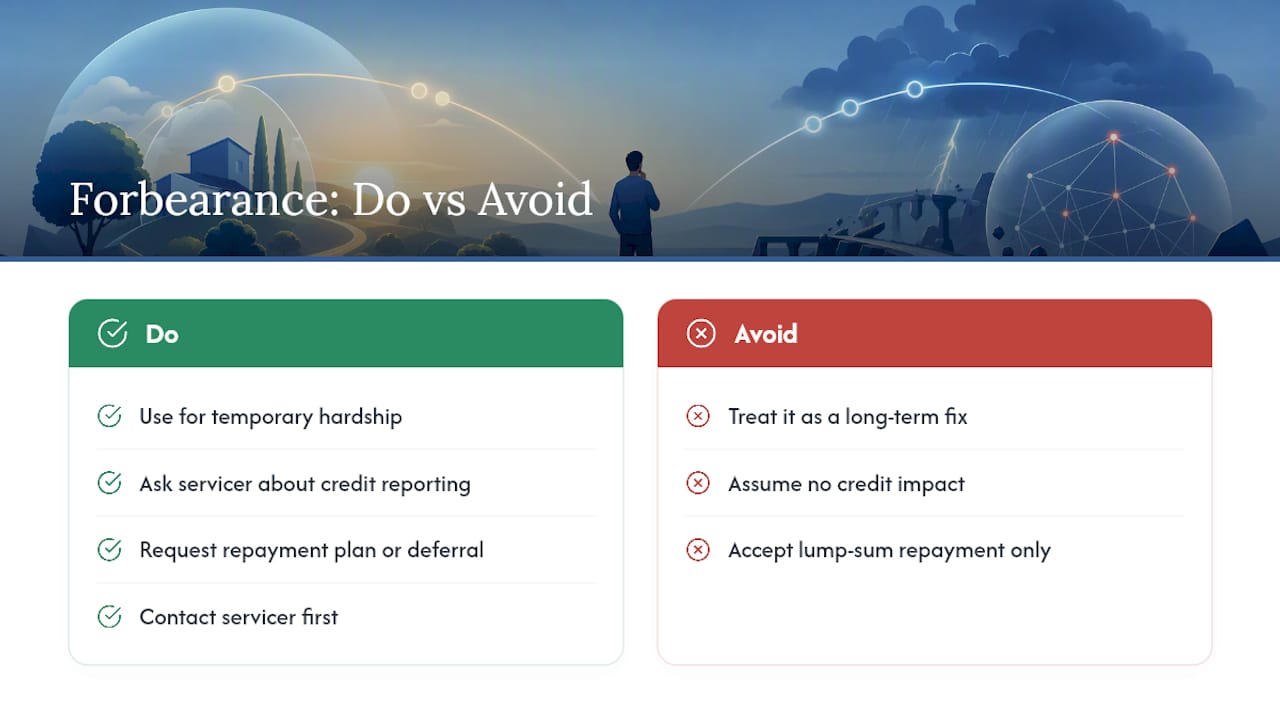
Entering forbearance without knowing which of these paths you'll take is one of the most common mistakes borrowers make. Forbearance without an exit plan tends to slide right back into delinquency.

How Do You Request and Negotiate Forbearance?
Getting a forbearance agreement is rarely automatic. You have to ask, document, and sometimes push back on vague terms.
- Contact your servicer or lender the moment hardship hits. Don't wait for a missed payment to show up on your account.
- Explain your situation clearly: job loss, medical event, business slowdown, whatever it is.
- Ask directly what forbearance options exist and what documentation they require.
- Gather your paperwork before the call: payment history, proof of income change, a written hardship explanation, and recent bank statements.
- Negotiate specifics: exact duration, repayment options once it ends, written confirmation that foreclosure won't proceed during the period, and clarity on escrow, taxes, and insurance.
- Write down every date, every name, and every promise made on the phone.
- Get the final agreement in writing before you rely on it.
- If anything feels unclear, a HUD-approved housing counselor or an attorney can review the terms with you at no cost or low cost.
Pro Tip: A verbal "don't worry, we'll work something out" from a servicer rep means nothing legally. Get the signed agreement before you stop paying.
What Are the Risks of Signing a Forbearance Agreement?
Forbearance can feel like relief, but it carries real trade-offs on both sides of the table.
- Missed payments don't disappear from your account history just because forbearance pauses collection; confirm directly with your servicer how the plan will be reported.
- Signing a broad acknowledgment of default or waiver of defenses can hand the lender a cleaner path to remedies if you break the deal later.
- Escrow, property taxes, and insurance often remain your responsibility during a mortgage forbearance. Skipping them can lead to tax liens or a lapse in coverage.
- Commercial forbearance deals sometimes list every prior default in the agreement. Leave one out, and a lender may later treat it as a fresh breach.
Lenders rarely grant forbearance out of goodwill alone. In commercial deals especially, forbearance usually comes bundled with something the lender wants in return, whether that's collateral, a guarantee, or tighter reporting. Treat every ask as a negotiation, not a favor.
Watch for red flags: anyone demanding an upfront fee, refusing to put terms in writing, or pushing aggressive covenant demands without explanation.
A Pre-Signing Checklist Before You Agree to Forbearance
Before you sign anything, run through this list.
- Confirm the exact duration and whether extensions are possible.
- Nail down the repayment path for deferred amounts: plan, deferral, or modification.
- Read the waiver language carefully. Know exactly what rights you're giving up.
- Verify who pays escrow, taxes, and insurance during the pause.
- Get a clear exit timeline and know when your servicer will contact you again.
- Call your servicer directly if anything in the agreement feels unclear.
- Reach out to a HUD-approved housing counselor for free guidance.
- Talk to an attorney experienced in mortgage or commercial workouts if the stakes are high.
Keep copies of every signed document and every email. You'll want that paper trail if a dispute ever comes up.
Treat Forbearance as a Bridge, Not a Destination
Too many borrowers treat forbearance like it solved the problem. It didn't. It bought time. The real work happens in what comes next: a repayment plan, a modification, or another decision entirely. If you go into forbearance without already thinking about the exit, you're setting up the same crisis to hit again in six months, just with a bigger balance attached.
When Forbearance Isn't the Right Fix, a Cash Sale Might Be
Forbearance buys time. It doesn't buy certainty. If your hardship isn't temporary, or you'd rather skip the whole cycle of repayment plans and renewed deadlines, selling your home outright removes the uncertainty entirely.

SLO Cash Buyer - San Luis Obispo County Home buyer purchases homes in any condition, in San Luis Obispo County, for cash, with no repairs, no cleaning, and no agent fees eating into your payout. Unlike forbearance, a completed cash sale ends the pressure for good instead of resetting the clock in a few months. This is one option among several, not legal advice, so compare it against your servicer's repayment terms and talk to a housing counselor or attorney if you're unsure which path fits your situation. If foreclosure risk or an unworkable repayment timeline has you looking for a firm exit, a cash sale can stop foreclosure before auction and give you a closing date instead of another negotiation. Reach out to SLO Cash Buyer - San Luis Obispo County Home buyer through Slocashbuyer for a confidential, no-obligation cash offer.
Frequently Asked Questions
Is forbearance a good option for everyone facing hardship? It works best for genuinely temporary setbacks, like a short job gap or a seasonal cash crunch. If your inability to pay is long-term, a loan modification is usually the more durable fix.
How does forbearance differ from deferment? Deferment typically applies more narrowly, often to student loans, and may follow fixed eligibility rules. Forbearance is a negotiated agreement, which gives mortgage servicers and commercial lenders more flexibility on terms.
Will forbearance hurt my credit? It depends on how your servicer reports the account. Ask directly whether missed payments will show up on your credit report during the forbearance period, since practices vary.
Do I have to repay the missed amount all at once? Not usually. Most agency programs, including those tied to Fannie Mae, Freddie Mac, FHA, and VA loans, favor repayment plans, deferral, or modification over a forced lump sum.
Who should I contact if I need help understanding my agreement? Start with your servicer, then reach out to a HUD-approved housing counselor or an attorney experienced in mortgage or commercial workouts if anything in the terms feels unclear.
This article is general information, not a substitute for advice from a qualified financial advisor. Consult a qualified financial professional about your own circumstances before acting on anything here.
Sources
- What is mortgage forbearance? | CFPB
- 12 C.F.R. § 1024.41 — Loss mitigation procedures
- Exit your forbearance carefully | CFPB
- The essential guide to a forbearance agreement and waiver to credit agreement | RealDealDocs