
The fastest a California foreclosure can legally move is about 110 to 120 days from a recorded Notice of Default to a trustee's sale, but most homeowners see a longer runway of 7 to 10 months from their first missed payment to auction. You keep the right to reinstate your loan up to a few days before the sale, and the 90-day cure period after a Notice of Default gives you real time to act. A complete loss mitigation application or a broker listing can add additional time if you use them correctly.
TL;DR:
- Homeowners generally have 7 to 10 months from the first missed payment to the foreclosure auction, with the shortest possible timeline being 110 to 120 days under ideal conditions.
- The 90-day reinstatement period after the Notice of Default is the primary window for homeowners to pay all owed amounts and potentially stop the sale.
- Filing a complete loss mitigation application can legally pause the foreclosure process if submitted at least 37 days before the scheduled sale, with written confirmation.
- A broker-signed listing agreement can grant a 45-day postponement of the sale, which can be extended with an additional signed purchase agreement.
- When time runs out, a cash sale to a homebuyer can be the fastest way to stop an auction, although it typically yields less than a reinstatement or listing.
Table of Contents
- California Foreclosure Timeline: The Statutory Steps From Missed Payment to Auction
- What Rights and Options Can Pause the Clock?
- What Happens on Auction Day and Right After
- Your Next Steps Checklist Before the Sale Date
- What I've Learned Watching Foreclosures Play Out in SLO County
- A Faster Way to Stop the Clock
- Sources
California Foreclosure Timeline: The Statutory Steps From Missed Payment to Auction
Every nonjudicial foreclosure in California runs through the same sequence of legal steps, each with its own minimum clock. Knowing where you stand in that sequence tells you almost exactly how much time you have left.
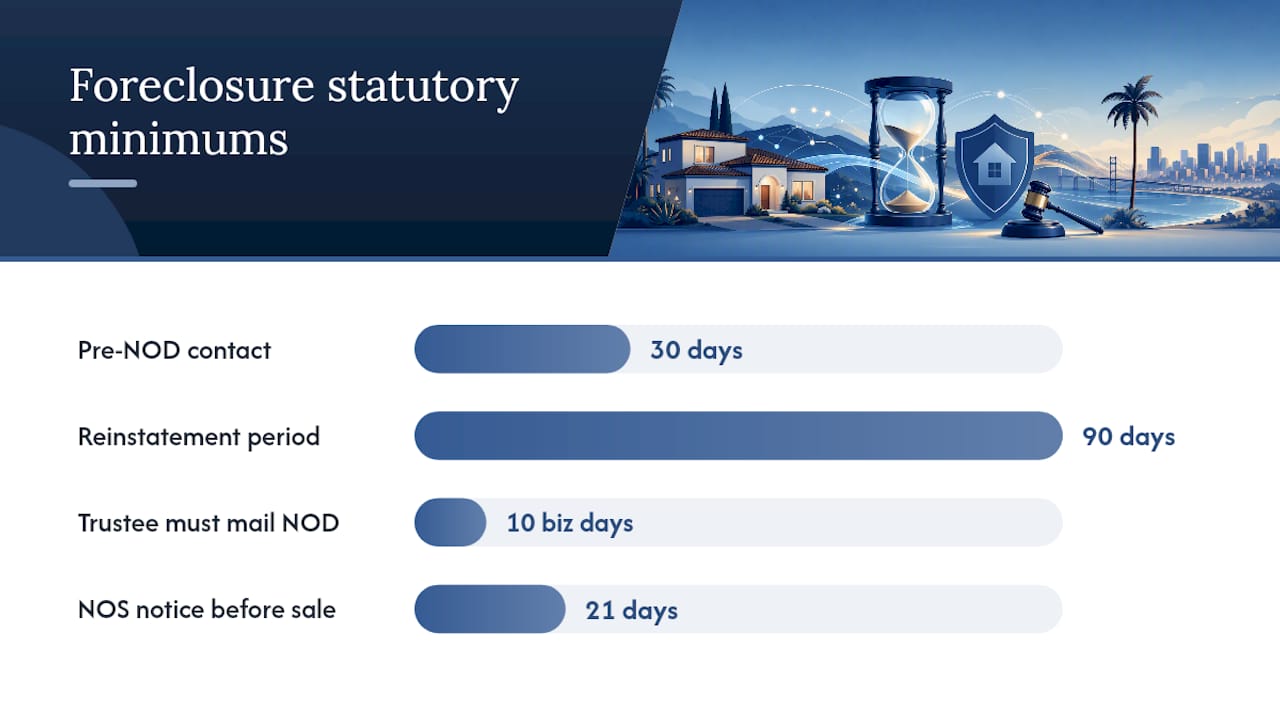
Step 1: Servicer contact attempt. Before your lender can even record a Notice of Default, California law requires the servicer to contact you, or show it made a genuine effort to do so, at least 30 days before recording that notice. This outreach requirement, part of the Homeowner Bill of Rights, exists to encourage communication about alternatives before the foreclosure paperwork starts.
Step 2: Notice of Default (NOD) recorded. Once the servicer records the NOD with the county recorder, the trustee has 10 business days to mail you a copy. That recording date starts your 90-day reinstatement or cure period, the single most important window in the entire process. During those three months, you can pay what you owe (past due amounts plus fees and costs) and stop the foreclosure cold.
Step 3: Notice of Trustee's Sale (NOS) recorded and published. After the 90-day period closes with no resolution, the trustee can record a Notice of Sale. State law requires the sale date be published, posted, and mailed at least 21 days before the auction.
Step 4: Trustee's sale. The auction happens on or after the noticed date, closing out the formal process.
Stack those minimums together and you get the statutory floor:
- 30 days of required contact attempts before the NOD
- 90 days of reinstatement rights after the NOD
- 21 days of published notice before the sale
That adds up to roughly 110 to 120 days from a recorded NOD to a trustee's sale under absolute best case (for the lender) conditions. In practice, servicer processing delays, loss mitigation reviews, and postponements almost always stretch that out. Public Counsel's own guidance to homeowners describes the more common range as 7 to 10 months from the first missed payment to the auction date. FHA, VA, and USDA-backed loans often carry additional federal servicing requirements that extend the pre-foreclosure period even further, so borrowers with those loan types should expect the process to run on the longer end.
What Rights and Options Can Pause the Clock?
The statutory minimums are not the end of your options. Several legal tools can slow, pause, or reset the timeline if used correctly and in time.
- Reinstate the loan. You have the right to reinstate, meaning pay the arrears, fees, and costs in full, at any point up until five business days before the scheduled sale. This is the cleanest fix if you can gather the funds, since it restores your loan to current status rather than just delaying the inevitable.
- Submit a complete loss mitigation application. If you apply for a loan modification or other workout option and your servicer confirms in writing that the application is complete, it can legally pause the sale while the review is pending. The catch is timing: submit fewer than 37 servicing days before the scheduled sale date, and federal protections may no longer stop the auction. Get that completeness confirmation in writing and keep a dated copy.
- Secure a broker listing postponement. Providing the trustee with a signed listing agreement from a licensed California real estate broker earns you a one-time 45-day postponement of the sale. If you then produce a signed purchase agreement at least five business days before that postponed date, you can often obtain a second 45-day postponement.
- File bankruptcy. A bankruptcy filing triggers an automatic stay that halts the sale immediately, but this is a major financial decision with long-term consequences and belongs in front of a bankruptcy attorney, not a DIY checklist.
Pro Tip: Delivery method matters as much as timing. Postponement requests and loss mitigation paperwork sent by regular mail can get lost or disputed. Use certified mail or hand delivery with proof, and always ask the trustee or servicer for written confirmation that your documents were received.
What Happens on Auction Day and Right After
The trustee's sale itself is usually an anticlimax. Bidders (often just the lender) show up, and the property goes to the highest bid.
- The lender usually bids first. The lender can submit a "credit bid," essentially bidding what's owed on the loan without putting up new cash.
- No third-party bidders are common. When nobody outbids the lender, the property reverts to the lender, who then holds title and controls next steps.
- Eviction follows on its own timeline. The new owner typically must serve a notice to vacate, and if occupants don't leave, an unlawful detainer (eviction lawsuit) process follows, which can take several weeks to a few months depending on the county court's caseload.
- Cash for keys is a real option. Former owners and tenants sometimes negotiate a move out date with a small relocation payment instead of fighting an eviction. Under California's SB 1079, certain eligible tenants and prior owners also get a limited window to submit a bid to purchase the property after a foreclosure sale on qualifying properties.
Your Next Steps Checklist Before the Sale Date
Speed matters more than perfection here. Work through this list in order.
- Call your servicer first. Get your account number, confirm whether an NOD or NOS has been recorded, and ask for the exact recording date.
- Contact a HUD-approved housing counselor. Use HUD's counselor search tool to find free, legitimate help. This step alone weeds out most foreclosure rescue scams, which target homeowners in exactly this situation.
- Gather your paperwork. Pull your mortgage statement, the recorded NOD or NOS, your payment history, a written hardship letter, and photo ID.
- Weigh your fastest realistic options. Reinstating stops everything if you have the funds. A complete loss mitigation application, submitted with the 37-day rule in mind, buys review time. A broker listing buys 45 days. A controlled cash sale trades some net proceeds for speed and certainty.
- Get everything in writing. Whatever path you choose, request written confirmation of any pause, postponement, or completeness determination, and keep dated copies of everything you send and receive.
Homeowners who start negotiating with their lender early, rather than waiting for the NOS to post, consistently end up with more workable options than those who wait until the last 21 days.
What I've Learned Watching Foreclosures Play Out in SLO County
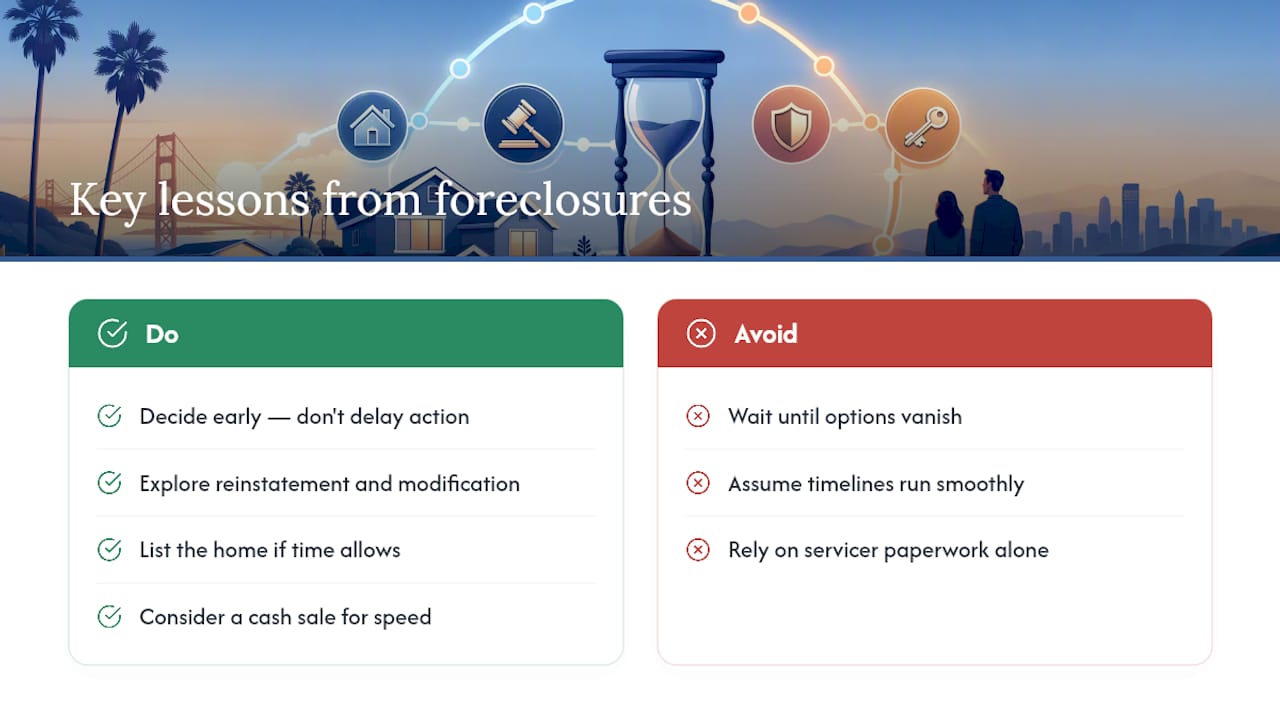
The statutory minimums make a tidy chart, but real cases rarely follow it that cleanly. Servicer paperwork gets lost, loss mitigation reviews drag past their own deadlines, and postponements pile up in ways no calendar can predict.
What I see most often locally is homeowners waiting too long to decide, then discovering their remaining options have narrowed to whatever closes fastest. Speed and certainty are exactly why so many turn to a cash sale near the end. There's no ideal path here, only the one that fits your actual timeline. Reinstating, modifying, listing, or selling for cash can all work. Combining them, when time allows, usually works best of all.
— Abel
A Faster Way to Stop the Clock
If your sale date is close and reinstatement or a loan modification isn't realistic in the time you have left, a direct cash sale is often the fastest legitimate way to stop an auction before it happens. A local cash home buyer purchases homes as-is with no repairs, no cleaning, no agent commissions, and can close on a schedule fast enough to beat a posted sale date when the numbers line up.

The trade-off is straightforward: a cash sale usually nets less than a traditional market listing or a successful reinstatement, but it removes the uncertainty of waiting on servicer paperwork or a buyer's financing to fall through. If you're facing a recorded Notice of Sale and want to know what a fast, no-obligation cash offer looks like for your property, visit the SLO Cash Buyer landing page and have your NOD or NOS recording date, loan balance, and property condition ready. That's the information that lets us give you a real number, fast.
This article is general information, not a substitute for advice from a qualified financial advisor. Consult a qualified financial professional about your own circumstances before acting on anything here.
Sources
- Your rights in a nonjudicial foreclosure | California Courts | Self Help Guide
- California Nonjudicial Foreclosure Process – Public Counsel (2026 PDF)
- The California Foreclosure Process – Consumer & Business (Los Angeles County DCBA)
- California Attorney General - Homeowner Bill of Rights (HBOR)
- HUD - Talk to a housing counselor