
If you need cash now or you'd otherwise lose the §121 exclusion, selling almost always wins on net proceeds. If your rental already covers every expense with room to spare and you're planning to hold for years, staying a landlord can build more wealth over time. Those two sentences are the whole decision, but the numbers behind them matter enormously.
Here's what actually swings the outcome. The §121 exclusion lets you keep $250,000 of gain tax-free if you're single, or $500,000 if you're married filing jointly, as long as you owned and lived in the home for at least two of the last five years. Selling costs, meanwhile, typically eat 6 to 10% of your sale price once you count commissions, closing fees, and pre-sale repairs. And if you hire a property manager, expect 8 to 12% of collected rent in ongoing fees, with Year 1 often landing closer to 18 to 20% once leasing and setup costs get added in.
A few quick rules of thumb before you dig into the math:
- Sell if you need the equity for your next move, or if renting would push you outside the two-of-five-year window and forfeit your tax exclusion.
- Keep the property if rental income sustainably covers the mortgage, taxes, insurance, and maintenance reserve, with cash left over.
- Sell if major repairs are looming and you don't want to fund them as a landlord.
- Keep it if you have a mortgage rate well below today's market rate. That rate is worth more than most people realize.
Key Takeaways
Selling usually wins financially when the §121 exclusion is on the table or repairs loom large; renting wins when cashflow is genuinely positive and the hold period is long.
| Point | Details |
|---|---|
| Selling costs eat 6 to 10% | Commissions, closing fees, and repairs come off the top before you see net proceeds. |
| The §121 exclusion is time-limited | You need two of the last five years as your primary residence to exclude up to $500,000 of gain. |
| Landlord fees run higher than advertised | Property management typically costs 8 to 12% of rent, often 18 to 20% in Year 1 with setup fees. |
| Breakeven can take a decade | Negative cashflow rentals may take 10+ years to catch up to what selling now would net. |
| A cash sale simplifies exit | SLO Cash Buyer - San Luis Obispo County Home buyer offers an as-is, no-repair option when the numbers favor selling fast. |
Table of Contents
- What Selling Actually Costs, Line by Line
- What It Costs to Stay a Landlord Every Year
- How Do Taxes Change the Sell-or-Rent Math?
- How Do You Actually Compare Sale Proceeds to Rental Income?
- Decision Checklist Before You Choose
- How Long Until Renting Actually Pays Off?
- Five Signs You Should Sell, Five Signs You Should Rent
- Worked Example: Assumptions and Sources
- If the Math Points to Selling, Here's a Faster Way to Do It
- Sources
What Selling Actually Costs, Line by Line
Sale price isn't the number that matters. Net proceeds are, and the gap between the two is often bigger than homeowners expect.
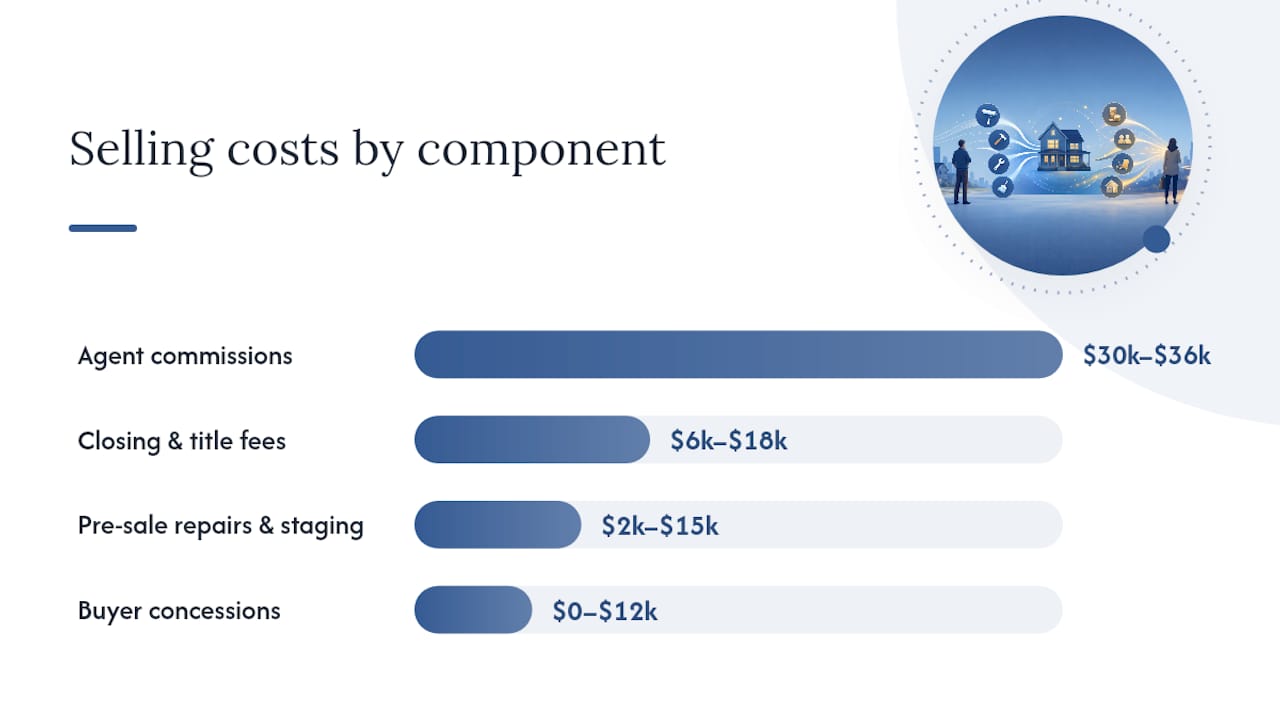
Start with agent commissions, typically 5 to 6% split between the listing and buyer's agents, though this is negotiable in most markets. Add closing costs, which include title insurance, escrow fees, and recording charges, usually running 1 to 3% of the sale price depending on your state. Some areas also charge a transfer tax, a one-time fee based on the sale price that varies by city and county.
Then come the costs that depend on your home's condition. Pre-sale repairs and staging can run anywhere from a few thousand dollars to tens of thousands if a home needs work to compete on the open market. Buyer concessions, credits you agree to cover for closing costs or repairs found during inspection, often shave another 1 to 2% off your net. Don't forget prorated property taxes and HOA dues, which get settled at closing, or a mortgage prepayment penalty if your loan has one (check your note; most conventional loans originated in the last decade don't, but some do).
Add it up and total selling costs commonly land between 6 and 10% of the sale price. On a $600,000 home, that's $36,000 to $60,000 gone before you see a dime.
Here's what that looks like broken down:
- Agent commissions (5 to 6%): $30,000 to $36,000
- Closing and title fees (1 to 3%): $6,000 to $18,000
- Pre-sale repairs and staging: $2,000 to $15,000, depending on condition
- Buyer concessions: $0 to $12,000
- Prorated taxes, HOA, and payoff fees: varies by timing and loan terms
Pro Tip: Commissions are negotiable, and repair costs are avoidable. If a home needs significant work, a cash sale skips the repair and staging line items entirely, which can close the gap between listing net proceeds and a faster, as-is sale.
What It Costs to Stay a Landlord Every Year
Landlord costs don't show up as one lump sum. They arrive as a slow drip of recurring bills, punctuated by the occasional five-figure surprise.

The recurring costs are the ones you can plan for: mortgage principal and interest, property tax, landlord insurance (which typically runs higher than a standard homeowner policy because it covers liability and lost rental income), utilities if you cover them, HOA dues, and property management fees if you hire help. That management line alone commonly runs 8 to 12% of collected rent, though hidden costs like leasing fees, renewal fees, and maintenance markups push the real number higher than the advertised rate.
The lumpy costs are the ones that catch landlords off guard: vacancy loss between tenants, routine maintenance calls, capital expenditures like a new roof or HVAC system, legal fees if an eviction becomes necessary, and turnover costs every time a tenant leaves. A widely used starting point is the 50% rule, which assumes half your gross rent goes to operating expenses before you even touch the mortgage. It's a rough estimate, not gospel, but it's a useful gut check before you commit to renting.
Here's a sample annualized cost sheet for a property renting at $2,500 a month ($30,000 a year):
- Mortgage (P&I): $14,400
- Property tax and insurance: $4,800
- Property management (10%): $3,000
- Maintenance and capex reserve: $3,000
- Vacancy allowance (one month): $2,500
- Total annual cost: $27,700, leaving roughly $2,300 in positive cashflow before turnover and legal contingencies
That margin is thinner than it looks. One unexpected repair or a two-month vacancy can flip the year negative.
Pro Tip: If you keep tenant retention high, one of the biggest hidden landlord costs disappears. Turnover, not maintenance, is usually what erodes annual returns fastest, so a modest rent discount to keep a good tenant often pays for itself.
How Do Taxes Change the Sell-or-Rent Math?
Tax timing is often the single biggest lever in this decision, and it's the one homeowners overlook until it's too late to fix.
Under IRS Publication 523, you can exclude up to $250,000 of gain ($500,000 married filing jointly) from federal tax if you owned and used the home as your primary residence for at least two of the last five years before the sale. That window is the whole ballgame. Once you convert the home to a rental and let those two years slip past, the exclusion shrinks or disappears entirely, and any depreciation you claimed while renting reduces the tax-free portion of your gain.
Here's the mechanic most people miss: renting out a former primary residence means you start depreciating the building portion of the property, typically over 27.5 years. That depreciation lowers your taxable rental income year to year, which feels like a win. But when you eventually sell, the IRS recaptures that depreciation and taxes it at up to 25%, on top of whatever capital gains tax applies to the rest of your profit.
The practical takeaway: if you're still inside your two-of-five-year window and you're on the fence, that exclusion is often worth more than several years of rental income and appreciation combined. Waiting to decide can cost you the exclusion outright. A California-specific breakdown of capital gains rules is worth reading if state tax treatment factors into your decision, and a 1031 exchange (deferring gains by rolling proceeds into another investment property) is worth a conversation with a CPA if you're selling a property that's already a rental and want to keep the money working.
How Do You Actually Compare Sale Proceeds to Rental Income?
Comparing a lump sum to a stream of monthly cashflow requires a common yardstick. Here's the framework.
- Calculate net sale proceeds. Sale price minus selling costs (use 6 to 10%), minus your remaining mortgage balance, minus any capital gains tax owed after applying the §121 exclusion.
- Calculate net annual rental cashflow. Gross rent minus mortgage payment, taxes, insurance, management fees, maintenance reserve, and a vacancy allowance.
- Project appreciation and equity buildup over your expected hold period, using a conservative local growth rate rather than a recent hot-market spike.
- Compare the present value of your net sale proceeds today against the present value of years of rental cashflow plus the eventual (smaller, tax-affected) sale proceeds down the road.
Three metrics make this comparison concrete: cap rate (annual net operating income divided by property value), cash-on-cash return (annual pre-tax cashflow divided by cash invested), and breakeven timeline (how many years of rental cashflow it takes to match what you'd net from selling today).
Here's a worked example for a $500,000 home renting at $2,800 a month, with a $2,000 monthly mortgage payment:
This example assumes 3% annual rent growth and a 40% operating expense ratio, which is in line with scenario models that flag underestimated vacancy and capex as the biggest reason rentals stay cash-flow negative longer than owners expect. If your numbers look like this, appreciation has to do a lot of heavy lifting to make renting worthwhile.
If your actual rent, vacancy rate, or repair history looks different, rerun the table with your own numbers before you draw a conclusion. A property with genuinely strong local rent growth or a below-market mortgage rate can flip this entirely positive.
Decision Checklist Before You Choose
Before you commit to either path, answer these questions with real numbers, not estimates:
- Does rent cover the mortgage, taxes, insurance, management, and a maintenance reserve, with cash left over?
- Do you need this equity to buy your next home or cover another financial goal?
- Are you still inside the two-of-five-year §121 exclusion window.
- Could you carry two mortgages if the home doesn't sell or rent immediately?
Watch for these red flags, which usually tip the scale toward selling: a large unrealized gain that would trigger a big tax bill if you wait and lose the exclusion, a major capital project on the horizon (roof, HVAC, foundation), or a local rental market with high vacancy risk.
Once you have your numbers, talk to a CPA about tax timing and depreciation recapture, a listing agent about realistic net proceeds in your local market, and a property manager about true operating costs, not the advertised management percentage.
How Long Until Renting Actually Pays Off?
Breakeven is the number of years it takes for cumulative rental cashflow, plus eventual equity, to catch up to what you'd net by selling today.
- Add up your cumulative negative cashflow (the subsidy you're funding out of pocket) for each year you rent instead of sell.
- Compare that subsidy against the after-tax proceeds you'd have banked by selling now, including the §121 exclusion.
- Add expected appreciation and mortgage paydown to see when the rental scenario finally overtakes the sell-now scenario.
Two quick scenarios illustrate the range. In a short breakeven case, a property with slightly positive cashflow in a fast-appreciating market can catch up to sale proceeds within 3 to 5 years. In a long breakeven case, a property running negative cashflow from day one, as many underestimated rentals do, may need 10 years or more, if it ever breaks even at all once you factor in depreciation recapture on the back end.
Appreciation rate and rent growth are the two assumptions that move this number the most. Shave a point off either one and your breakeven timeline can stretch by years.
Five Signs You Should Sell, Five Signs You Should Rent
Sometimes the full worksheet isn't necessary. These signals usually point clearly in one direction.
Lean toward selling if:
- You need the equity for a down payment, debt payoff, or another goal.
- You're still inside your §121 exclusion window and don't want to risk losing it.
- The home needs major repairs you don't want to fund as a landlord.
- You've managed a rental before and know you don't want to do it again.
- Your local market looks like it's peaking and you'd rather lock in the gain.
Lean toward renting if:
- Rent would cover every cost with a comfortable margin left over.
- You have a mortgage rate well below what's available today, a benefit that's easy to underestimate.
- Local rent growth has been strong and consistent for several years.
- You're planning a genuinely long hold, ten years or more.
- You want to keep the asset in the family or as a long-term inheritance.
Local market conditions and your own tax situation can override any of these signals, so treat this as a starting point, not a final answer.
Worked Example: Assumptions and Sources
Depreciation was calculated on a 27.5-year schedule for the building value only, and recapture was assumed at the standard federal rate applied to depreciation taken during the rental period, per IRS guidance. Adjust the rent growth, expense ratio, and tax rate to match your own bracket and local market before relying on the output. Selling cost assumptions and management fee ranges came from industry averages cited earlier in this piece.
A Practical Note From Abel
In most of the situations I see, the decision comes down to timing, not preference. Homeowners still inside their §121 window with a property needing real work almost always come out ahead selling now rather than gambling on rental income that has to first cover repairs, vacancy, and management fees. I've watched enough of these numbers play out to trust the math over the emotional pull of "keeping it as an investment." When the spreadsheet is close, that's usually the moment to get a professional opinion before committing either way.
If the Math Points to Selling, Here's a Faster Way to Do It
If your worksheet says selling wins, and especially if repairs, a difficult tenant, or a tight timeline are part of the picture, a traditional listing isn't your only route. SLO Cash Buyer - San Luis Obispo County Home buyer buys homes in any condition, no repairs, no cleaning, no agent commissions, and no waiting for a buyer's financing to come through.

That matters most in exactly the scenarios covered above: a property with deferred maintenance you don't want to fund, a tenant-occupied home you'd rather sell as-is than manage through a turnover, or a timeline that doesn't allow for months on the market. Run the worksheet above with your real numbers first. If net proceeds or liquidity needs favor a quick sale, an as-is cash offer skips the repair, staging, and negotiation costs that eat into a traditional sale. Visit the SLO Cash Buyer landing page to request a fair cash offer and see your timeline options.
Sources
- Publication 523 (Selling Your Home) - IRS
- Property Management Fees in 2026: Average % + Real Cost Breakdown
- Sell or Rent Your House After You Move? (2026 Tax Guide) | Taxstra
Tax rules and local market conditions vary, so confirm your specific numbers with a CPA or licensed real estate agent before deciding.
This article is general information, not a substitute for advice from a qualified financial advisor. Consult a qualified financial professional about your own circumstances before acting on anything here.